Raising the Profile of Women in Science

By Adrienne Roehrich, Chemistry Editor
One of the goals of Double X Science is to raise the profile of women in science. When others are doing this exact same things, we like to let our readers know. Here’s a few recent efforts to expand the public’s knowledge of women scientists:

As always, we have our Notable Women in Science series. We cover women in science who have been notable historically and currently. We also have our Double Xpression series which profiles women who are into science.
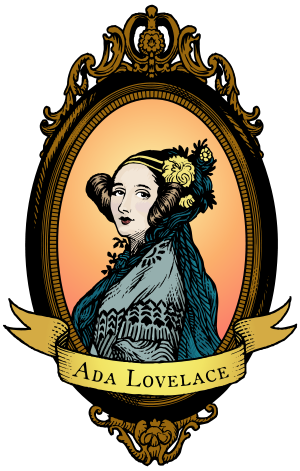

The Royal Society recently had a wikipedia push for writers to start new and expand the pages of women in science. Having visited wikipedia for writing the Notable Women in Science series, I can say that the number of pages created has definitely expanded and certainly there is much more information provided on a number of women. But there are still gaps. Look for more from Double X Science on this topic in the future.

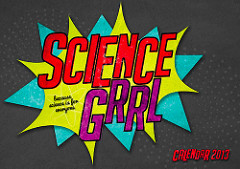
A group in the UK is making a calendar “to showcase real women doing great science.” Learn more about ScienceGRRL by visiting their website and following thier social media. The images being used in the calendar look to be scenic or portrait-style.

SpotOn provides some tools for the female scientist to promote herself and also provides links that those interested in science might be interested in following, such as twitter lists of women in science.

When researching this post, I found several sites trying to promote women in science. This site provides resources as well as 4000 years of women in science. In addition, they link to many associations dedicated to helping women in science. Geek Feminism has Wednesday Geek Woman posts every Wednesday highlighting women in STEM. The RAISE project has an on-going blog about the issues facing women in science.

Please comment: What is your favorite site working to raise the profile of women in science and why?

These views are the opinion of the author and do not necessarily reflect or disagree with those of the DXS editorial team.

A Few Modern Physicists

by Adrienne M. Roehrich, Chemistry Editor
In this edition of Notable Women in Science, I focus on women working in physics, typically traditional physics rather than astrophysics. There is no particular reason to make this distinction other than it allows me to choose a small group of women to highlight within a parameter set. These women are listed in no particular order.


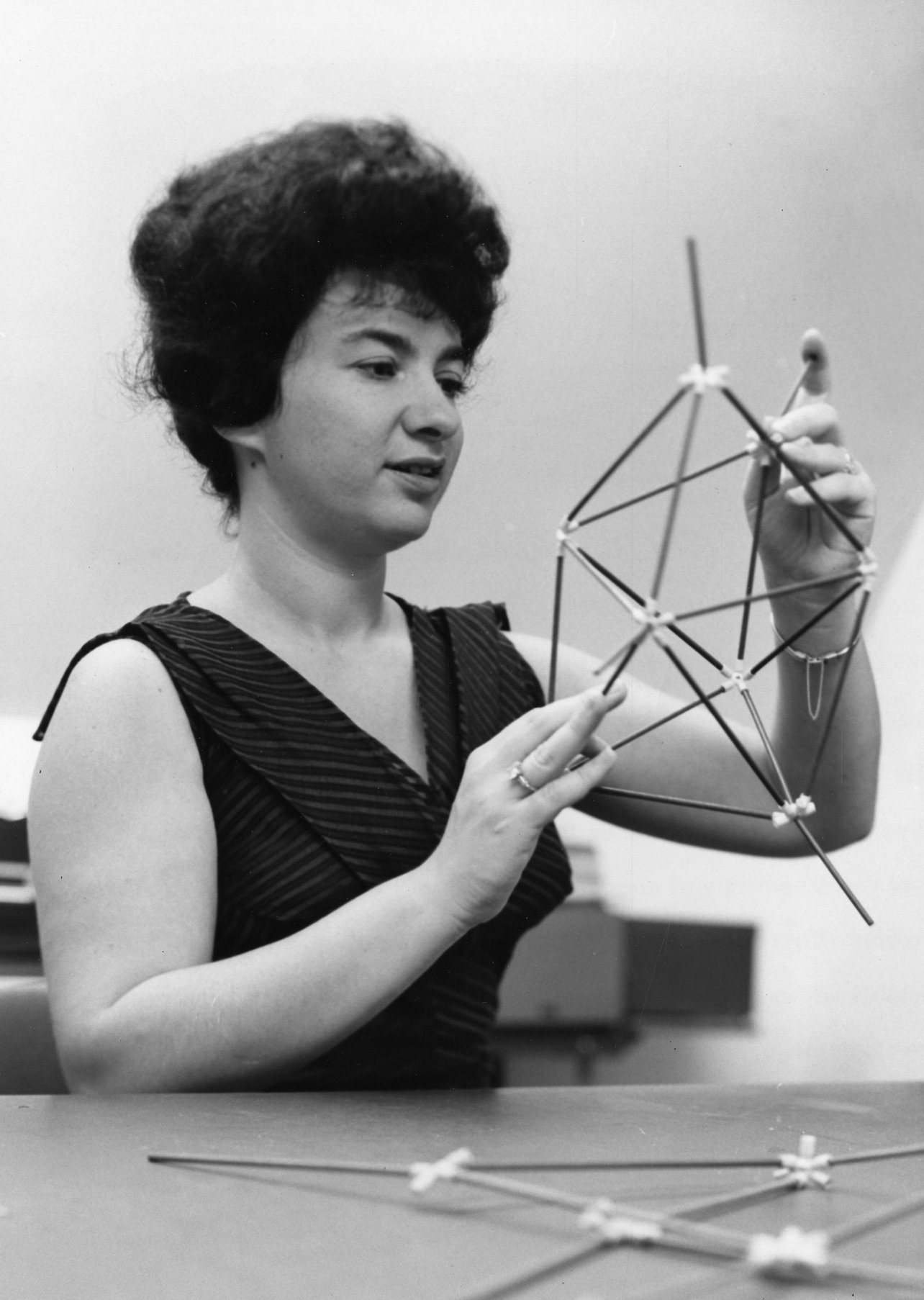
Vera E. Kistiakowsky spent much of her career as a professor at MIT. Born in 1928, she received her A.B. from Mt. Holyoke College in 1948 and her Ph.D. from the University of California – Berkeley in 1952, both degrees in chemistry. Her chosen career stemmed from advice from her father to support herself and not depend on another person to support her. Her father was a respected physical chemistry professor at Harvard and his support in her chosen activities was instrumental to her success. She entered college at the age of 15, choosing a pre-med major. She changed to chemistry due to Mt. Holyoke’s extraordinary female faculty at the time. While her degrees are in chemistry, her studies and research were physics intensive.  Graduating with her Ph.D. before her newly married husband hindered her initial job opportunities. She had several positions before eventually settling into a professorship at MIT. During her tenure at MIT, she was scientifically prolific with 86 technical publications as well as highly active in feminist activities, including organizing for the National Organization of Women (NOW), Women In Science and Engineering (WISE), the Association for Women in Science (AWIS), and an ad hoc committee in the American Physical Society (APS) on women physicists to name a few.

Helen Thom Edwards is recognized for her work with the Tevatron. She was born in 1936 and received both her B.A. and Ph.D. from Cornell University in 1957 and 1966, respectively. Her interest in science was outside that of her family’s interests, so she was used to paving her own way. Her technical and mechanical acumen served her well as a group leader at the Fermilab. Dr. Edwards is a team player and insists upon acknowledging the contributions of her colleagues in her and Fermilab’s success.

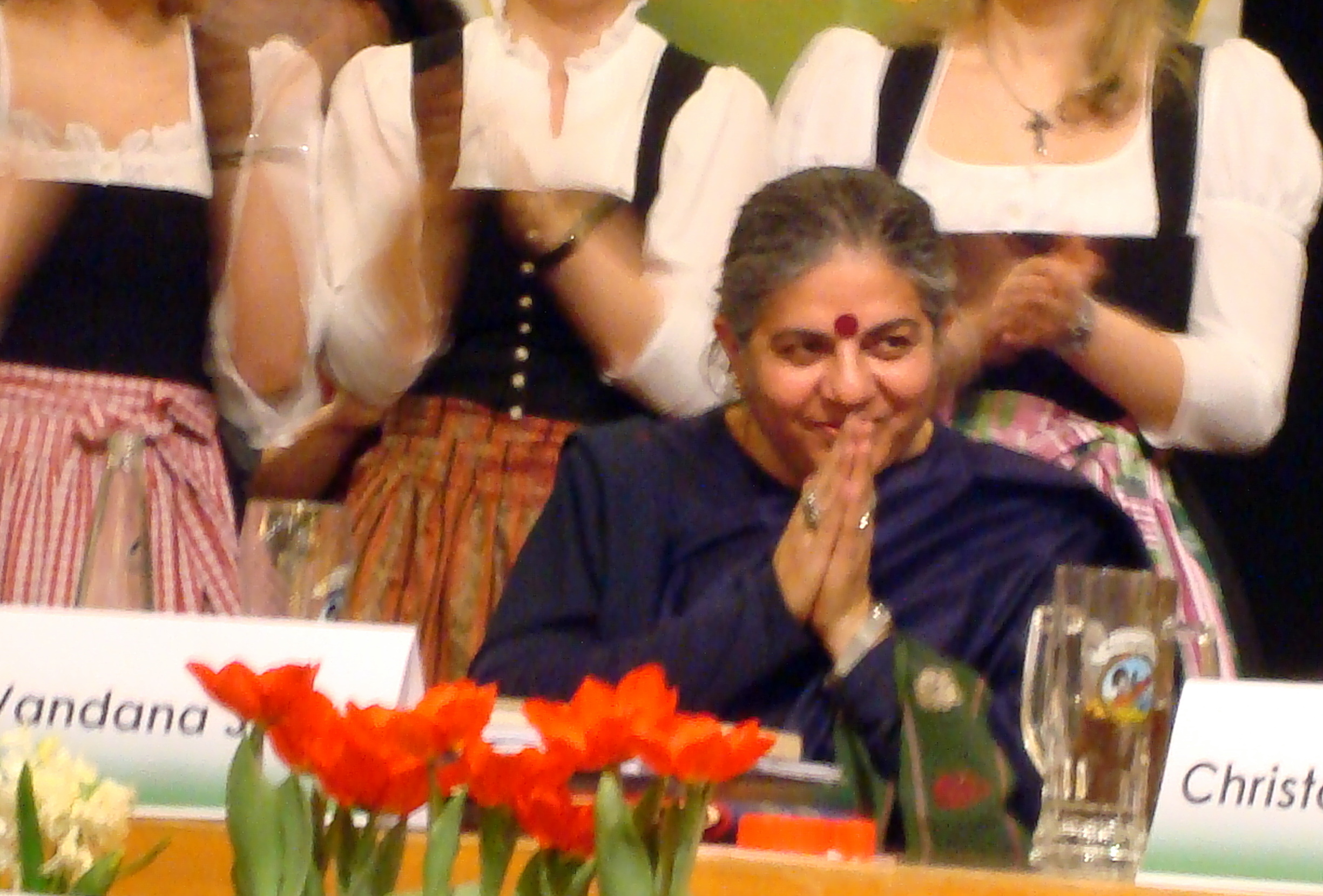
Vandana Shiva in 2008.
[Edited, 11/26/12, 14:43 ET]: Vandana Shiva was trained in physics and the philosophy of science and now works as an environmentalist, achieving considerable global prominence. She was born in 1952 and, according to most sources, earned a B.A. in physics, a master’s in philosophy of science, and a Ph.D. in physics. When she began her training as a nuclear scientist, she encountered a hostile environment, which caused her to emigrate west. Her experiences led her to become a prominent (and extremely controversial) environmentalist and into the position of Director at the Research Foundation for Science, Technology and Natural Resources Policy in Dehradun, India. She writes books and publishes articles in the area of environmentalism. [ETA: As a commenter notes below, Shiva also has been embroiled in controversy and accused of taking an anti-scientific stance over her assertions about “terminator seeds.”]
Ingrid Daubechies, 2005.

Ingrid Daubechies is a physicist and a mathematician known for her work in wavelets. 

Born in 1954, she received her B.S. and Ph.D. at Vrije University in Brussels in 1975 and 1980, respectively. Her interest in science and math was nurtured by her parents who also encouraged her independence. In 1984, she received the Louis Empain prize for physics for the work she accomplished before the age of 29. The prize was followed by tenure in her position at the Free University Brussels. She moved into a position at Rutgers and also worked at the AT&T Bell Laboratories. In 1992, she was awarded a MacArthur Foundation Fellowship followed by the Steele Prize from the American Mathematical Society in 1994. She has continued to receive honors and ovations to this day.

Janet M. Conrad researches neutrinos. She was born in 1963 and received her B.A. from Swarthmore College in 1985, her M.Sc. from Oxford University in 1987, and her Ph.D. from Harvard University in 1993. After a postdoctoral stint at Columbia University, she moved into a professor position there. In 2008, she moved to MIT. She has received many awards, including an NSF CAREER Award, an Alfred P. Sloan Research Fellow, and the Maria Goeppert-Mayer Award from the APS. She can be found involved in research and teaching at MIT, as well as communicating science to scientists and general audiences around the country.

Reka Albert blends cross and inter-disciplinary expertise. She received her B.S. and M.S. from the Babes-Bolyai University in Romania and her Ph.D. from the University of Notre Dame in 2001. After a postdoctoral position at the University of Minnesota, she joined the faculty at Pennsylvania State University, where she is currently a professor in the physics department. She has received several awards for her work, including a Sloan Research Foundation Fellowship, an NSF Career Award, and the Maria Goeppert-Mayer Award.

Louis Empain Prize is awarded every five years to a young Belgian scientists on the basis of work done before the age of 29.

MacArthur Foundation Fellowship is awarded to individuals who have shown extraordinary originality and dedication in their creative pursuits and a marked capacity for self-direction.

The Steele Prize is awarded for cumulative work of mathematical contribution to the field.

The NSF Career Award is a highly competitive grant awarded to early career scientists.

Alfred P. Sloan Fellowships are awarded to distinguished scholars with high potential for impact in their respective fields.

The Maria Goeppert-Mayer Award recognizes outstanding achievement by a woman physicist in the early years of her career.

The opinions expressed in this post do not necessarily agree or conflict with those of the DXS editorial team and contributors.

Historical Chemists Part II

If you have been watching tweets from @DoubleXSci since early December, you’ll have noticed tweets about Notable Historical and Modern Women in Science. Nearly 100 women were presented over twitter. Those women will be presented in a series here on the blog with the original tweeted links and information as well as with some additional information not able to be presented in 140 characters. We hope you look up more on these women.


Leonora Neuffer Bilger was the 1953 Garvan Medal winner and a big influence at the University of Hawaii.
(1893-1975) Dr. Bilger received her PhD in chemistry from the University of Cinncinnati in 1916. She graduated and went straight into a position as head of the chemistry department at Sweet Briar College. A brief stint at the University of Cinncinnati gave her skills that she later used in her position as Chair of the Department of Chemistry at the University of Hawaii to design a new chemistry laboratory facility. Her post as University of Hawaii Department Head began in 1943 and lasted 11 years. Her research was on asymmetric nitrogen compounds, for which she won the Garvan Medal.

Nutritional Chemist Mary Letitia Caldwell was a role model and mentor over 6 decades.
(1890-1972) Born in Bogota, Columbia of missionaries, she arrived in the U.S. to attend high school. Dr. Caldwell was supported by her family in her pursuit of education and science. Due to gender restrictions, Caldwell attended a women’s college and stayed on there for teaching initially. This gave her the start on what she is known for: being a role model and mentor for other women for six decades. She received her A.B in 1913 from Western College for Women, her master’s degree in 1919 from Columbia, and her PhD in 1921 from Columbia, where she stayed on to teach. She entered the relatively new at the time field of nutritional chemistry, laying the groundwork for those after her. While Caldwell was well-known for the quality of research and diligence in her work, she also maintained a work-life balance, as an avid hiker, doting aunt, and gardener.

Emma Perry Carr
Photo from Wikimedia Commons

Emma Perry Carr was a pioneer in UV spectroscopy and a beloved teacher.
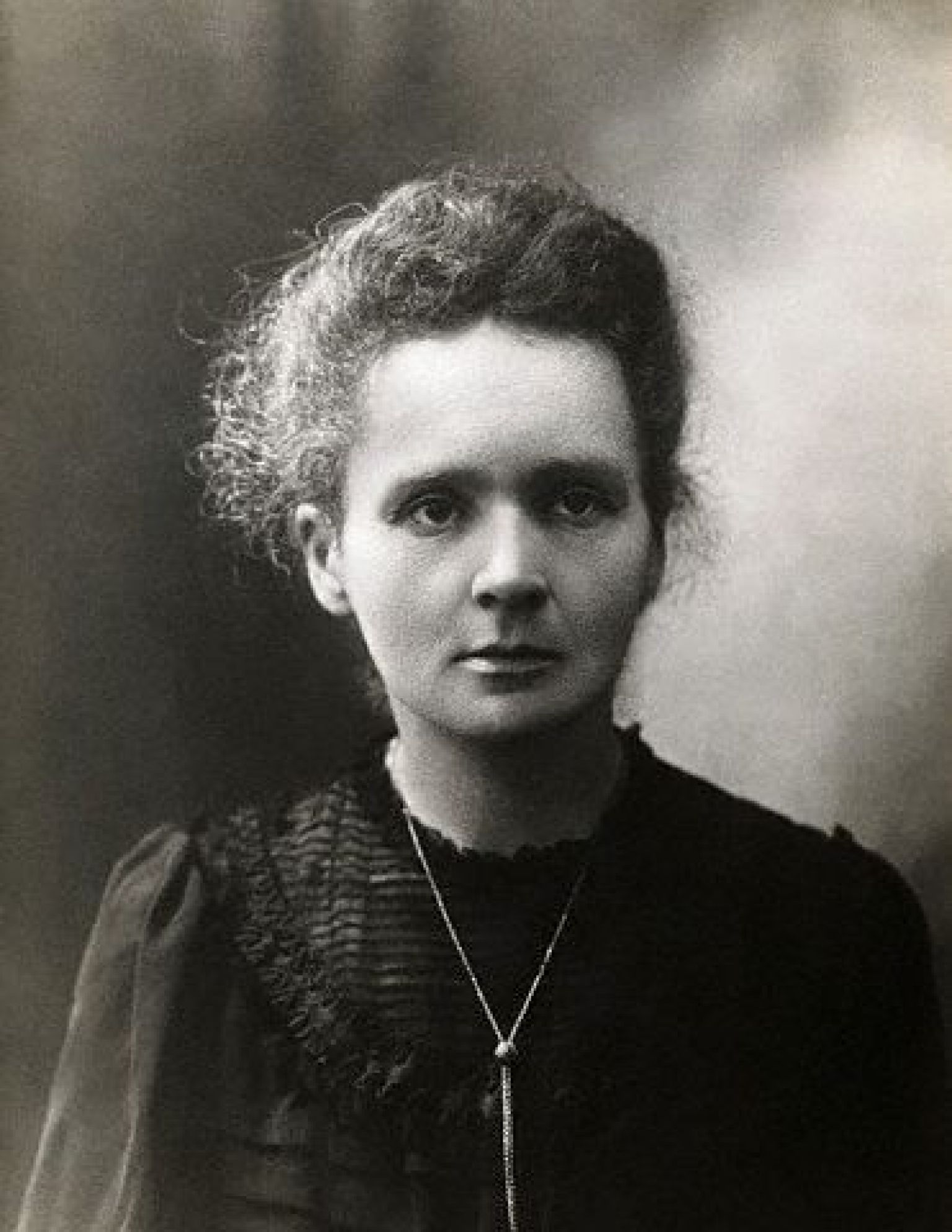
(1880-1972) Emma Perry Carr first attended Mr. Holyoke College then transferred to and received her B.S. from the University of Chicago in 1905. After a short duration as an instructor at Mt. Holyoke, Dr. Carr returned to the University of Chicago to receive her PhD in 1910. She returned to Mt. Holyoke to become a full professor and head of the department by the age of 33, a post she held for 33 years. Dr. Carr was also a devoted aunt,a fashionable dresser, and a talented storyteller. She had a relationship with Mary Sherrill, another professor at Mt. Holyoke, whom she shared a residence with for 26 years. Emma Perry Carr was the first recipient of the Garvan Medal.

Marie Sklodowska Curie
Photo from Wikimedia Commons

Physicist & Chemist Marie Sklodowska Curie was the first twice Nobel Prize laureate.

(1867-1934) Much has been written about Marie Curie. She is, perhaps, the first historical figure to come to mind when a person says “Notable Woman in Science.” She is the first person to have been a twice Nobel Laureate. Marya Sklodowska was born in Poland, and lived through the loss of her eldest sister and mother by age 11. After graduating first her in class from high school, she attended a secret university because Polish universities could not admit women. She wished to go to Paris to study, so she worked and saved her money to do so. She was the first women to receive her Licence es Sciences Physiques from the Sorbonne in 1893, graduating first in her class again. She received her Licence es Sciences Mathematiques in 1894 from the same institution. In 1903, she attained her PhD from the University of Parish, the same year she was awarded the Nobel Prize in Physics. Difficulties continued in her personal life, such as the death of her husband in 1906, her own ill health due to radiation poisoning, and her constant fight for her place in her work. She broke so many barriers, being the first woman in so many circumstances.

Mary Fieser was well-known for her contributions to organic chemistry.
(1909-1997) Mary Feiser was encouraged by her parents to excel academically. She attended Bryn Mawr and received her B.S. in chemistry in 1930. She then attended Radcliffe college and worked on her master’s thesis in the lab of Louis F. Feiser at Harvard. She received her A.M. in 1931 and married in 1932. She opted to continue to work in her husband’s lab instead of pursue a PhD because of the funding and Harvard facilities. With her help, 15 papers and 17 books were published by Feiser. However, Harvard never granted her a salary nor official title for 29 years. Even at 85 years of age, Mary Feiser continued to write and publish organic chemistry books, which were well received.

Dorothy Anna Hahn was a researcher, professor, and mentor for women in chemistry.
(1876-1950) Dorothy Hahn received her B.A. in chemistry from Bryn Mawr and went to work at Mt. Holyoke College under the auspices of Emma Perry Carr. Together, the two women were a force producing many women chemists. While Dr. Carr ran the chemistry department, it is said Dr. Hahn ran the organic chemistry department. Dr. Hahn pursued and recieved her Ph.D. from Yale University in 1916 due to a fellowship from the AAUW (American Association of University Women). Hahn also preceeded well-known scientists Gilbert Lewis and Irving Langmuir on a theory of valence electrons. Professor Hahn was a huge influence on organic chemistry, teaching, and women in chemistry.

Allene Rosalind Jeanes was a pioneering researcher with several patents.
(1906-1995) Allene Rosaland Jeanes was born and raised in Texas. She received her A.B with highest honors from Baylor University in 1928. She graduated with her M.A. from the University of California – Berkeley in 1929. She taught for awhile in a few different colleges, then decided to return to graduate school. She attained her PhD from the University of Illinois in 1938. While she wanted to go into pharmaceutical research, opportunities were limited. She took a position at the National Institute of Health. Her research took her through several government positions and had applications in the food industry. She was honored with many awards, including the Garvan Medal and Federal Women’s Award from the U.S. Civil Service Commission.

Nuclear Chemist Ellen Gleditsch was virtually unknown despite her accomplishments.
(1879-1968) The story of Ellen Gleditsch is not well known in her native Norway nor abroad, and signifies how difficult it was for women to be recognized for their work. She received her degree in pharmacology in 1902. She worked with Marie Curie for 5 years, and received her Licencee es Sciences from the Sorbonne in 1912. She went to work at Yale University despite the animosity toward her from the men at the U.S. institutions of Yale and Harvard and received her D.Sc. form Smith College in 1914. In 1929, Oslo University became embroiled in controversy over the decision to advance Ellen Gleditsch to the position of professional chair, and it took a letter from Marie Curie to help quell the public outrage. During her time in Oslo, she also provided a home for scientists fleeing Nazi Germany. She continued to be an advocate and mentor for women in the sciences until her death at age 88.

Anna Jane Harrison was the first woman president American Chemical Society.
(1912-1998) Born in Missouri, Anna Jane Harrison was raised on a farm and her childhood science education tended to be “go out and find caterpillars.” She learned about Caterpillar tractors from her father for that assignment. Her high school science teachers inspired her interest in science, so she went to the University of Missouri to earn a B.A. in chemistry in 1933, a B.S. in education in 1935, a M.A. in chemistry in 1937, and a Ph.D. in physical chemistry in 1940. She was the first woman to earn a PhD at the institution. After meeting Lucy Picket and Emma Carr at a meeting of the American Chemical Society (ACS), she went on to work at Mt. Holyoke College, carrying on the traditions established there by Emma Carr and Dorothy Hahn. She also has several more “firsts” including being the first woman to chair the Division of Chemical Education of the ACS and the first woman elected president of the ACS in the 102 year history of the organization up to then. She was honored with the honorary degree of D.Sc. from ten instutitions. She enjoyed traveling and once stated, “What I really like is to go places one isn’t supposed to go.”

Mentioned Awards
The Garvan Medal is an award from the American Chemical Society to recognize distinguished service to chemistry by women chemists.
Nobel Prize: From the site:
Every year since 1901 the Nobel Prize has been awarded for achievements in physics, chemistry, physiology or medicine, literature and for peace. The Nobel Prize is an international award administered by the Nobel Foundation in Stockholm, Sweden. In 1968, Sveriges Riksbank established The Sveriges Riksbank Prize in Economic Sciences in Memory of Alfred Nobel, founder of the Nobel Prize. Each prize consists of a medal, personal diploma, and a cash award.
Federal Women’s Award from the U.S. Civil Service Commission was awarded to a woman for a high level of scientific achievement.

Rest in peace, Sally Ride

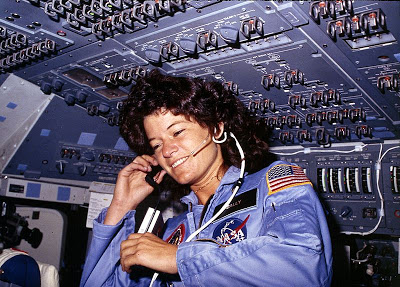
Photo public domain image, via Wikimedia Commons.

By Matthew Francis, DXS Physics Editor


This week—on Monday, July 23—Sally Ride passed away after a battle with pancreatic cancer. She was 61.


Dr. Ride was a physicist and passionate advocate for STEM education for girls, a position she bolstered through her fame as a former Space Shuttle astronaut. In fact, she was the first American woman in space, and only the third woman worldwide to travel into space. She flew twice aboard the Challenger, first in 1983 and then again in 1984, when she controlled the Shuttle’s robotic arm to deploy a satellite. Later, she served in the investigations after both the Challenger and Columbia disasters, the only person to sit on both committees. After retiring from NASA, she started Sally Ride Science, a company devoted to providing educational materials and classroom presentations to schools, specifically with an eye toward encouraging girls in the fields of science and engineering.


I remember her flights well, as I paid a lot of attention to the space program when I was young. (I also loved the robotic arm on the Shuttle, and wanted a chance to play with it. Now I understand that, while it might resemble a video game, it’s a video game with millions of dollars in equipment at stake. However, I still haven’t gotten over wanting to play with robotic arms. I can admit that, right?) I was the kid who wrote letters to NASA, asking for photos and information about their spacecraft. I have the pictures they sent me in a stack on my desk right now, in fact, and I’m looking at them as I write this post. While the photos themselves predated Dr. Ride’s trips into space (the last group photo in the batch comes from the third flight, STS-3, while she first flew on STS-7), my greatest interest in the Shuttle peaked during her time as as an astronaut.


Much digital ink has been spilled over the revelation about her sexual orientation—her partner in business, writing, and life for the last 27 years was Tam O’Shaughnessy, which was no secret to her family and friends but not widely known beyond. I can’t really blame Dr. Ride for keeping mostly quiet about it. After all, in the 1980s, it could have been grounds for dismissal from NASA; she faced enough sexism as it was. Her very existence as a woman astronaut was symbolic, and even today the default American astronaut is a white, (presumably) heterosexual male. Although the astronaut corps is a lot more diverse than it used to be, NASA’s close ties with the military and its historical homophobia have no doubt made it difficult for any astronaut to acknowledge their sexual identity openly. For Dr. Ride and her primary mission in life to encourage girls in science, I can understand her reluctance to make herself into another symbol. However, that very fact is a sad comment, that being a woman in the public sphere is enough to be considered unusual that she didn’t want to bring her sexual orientation into the picture. (I don’t even presume to call her a lesbian, since human sexual identity is more fluid than many of us like to admit.)


Over the last two days, many people have written eulogies, reminiscences, tributes, and biographies; I’m not sure I can add much to those. Here are some of the best:

  • Nadia Drake’s personal story from her childhood brought tears to my eyes. Similarly, I love astronomer Meg Urry’s tribute.
  • Here’s the big New York Times official obituary, which (as you might expect) is quite good and thorough.
  • While we rightfully celebrate Sally Ride’s accomplishments, let’s face it: the United States was really late in sending women into space. Institutional sexism delayed women astronauts far longer than should be acceptable in any civilized nation, and the locker-room culture at NASA during that era bears a lot of responsibility for the problem. Thirteen women trained to be part of the Mercury program, but were barred from ever flying. I lost a lot of respect for John Glenn when I found out he actively worked against allowing women to fly.
  • Natalie Wolchover at Space.com examines why there aren’t openly gay astronauts in much more detail; here’s another post on a similar personal note, from a lesbian astronomer.
  • An obituary from BuzzFeed, with comments from Ride’s sister, Bear. (Seriously, isn’t it also awesome to have a sister nicknamed “Bear”?)

Please leave your recollections of Sally Ride in the comments.
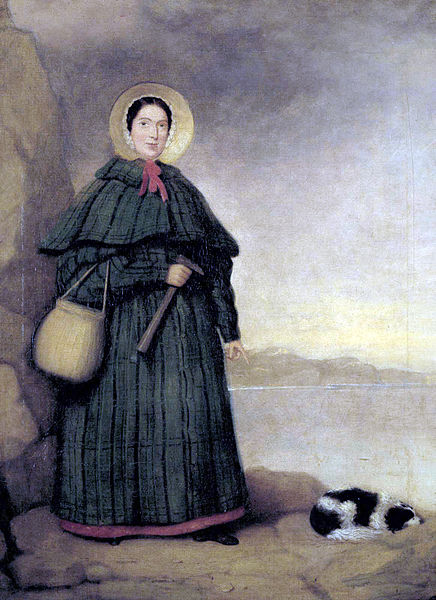
Happy belated birthday, Mary Anning!

Mary Anning and a small, non-fossilized dog. (Source)

[Today, we’re featuring a post by Mike Rendell, author and keeper of Georgian Gentleman, a blog chronicling aspects of 18th century life. Mike spent 30 years as a lawyer-poor fellow-before he retired to time travel in his mind back to the 18th century, where he has set up mental shop permanently. By what he calls a “curious stroke of luck,” he has all of the 18th century papers of his great-great-great-great (that’s four) grandfather, including diaries, accounts, letters, and even shopping lists. In 2011, he published the story of this ancestor’s life as a social history, “The Life of a Georgian Gentleman,’ and thus, a blog was also born. We thank Mike for having graciously given us permission to publish his post here because we are huge fans of Mary Anning, who, as was typical, did not receive recognition from or entree into male scientific society of her day. We have added in a few explanatory links, too.]
Today the spotlight is turned not on a well-educated man, or a wealthy daughter with aristocratic connections, but on a girl who was amongst the poorest of the poor; who in many ways led a miserably hard and short life; who could barely read and write, and yet was someone who amazed the scientific world in the first half of the nineteenth century.
Her name was Mary Anning, born in Lyme Regis in Dorset on 21st May 1799. She cannot be said to have had an auspicious start in life. She was one of ten children – but eight died in childhood. An elder sister had already been called Mary but she had perished in a fire when her clothes were ignited from some burning wood shavings. Our heroine was born five months after this tragic death, and was named Mary in memory of her dead sibling.
Mary had luck, of a sort, on her side. When she was eighteen months old she was being held in the arms of a neighbour called Elizabeth Haskings who was in a group of women watching a travelling show. A storm sprang up and the group took shelter beneath an elm tree, but a bolt of lightning struck the tree, killing three of the women including Elizabeth. Yet Mary was apparently unscathed. Fate had something quite remarkable in store for the young girl…
Mary’s parents were Dissenters, meaning that education opportunities were limited and the family were subject to legal discrimination. A member of the Congregationalist Church, she attended Sunday School and here learned the rudiments of reading and writing. The Congregational Church, unlike the Anglican Church, attached great importance to education, particularly for young girls, and she was encouraged in her development by the pastor Revd James Wheaton. Her prized possession was apparently a copy of theDissenters’ Theological Magazine and Review Continue reading

Excerpts from Sophie’s Diary: A Mathematical Novel

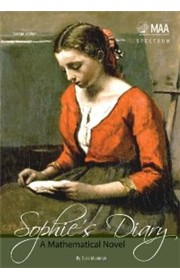
Today we enjoy a bit of math, as told in Sophie’s Diary: A Mathematical Novel. Written by Dr. Dora Musilek, this novel was inspired by the French mathematician Sophie Germain, an important contributor to number theory and mathematical physics. Her correspondence with some of history’s great mathematicians such as Lagrange, Legendre, and Gauss are known while her life prior to that is shrouded in the unknown. Dr. Musilek explored Germain’s early life and uses the concept of an adolescent’s diary to discuss how Germain may have taught herself math while dealing with the social upheaval of the French Revolution, which occurred at this time in her life. Read on for an engaging lesson in math.


Monday | January 2, 1792


I begin the new year with more determination and a renewed resolve to study prime numbers. One of my goals is to acquire the necessary mathematical background to prove theorems.


Prime numbers are exquisite. They are whole pure numbers, and I can manipulate them in myriad ways, as pieces on the chessboard. Not all moves are correct but the right ones make you win. Take, for example, the process to uncover primes from whole numbers. Starting with the realization that any whole number n belongs to one of four different categories:

The number is an exact multiple of 4 : n = 4k

The number is one more than a multiple of 4 : n = 4k + 1

The number is two more than a multiple of 4 : n = 4k + 2

The number is three more than a multiple of 4 : n = 4k + 3


It is easy to verify that the first and third categories yield only even numbers greater than 4. For example for any number such as k = 3, 5, 6, and 7, I write: n = 4(3) = 12, and n = 4(6) = 24; or n = 4(5) + 2 = 22, and n = 4(7) + 2 = 30. The resulting numbers clearly are not primes. Thus, I can categorically say that prime numbers cannot be written as n = 4k, or n = 4k + 2. That leaves the other two categories.


So, a prime number greater than 2 can be written as either n = 4k+ 1, or n = 4k + 3. For example, for k= 1 it yields n = 4(1) + 1 = 5, and n = 4(1) + 3 = 7, both are indeed primes. Does this apply for any k? Can I find primes by using this relation? Take another value such as k = 11, so n = 4(11) + 1 = 45, and n= 4(11) + 3 = 47. Are 45 and 47 prime numbers? Well, I know 47 is a prime number, but 45 is not because it is a whole number that can be written as the product of 9 and 5. So, the relation n = 4k + 1 will not produce prime numbers all the time.


Over a hundred years ago Pierre de Fermat concluded that “odd numbers of the form n = 4k + 3 cannot be written as a sum of two perfect squares.” He asserted simply that n= 4k + 3 a2 + b2. For example, for k = 6, n = 4(6) + 3 = 27, and clearly 27 cannot be written as the sum of two perfect squares. I can verify this with any other value of k. But that would not be necessary.

And now we skip ahead to another excerpt where differential calculus is described.


Wednesday | February 27, 1793


I feel strong enough to resume my studies. My mind is clear again to meet the challenges of a new topic that at first seemed insurmountable. I resumed my studies of differential calculus.


There is something magical about Infiniment petits. I went back to the basic definition: “a derivative of a function represents an infinitesimal change in the function with respect to whatever parameters it may have.” The simple derivative of a function f with respect to x is denoted by f’(x), which is the same as df/dx. Newton used fluxions notation dz/dt = ż, but it means the same, so I will use f’ or df/dx from now on. Well, I can now take the derivative of certain classes of functions because I just follow certain rules.


If my function is of the type xn, I use the fact that d/dx(xn) = nxn−1.So, if I have f(x) = x5, its derivative should be 5x4. This is easy. If Ianalyze trigonometric functions such as sin x and cos x, then I use thederivatives d/dx(sinx) = cos x, and d/dx(cosx) = − sin x.

Taking derivatives is so easy! I could spend hours deriving more complicated functions. However, I wish to learn also how to see the world through mathematics. I must find the connection between differential equations and physics. I am eager to explore this applied aspect of mathematics.


Let’s start with a differential equation, an equation involving an unknown function and its derivatives. It can be relatively easy such as

or a bit more complicated such as the linear differential equation:
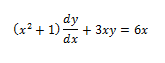
or even a nonlinear equation such as this:
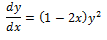

A differential equation is linear if the unknown function and its derivatives appear to the power 1 (products of these are not allowed) and nonlinear otherwise. The variables and their derivatives must always appear as a simple first power. Nonlinear equations are difficult to solve and some are impossible.


First I need to master linear equations. Some mathematicians use the notation y’ for the dy/dx derivative, or y’’ for d2y/dx2, and so forth. Thus,the previous linear equation would be written as (x2 + 1)y’ + 3xy = 6x. I need to keep these differences of notation in mind, since I am studying from five different books.


I studied the properties of differential equations and learned to solve them. Now, I must learn how to apply differential equations. But how do I translate a physical phenomenon into a set of equations to describe it? It is impossible to depict nature in its totality, so one usually strives for a set of equations that describes the physical system approximately and adequately.


Say that I want to predict the growth of population in Paris. To do it, I can use an exponential model, that is, an equation that represents the rate of change of the population that is proportional to the existing population. If P(t) represents the population change in time (t), I write

where the rate k is constant. I observe that if k > 0, the equation describes growth, and if k < 0, it models decay. The exponential equation is linear with a solution P(t) = P0ekt, where P0is the initial population, i.e., P(t = 0) = P0.


Mathematically, if k> 0, then the population grows and continues to expand to infinity. On the other hand, if k < 0, then the population will shrink and tend to 0. Clearly, the first case, k > 0, is not realistic. Population growth is eventually limited by some factor, like war or disease. When a population is far from its limits of expansion, it can grow exponentially. However, when nearing its limits, the population size can fluctuate. Well, I think that the equation I use to predict the rate of change of population can be modified to include these factors to obtain a result closer to reality.


Aristotle thought that nature could not be expected to follow precise mathematical rules. But Galileo argued against this point of view. He envisioned the experimental mathematical analysis of nature to be used to understand it. Newton was inspired by Galileo and later developed the laws of motion and universal gravitation. Newton, Leibniz, Euler, and other great people then created the mathematics that help us converse with the universe.


Oh, how glorious it is to speak such a language and understand the whispers from the heavens and the world around me.


Dr. Dora Musilek is a research scientist and also lectures on the role and contributions of women scientists and mathematicians. She holds a Ph.D. in aerospace engineering. You can learn more about Dr. Musilek and her novel at sophiesdiary.net You can learn more about Dr. Musilek’s writing process at MAAA Books Blog.


These views are the opinion of the author and do not necessarily either reflect or disagree with those of the DXS editorial team. 

Modern Chemists

Our next installment of notable women in science brings us to chemists. Many of these women were born in the early part of the 20thcentury and forged their paths in tough times. All are still inspiring others today. Presented in no particular order:

Catherine Clarke Fenselau is a pioneer in mass spectrometry. Born in 1939, her interested in science was apparent before her 10th grade. She was encouraged to attend a women’s college, which at the time gave what she called “a special opportunity for serious-minded young women.” She graduated from Bryn Mawr with her A.B. in chemistry in 1961. Her graduate work at Stanford introduced her to the technology she would become known for, receiving her Ph.D. in analytical chemistry in 1965. Dr. Fenselau and her husband took positions at the Johns Hopkins University Medical School, at which time she had two sons. Johns Hopkins was under a mandate to accept female students and have female faculty at the time. Dr. Fenselau was made aware of the disparity of the treatment of male and female faculty, when in the 1970s the equal opportunity laws came into effect and she received an unexplained 25% raise. Her research resided in mass spectrometry, specifically in its use in biology. She became known as an anti-cancer researcher. Dr. Fenselau spoke often to chemists about feminism and goals, such as equal pay, opening closed career opportunities to women, and achieving the bonuses often only awarded to men. She has worked as an editor on several scientific journals. Some of her awards include the Garvan Medal, Maryland Chemist Award, and NIH Merit Award. Having proper help at work and at home, and having supportive mentors and spouse has helped her achieve her success.

Elizabeth Amy Kreiser Weisburger is considered a real-lifemedical sleuth. Born in 1924, Dr. Weisburger was one of 10 children and schooled at home for her early education. She received her B.S. in chemistry, cum laude, Phi Alpha Epsilon from Lebanon Valley College. She received her Ph.D. in organic chemistry in 1947 from the University of Cincinnati. She married and had three children. Her research has caused her to be proclaimed a pioneer in the field of chemical carcinogenesis. She balanced her busy life of working at the NCI, committee work, giving lectures, attending meetings, writing and reviewing papers while caring for children with the aid of housekeepers and nursery childcare. Some of her awards include the Garvan Medal and the HillebrandPrize. Her life philosophy is summed up with “Don’t take life so seriously; you’ll never get out of it alive.”

Helen M. Free, photo from the ACS
Helen M. Free is a major contributor to science and science education. Born in 1923, Ms. Free attended the College of Wooster, graduating with honors and a B.S. in 1944. In 1978, she earned a M.A. from Central Michigan University. In the meantime, she worked as a chemist at Miles Laboratories. She developed clinical effective and easy to use laboratory tests. She worked her way up through the company and also held an adjunct professor position at Indiana University, South Bend. Ms. Free has used her time to be active in professional societies and has served as president for the American Association for Clinical Chemistry and the American Chemical Society. Her awards include the Garvan Medal, a Distinguished Alumni Award from Wooster, and is the first recipient ofthe Public Outreach Award bearing her name.

Jeanette Grasselli Brown is an industry researcher and director. Born in 1929, she graduated summa cum laudewith her B.S. from Ohio University in 1950 and received her M.S. in 1958 from Western Reserve University. She worked at Standard Oil of Ohio (now BP of America), and became the first woman director of corporate research there. She has received numerous awards including the Garvan Medal, Ohio Women’s Hall of Fame, and the Fisher Award in Analytical Chemistry. She has published 75 papers in scientific journals, written 9 books, and received 7 honorary Doctorate of Science degrees. She is an activist for the future of women in science.

Jean’ne Marie Shreeve is an important fluorine chemist. Born in 1933, she encountered sexism through her mother’s inability to be employed despite her training as a schoolteacher. Dr. Shreeve graduated with a B.A. from Montana State University in 1953, followed by an M.S. in 1956 from the University of Minnesota, and a Ph.D. in inorganic chemistry in 1961 from the University of Washington. After graduating, she worked her way through the professorial ranks at the University of Idaho. Besides her own research, Dr. Shreeve has devoted herself to educating other chemists. Some of her awards include U.S. Ramsey Fellow, Alfred P. Sloan Fellow, and Garvan Medal.

Joyce Jacobon Kaufman by Smithsonian Institution
Joyce Jacobson Kaufman is distinguished in many fields. Born in 1929, she was reading before the age of 2 and was a voracious reader as a child. This led to her reading the biography of Marie Curie, which inspired her to be a chemist. Dr. Kaufman received her B.S., M.A., and Ph.D. in physical chemistry from Johns Hopkins University in 1949, 1959, and 1960, respectively. She married and had a daughter. Her research in the application of quantum mechanics to chemistry, biology, and medicine led to her renown in several fields. She has also spent much time in service positions. Her awards include the Martin Company Gold Medal for Outstanding Scientific Accomplishments (received 3 times), the Garvan Medal, and honored as one of ten Outstanding Women in the State of Maryland.

Madeleine M. Joullie is known for elegant research and inspirational teaching. Born in 1927, her early life in Brazil was overly-protective, so her father encouraged her to attend school in the U.S.A. She received her B.Sc. from Simmons College in 1949, and her M.Sc. and Ph.D. in chemistry in 1950 and 1953, respectively, from the University of Pennsylvania. She then worked her way through the professorial ranks at the University of Pennsylvania. Initially, only the women graduate students would work with her, and they were few and far between. She has explored many research avenues over the course of her career. Her awards include the Garvan Medal, the American Cyanamid Faculty Award, the Henry HillAward, and the Lindback Award for Distinguished Teaching.

Marjorie Caserio is a researcher, educator, author, andacademic administrator. Born in 1929, she entered university with the goal of becoming a podiatrist in order to generic income. She received several rejections from colleges due to her gender, and eventually was accepted to be the only woman in her class. She received her B.S. from Chelsea College, University of London in 1950 and an M.A. and Ph.D from Bryn Mawr in 1951 and 1956. Dr. Caserio is co-author of one of the most popular organic chemistry textbooks in the chemistry during the 1960s and 1970s. Her awards include the Garvan Medal and John S. Guggenheim Foundation Fellow.

Mary Lowe Good has won several awards and is a public servant. Born in 1931, she was supported in her aspirations by her parents. She received her B.S. in 1950 from the University of Central Arkansas, which was then the Arkansas State Teachers College. She went on to receive her M.S. and Ph.D. in inorganic and radiochemistry from the University of Arkansas in 1953 and 1955. Her career began in academic, but an appointment to the National Science Foundation by President Carter changed the course of her career. She served the International Union of Pure and Applied Chemistry, and president of the American Chemical Society and Zonta International Foundation. Some of her awards include Garvan Medal, CharlesLathrop Parsons Award, and 18 honorary doctorates.

Ruth Mary Roan Benerito is an academic and government scientist. Born in 1916, she began college at the age of 15 at Sophie Newcomb College, the women’s college of Tulane and received her B.S. in 1935. She received her M.S. from Tulane University in 1938, which she worked half-time while working another job at the same time. She taught at Tulane and its colleges before going to the University of Chicago to get her Ph.D. in 1948 in physical chemistry, again working on a part-time basis. Her career oscillated between academia and industry, earning her a large number of awards, including the Federal Women’s Award, the Southern Chemist Award, and inducted as a Fellow into the American Institute of Chemists and Iota Sigma Pi.

Awards

The Garvan Medal is an award from the American Chemical Society to recognize distinguished service to chemistry by women chemists.

The Maryland Chemist Award recognizes and honors its members for outstanding achievement in the fields of chemistry.

The NIH Merit Award is a  symbol of scientific achievement in the research community.

The Hillebrand Prize is awarded for original contributions to the science of chemistry.

The Distinguished Alumni Award from Wooster is presented annually to alumni who have distinguished themselves in one of more of the following area: professional career; service to humanity; and service to Wooster.

Helen M. Free Award recognizes outstanding achievements in the field of public outreach.

Ohio Women’s Hall of Fame provides public recognition of contributions made to the growth and progress of Ohio and the nation.
The Fisher Award in Analytical Chemistry recognizes outstanding contributions to the field of analytical chemistry.

U.S. Ramsey Fellow is no longer offered.

Alfred P. Sloan Fellow is awarded to scientists and scholars of outstanding promise.

Outstanding Women in the State of Maryland awards women under the age of 40 for their achievements already made in an early career.

The American Cyanamid Faculty Award

The Henry Hill Award recognizes distinguished service to professionalism.


John S. Guggenheim Foundation Fellow is awarded for demonstrating outstanding scholarship.

Charles Lathrop Parsons Award recognizes outstanding public service.


The Southern Chemist Award

The American Institute of Chemists  advances the chemical sciences by establishing high professional standards of practice and to emphasize the professional, ethical, economic, and social status of its members for the benefit of society as a whole.

Iota Sigma Pi is a national honor society for women in chemistry.

Much of the information for this post came from the book Notable Women in the Physical Sciences: A Biographical Dictionary edited by Benjamin F. Shearer and Barbara S. Shearer.

Adrienne M Roehrich, Double X Science Chemistry Editor