Diversity in Science Carnival #14: Women’s History Month-Exploring the role of women in the STEM enterprise

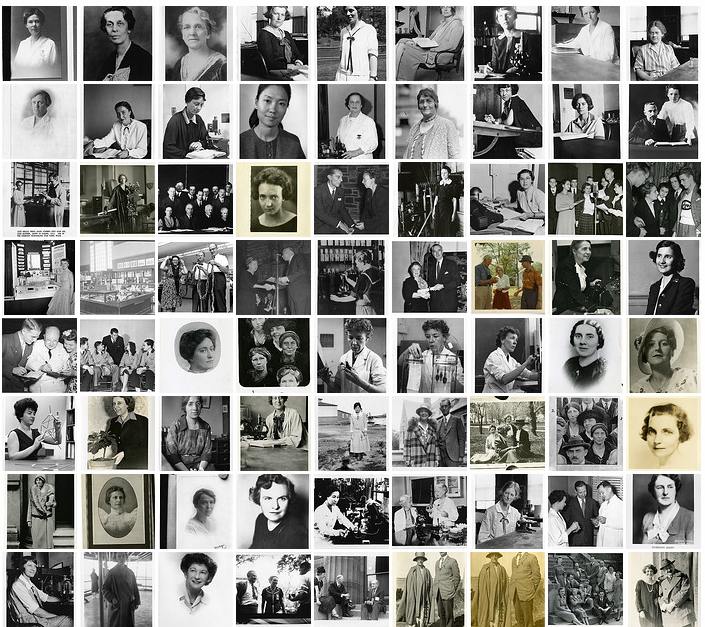
Women in Science, via the Smithsonian.

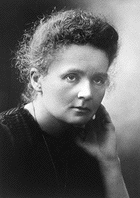
“We must believe that we are gifted for something.” Marie Curie
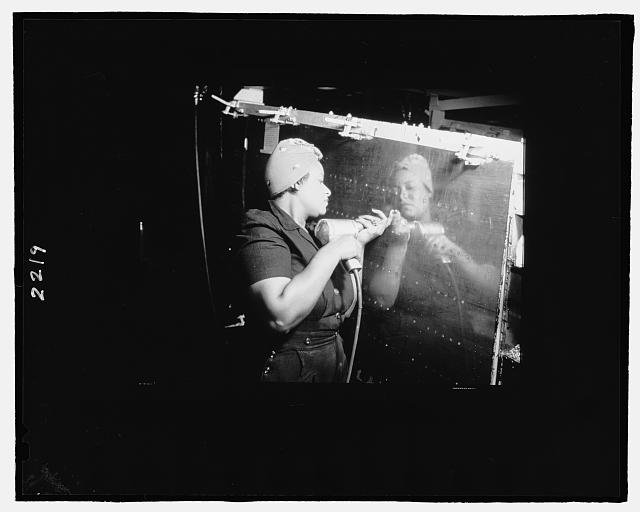
Image of a real Rosie the Riveter from the
Women’s History Month site.
It’s tempting to cast the role of women in STEM (Science, Technology, Engineering, and Math) as one of struggles and battles because of their sex, rather than as one of contributions because of their minds. But for Women’s History Month and this Diversity in Science Carnival #14, our focus is the role of women in the enterprise of STEM. There’s more to a woman than her sex and her struggles in science-there is, after all, the enormous body of work women have contributed to science.
 

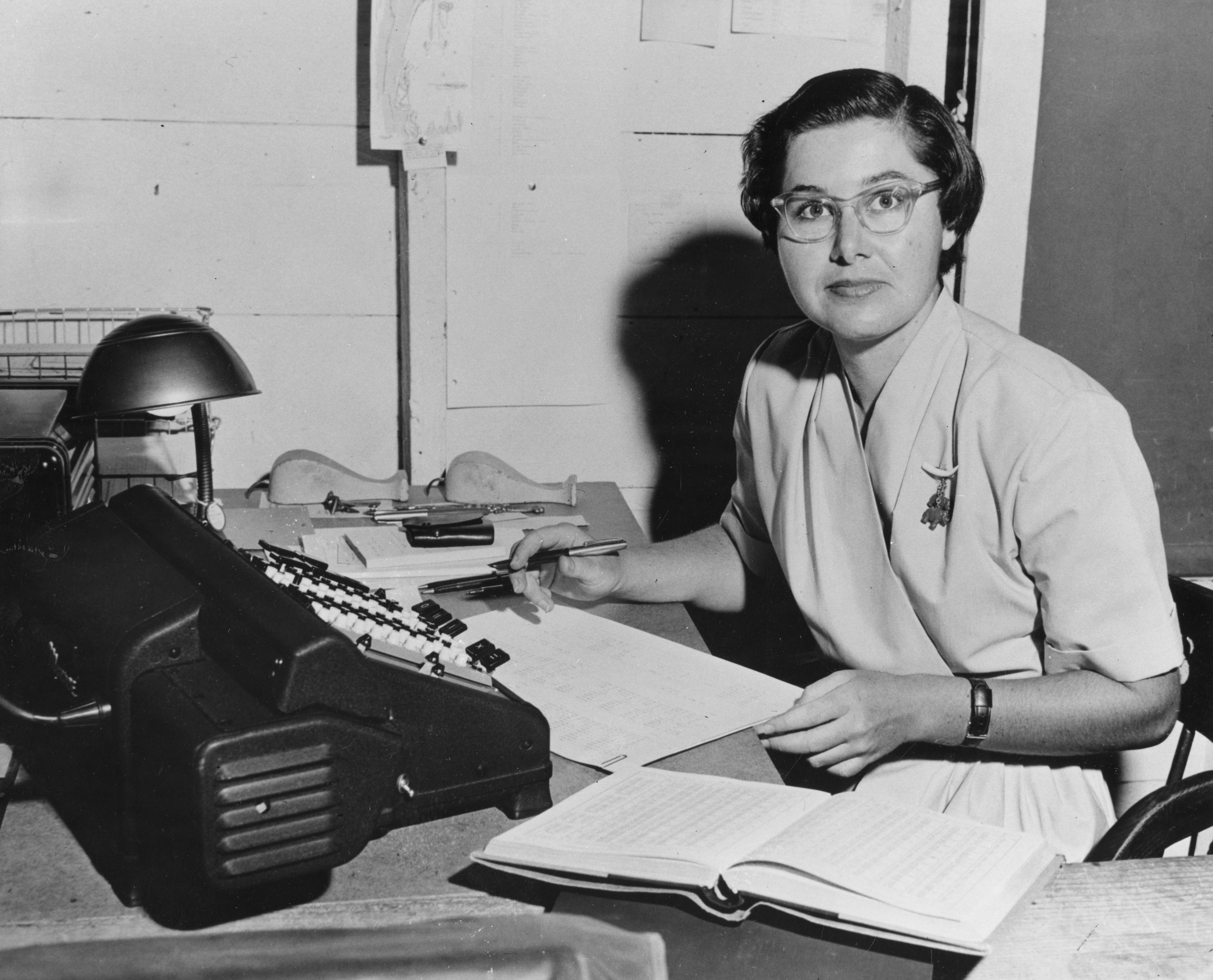
Our history is ongoing, but we can start with a look back. Thanks to the efforts of the Smithsonian Institution Archives, we can put faces to the names of some of the female STEMmers of history. In a presentation of photographs in an 8 by 9 space, we can see the images of 72 women who contributed to the enterprise of STEM, many of them involved with the Smithsonian in some capacity. As their clothes and the dates on the photos tell us, these women were doing their work in a time when most women didn’t even wear pants.
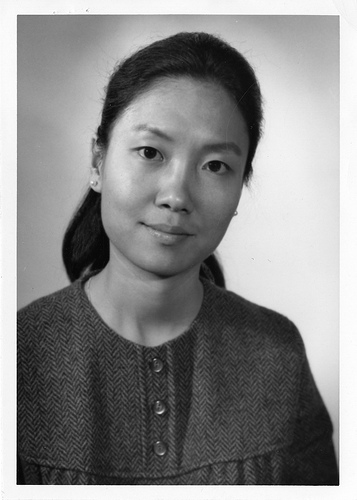
Some are Big Names-you’ve probably heard of Marie Curie. But others are like many of us, women working in the trenches of science, contributing to the enterprise of STEM in ways big and small. Women like Arlene Frances Fung, whose bio tells us she was born in Trinidad, went to medical school in Ireland, and by 1968 was engaged in chromosome research at a cancer institute in Philadelphia. From Trinidad to cancer research, her story is one of the millions we could tell about women’s historical contributions to science, if only we could find them all. But here there are 72, and we encourage you to click on each image, look at their direct gazes, ponder how their interest in science and knowledge trumped the heavy pressures of social mores, and discover the contributions these 72 women made, each on her own “little two inches wide of ivory.”

For more on historical and current women in science, you can also see Double X Science’s “Notable Women in Science” series, curated by Adrienne Roehrich.

And then there are the women STEMmers of today, who likely are, according to blogger Emma Leedham writing at her blog Pipettes and Paintbrushes, still underpaid. Leedham also mulls here what constitutes a role model for women-does it require being both a woman and a scientist, or one or the other?
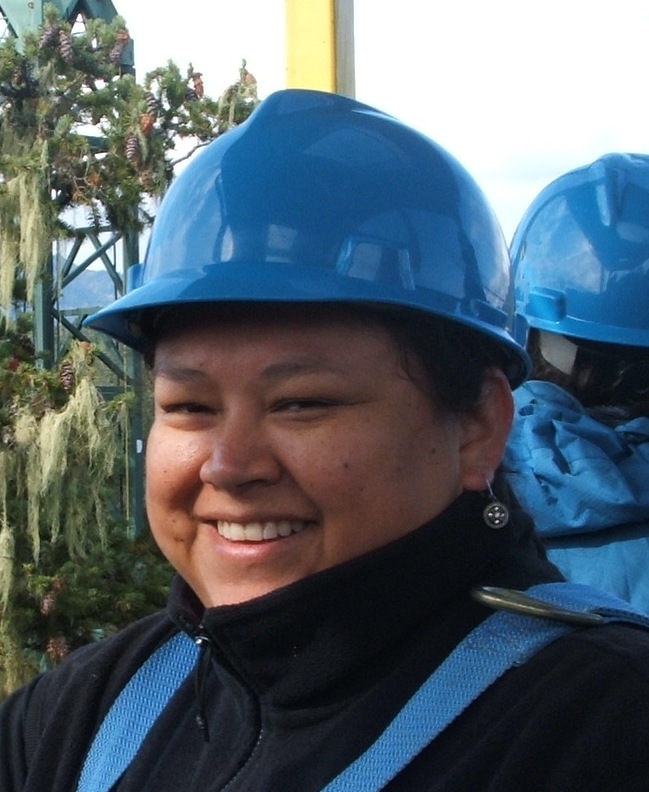
Laurel L. James
Laurel L. James, writing at the University of Washington blog for the school’s SACNAS student chapter, answers with her post, “To identify my role as a woman in science: I must first honor my mother, my family and my past.” Her mother was the first “Miss Indian America,” and Laurel is a self-described non-traditional student at the school, where she is a graduate student in forest resources. She traces her journey to science, one that involved role models who were not scientists but who, as she writes, showed her “how to hang onto the things that are important with the expectation of getting something in return all the while, persevering and knowing who you are; while walking with grace and dignity.” I’d hazard that these words describe many a woman who has moved against the currents of her society to contribute something to the sciences.
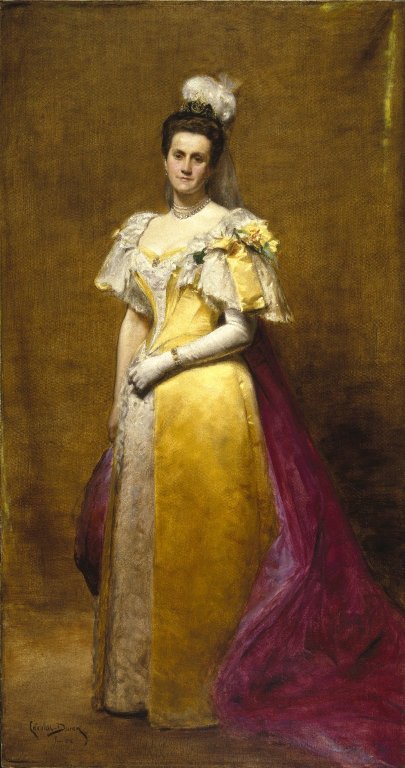
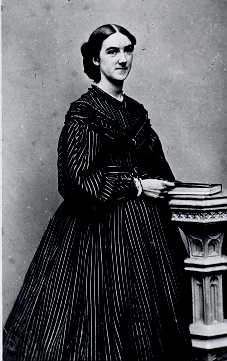
A great site, Steminist.com, which features the “voices of women in science, tech, engineering, and math,” runs a series of interviews with modern-day STEMmers, including Double X Science’s own Jeanne Garbarino, and Naadiya Moosajee, an engineer and cofounder of South African Women in Engineering. You can follow Naadiya on Twitter here. Steminist is also running their version of March Madness, except that in honor of Women’s History Month, we can choose “Which historical women in STEM rock (our) world.” The 64 historical STEMinists in the tourney are listed here and include Emily Warren Robling (left), who took over completion of the Brooklyn Bridge when her husband’s health prevented his doing so; she is known as the first woman field engineer. Double X Science also has a series about today’s women in science, Double Xpression, which you can find here.

Today, you can find a woman-or many women-in STEM just about anywhere you look, whether it is as a government scientist at NOAA like Melanie Harrison, PhD, or at NASA. It hasn’t always been that way, and it can still be better. But women have always been a presence in STEM. In the 18thand 19th centuries, astronomer Caroline Herschellabored away through the dark hours of just about every night of her adult life, tracking the night sky. Today, women continue these labors, and STEM wouldn’t be what it is today without women like Herschel willing to stay up all night with the skies or spend days on end in the field or lean over a microscope for hours just to add a tiny bit more to what we know about our world and our universe.
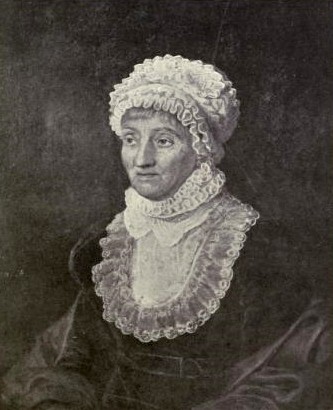
Caroline Herschel
For women in science, we’re there-at night, in the lab, in the field-because we love science. But as the non-science role models seem to tell us, we stick to it-and can stick with it-because we had role models in and out of science who showed us that regardless of our goals, our attitudes and willingness to move forward in spite of obstacles are really what drive us to success in STEM careers. Among the links I received for this carnival was one to Science Club for Girls, which is sponsoring a “Letter to My Young Self” roundup for Women’s History Month. The letters I’ve read invariably have that “stick with it” message, but one stood out for me, and I close with a quote from it.

It’s a letter by Chitra Thakur-Mahadik, who earned her PhD in biochemistry and hemoglobinopathy from the University of Mumbai and served as staff scientist a Mumbai children’s hospital for 25 years. She wrote to her younger, “partially sighted” self that, “The future is ahead and it is not bad!” She goes on to say, “Be fearless but be compassionate to yourself and others… be brave, keep your eyes and ears open and face the world happily. What if there are limitations? Work through them with awareness. —Yours, Chitra”
Links and resources for women in STEM, courtesy of D.N. Lee

AWIS:  http://www.awis.org/
Women of Color STEM Conference: 
http://intouch.ccgmag.com/page/woc_conference
Under the Microscope: 
http://www.underthemicroscope.com/
AAUW STEM: 
http://www.aauw.org/connect/ngcp/index.cfm
STEMinist: 
http://www.steminist.com/

Stay tuned for the April Diversity in Science Carnival #15: Confronting the Imposter Syndrome. This topic promises to resonate for many groups in science. I’m pretty sure we’ve all felt at least of twinge of imposter syndrome at some point in our education and careers. Your editor for this carnival will be the inimitable Scicurious, who blogs at Scientific American and Scientopia.


UPDATE: Carnival #15 is now available! Go read about imposter syndrome, why it happens, who has it, and what you can do about it.

By Emily Willingham, DXS managing editor 
Historical Physicists

Featured today are 10 more women who broke boundaries by their presence in physics. They lived from 1711 to 2000. While I again limited information to one paragraph, I tried to highlight how they got their start, what universities, family members, and scientists were supportive of them. For these women, without the support of fathers, mothers, husbands, and mentors (all male with one exception) their life in science would not have happened. While barriers are not as difficult today as they were at the times these women made their way, it is a testament to what can be done when families and scientists support each other. These women are an inspiration and I hope you look up more information for them. In addition, I’d love to hear who your favorite women in science are in the comments.

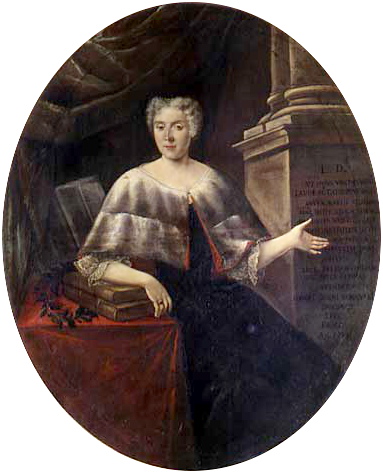
Laura Bassi by Carlo Vandi
Laura Bassi (1711-78) lectured on science until a few hoursbefore her death. An Italian scientist of international fame and one of the first women physicists in western history, Dr. Bassi earned her doctorate in philosophy and science through public debate from the University of Bologna. The University of Bologna offered Dr. Bassi a position in an effort to be known as a leader in women’s education. Unfortunately, this forward step was not acceptable to much of the rest of the world’s academic community and required stipulations to Dr. Bassi teaching. However, she countered these limitations with determination and passion. Her appointment to full membership in the Bendettini Academics also deterred some naysayers of Dr. Bassi’s involvement in research and teaching. In order to further her career, she married. A married woman could achieve more than a single woman at that time. Her death in 1778 was unexpected, especially as she had participated in an Academy of Sciences lecture on a few hours before.


If you can access the full article, I highly recommend The Desire to Contribute: AnEighteenth-Century Italian Woman of Science by Gabriella Berti Logan for more information on Laura Bassi.
Margaret Eliza Maltby (1860-1944) was a recognized scientistand advocate for women in science.  She overcame the education offered to women by taking extra courses in order to attend Oberlin College and receive a B.A. She studied with the Art Students’ League in New York City to explore her interest in art and then taught high school before enrolling as a “special student” at the Massachusetts Institute of Technology (MIT), receiving her B.S. Oberlin recognized this extra effort by awarding Dr. Maltby an M.S. She became a physics instructor at Wellesley College. She was encouraged in her graduate students by an AAUW fellowship to attend Göttingen University, which culminated in Dr. Maltby being the first American woman to receive a Ph.D. in physics from any German university. Dr. Maltby worked as an instructor, a researcher, and administrator in many universities and colleges in the U.S. and abroad. Her stature as a scientist was acknowledged with her entry in the first edition of AmericanMen of Science. She also was active in the AAUW, advocating for women to gain education and enter scientific fields. After her retirement from university life, she maintained her interest in the arts.

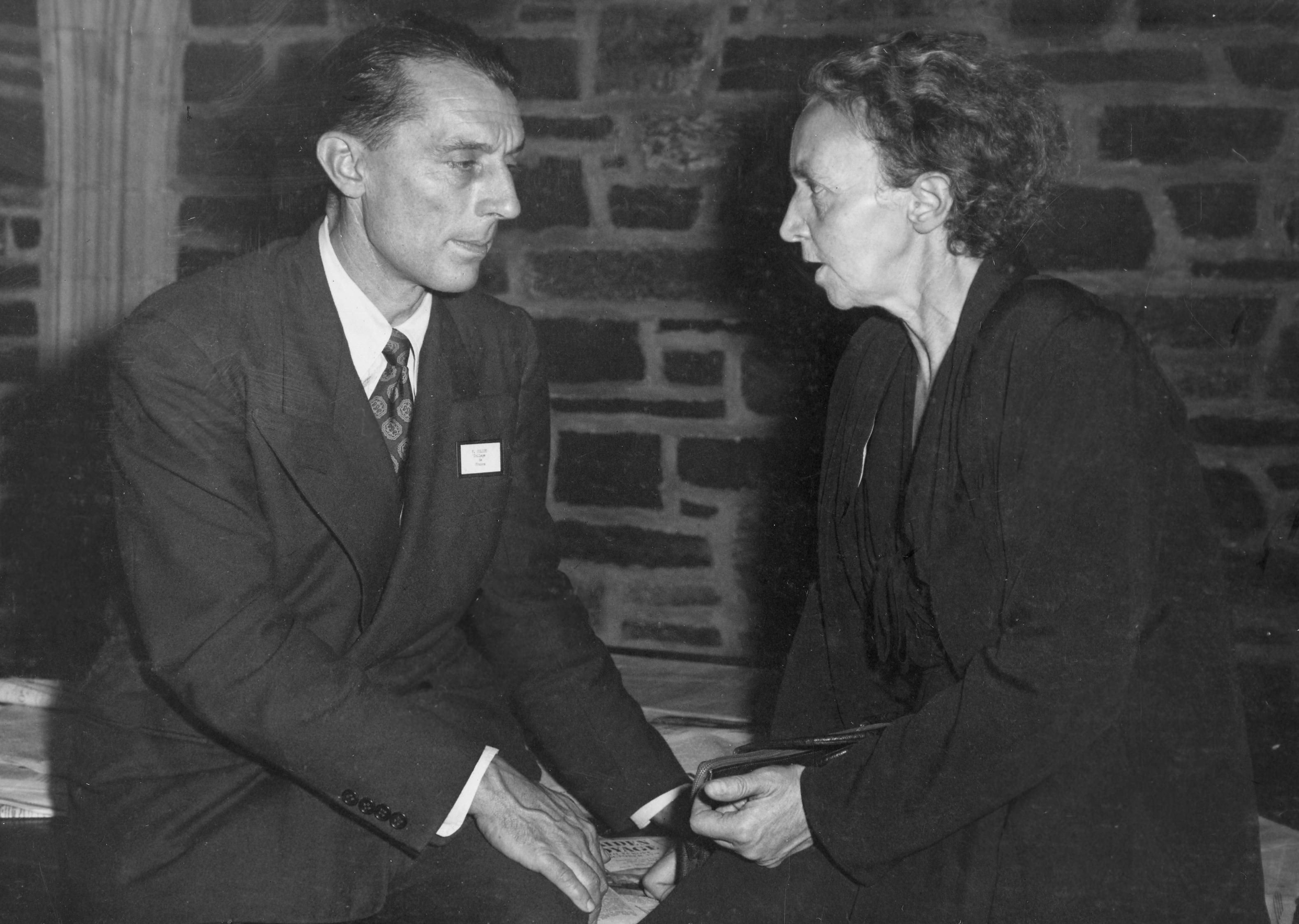
Frederic and Irene Joliot-Cure by By James Lebenthal
Irène Joliot-Curie (1897-1956) was a Nobel Prize Laureate for “artificial radioactivity.”    Born to the woman every person thinks of as the epitome of a woman in science, Marie Curie, Irène had an extremely close relationship with her paternal grandfather. Her schooling was outside of the standard schooling type, her first years at home and her latter years in a science and math heavy co-operative school of Madame Curie’s colleagues. She received her Bachelor’s degree from the Collège Sévigné and went on to study at the Sorbonne. She received her doctorate in 1925 based on work with her mother at the Radium Institute of the Sorbonne. She married Frédéric Joliot, another research assistant of Madame Curie’s. Dr. Joliot-Curie continued her research, interrupted by a stint as Undersecretary of State for Scientific Research, one of the first high government posts to be offered to a woman. She worked as a professor for the Sorbonne and director of the Radium Institute, but was not admitted to the Academy of Sciences due to discrimination despite her work. She died, like her mother, of acute leukemia. Her scientific work was complemented by her love of physical activity and motherhood.
Katharine Burr Blodgett By Smithsonian Institution, U.S.
Katharine Burr Blodgett (1898-1979) was a woman with an amazing number of firsts.   Born to a widow, she was a world citizen in her formative years, attended high school at a private school in New York City, won a scholarship to attend Bryn Mawr, and graduated second in her class there. She received her Master’s degree from the University of Chicago, then headed off to work with Nobel Laureate Irving Langmuir at General Electric (GE) and becoming the first woman research scientist there. She was able to work with Nobel Laureate Sir Ernest Rutherford and earn her Ph.D. from Cambridge University as the first woman to earn a doctorate from Cambridge. She returned to GE. During her career, she invented many applications and is credited with six patents. She achieved much when many women did not, but her work was de-valued in the media. She did earn recognition from her peers, including the ACS Garvan Medal, the Photographic Society of America Progress Medal, and a day named after her in her hometown of Schenectady, NY. In addition to her scientific life, she enjoyed gardening, civic engagement, acting, and “dart[ing] about Lake George in a fast motor boat.”
Astrophysicist Charlotte Emma Moore Sitterly (1898-1990) was an authority on sun composition. She started her career as an excellent student with extracurricular interests, attending Swarthmore College to earn her B.A. Upon graduation, she accepted a position as a mathematics computer at Princeton University Observatory, one of the few employment opportunities available to science inclined women at the time. A stint at the Mount Wilson Observatory led to results published a 1928 monograph which was considered the authoritative work on the solar spectrum for four decades. She received her Ph.D. from the University of California, Berkeley in 1931. Her work earned her the Annie J. Cannon Prize, Silver and Gold Medals from the Department of Commerce, and several honorary doctorates in the U.S. and abroad. She was the first woman elected foreign associate by the Royal Astronomical Society of London. Her enthusiasm for her work continued until her death.

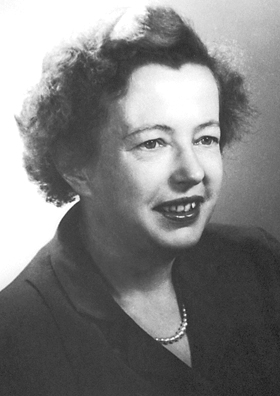
Maria Goeppert-Mayer By Nobel Foundation
Nuclear Physicist Maria Goeppert-Mayer (1906-1972) was the second woman to win the physics Nobel. Her early education was public education for girls followed by a private school founded by suffragettes. Circumstances led Dr. Goeppert-Mayer to take her exiting exams a year early, passing them she attended the University of Göttingen for her college education in mathematics. She continued to study physics at the University of Göttingen, earning her Ph.D. in 1930. She also married that year. The couple moved to America in hopes of better career trajectory for Dr. Goeppert-Mayer. Finding a position was difficult. When she had her first child, she stayed home with her for one year, then returned to research. While her positions were always part-time and not well recognized, she grew a well-respected network of collaborators. This network led to work with Hans Jensen which won her the Nobel Prize, shared with Jensen. Her network also eventually led to a full professorship position after 20 years of volunteer work. During this time, her health began to fail. She persevered with her work, publishing her last paper in 1965. The American Physical Society established an award in her honor in1985.
Gertrude Scharff Goldhaber (1911-1998) was a respected researcher.  She grew up in a time in Germany where girls were expected to become schoolteachers. She had a fascination with numbers, and eventually studied physics at the University of Munich, receiving her PhD in 1935. She fled Germany during the rise of the Nazis due to being Jewish, arriving in the United States and becoming a citizen in 1944. She had a wide involvement in the various National Laboratories studying nuclear physics. She also maintained several committee positions in the science community. She was also a strong advocate for women in the science community, forming a Women in Science group at Brookhaven National Lab and supporting other similar groups elsewhere. After her retirement from research, she continued interests in the history of science, outdoor activities, and art.
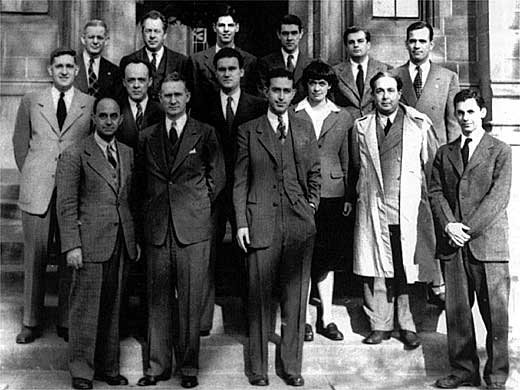
The Chicago Pile One Team
Physicist, Molecular Spectroscopist Leona Woods MarshallLibby (1919-1986)  Leona Woods grew up on a farm and was known for her inexhaustible energy. She attained her B.S. in chemistry from the University of Chicago when she was only 19 years old, and earned her PhD 5 years later. She worked as the only woman and youngest member of the Chicago Metallurgical Laboratory, a secret war group led by Enrico Fermi who built the world’s first nuclear fission reactor during her graduate work. Dr. Woods’ expertise was essential to the undertaking. She married another member of her team. She hid her first pregnancy until 2 days before her son’s birth. She took one week off before returning to work. Childcare was provided by her mother and sometimes Fermi’s bodyguard, John Baudino. Dr. Marshall was encouraged by Fermi as a female physicist. In the late 1950s, Dr. Marshall was divorced from her husband, pursuing her own career. In the early 1960s, Dr. Marshall moved to Colorado to work and married Willard Libby. Her mind was always considering any number of problems from many angles. She worked up until her death and was honored posthumously for her work, along with Lise Meitner, Marie Curie, and Irene Joliot-Curie.
Chien-Shiung Wu
Chien-Shiung Wu (1912-1997) was a foremost experimental physicist of modern era. She was encouraged as a girl to pursue her schooling as far as possible. This led her to teaching training, which lacked science so she taught herself physics, chemistry, and mathematics. She graduated high school with the highest grades in her class, earning her a place at the National Central University in Nanjing. She taught and did research upon graduation, then moved to the United States to pursue graduate studies. She earned her Ph.D. from the University of California – Berkeley in 1940, four years after leaving China. She was known for her expertise in nuclear fission and was consulted by top scientists. Despite this, her gender and nationality hindered her finding appropriate employment due to discrimination on both accounts. She married and started a teaching career, although she missed research. Upon the recommendation of Ernest Lawrence, she received offers from several Ivy League schools who were not accepting female students at the time. She became Princeton’s first woman instructor at that time. She was offered several positions, including back in China, but chose to remain in the U.S. to raise her son. She was unable to return to China until 1973. She worked at Columbia for many decades and earned accolades for her work.

Xide Xie (1921-2000) is a woman in China who needs no introduction. Her early life involved much moving due to war and ill health, during which she taught herself English, calculus, and physics. She graduated in 1942 with a degree from Xiamen University. She moved to the United States to receive her master’s degree from Smith College in 1949 and her Ph.D. in physics from M.I.T. in 1951. She married in England and returned to China, despite the political climate. She taught and did research at the prestigious Fudan University. During the Cultural Revolution of 1966-76, she was detained, publicly humiliated, and endured breast cancer. After this upheaval, she returned to Fudan University, growing the physics department and achieving more esteemed positions in the University and government. She had also remained connected to her family, caring for her husband through lengthy illness. Her achievements were internationally recognized.

Awards Mentioned

Benedettini Academics were a select group of scholars from the Academy of Sciences created and named for Pope Benedict XIV to conduct research and present it annually at Academy meetings. This appointment escalated the prestige of the scientist above that given by being a member of the Academy of Sciences.

American Association for University Women (AAUW): Margaret Maltby received the European Fellowship from the Association of Collegiate Alumnae, which became the AAUW. This fellowship was specifically intended to help American women pursue graduate studies to circumvent rules that did not allow women to enroll in coeducational universities or earn graduate degrees.

The Nobel Prize is an international award given in several fields. It is one of the most prestigious awards for scientists in the eyes of the public.

The Garvan Medal is an award from the American Chemical Society to recognize distinguished service to chemistry by women chemists.
The Photographic Society of AmericaProgress Medal recognized a person who has made an outstanding contribution to the progress of photography or an allied subject.
Annie Jump Cannon Prize is given to a North American female astronomer in the early stages of her career for her distinguished contribution to the field.
Department of Commerce Silver Medal, Gold Medal are the highest honors granted by the department for distinguished and exceptional performance.


Much of the information for this post came from the book Notable Women in the Physical Sciences: A Biographical Dictionary edited by Benjamin F. Shearer and Barbara S. Shearer.
Images for this post came from Wikimedia Commons.

Adrienne M Roehrich, Double X Science Chemistry Editor


Modern Astronomers

This edition of the Notable Women in Science series presents modern astronomers. Many of these women are currently working in fields of research or have recently retired. As before, pages could be written about each of these women, but I have limited information to a summary of their education, work, and selected achievements. Many of these blurbs have multiple links, which I encourage you to visit to read extended biographies and learn about their current research interests.

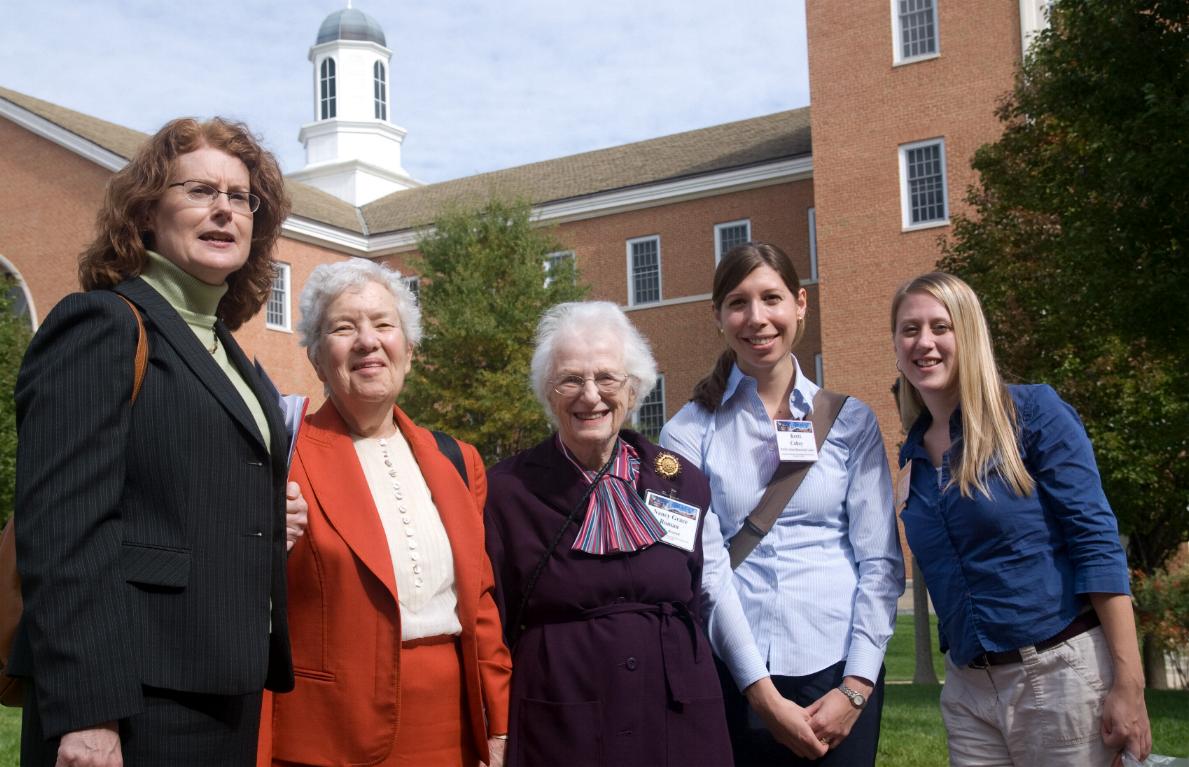
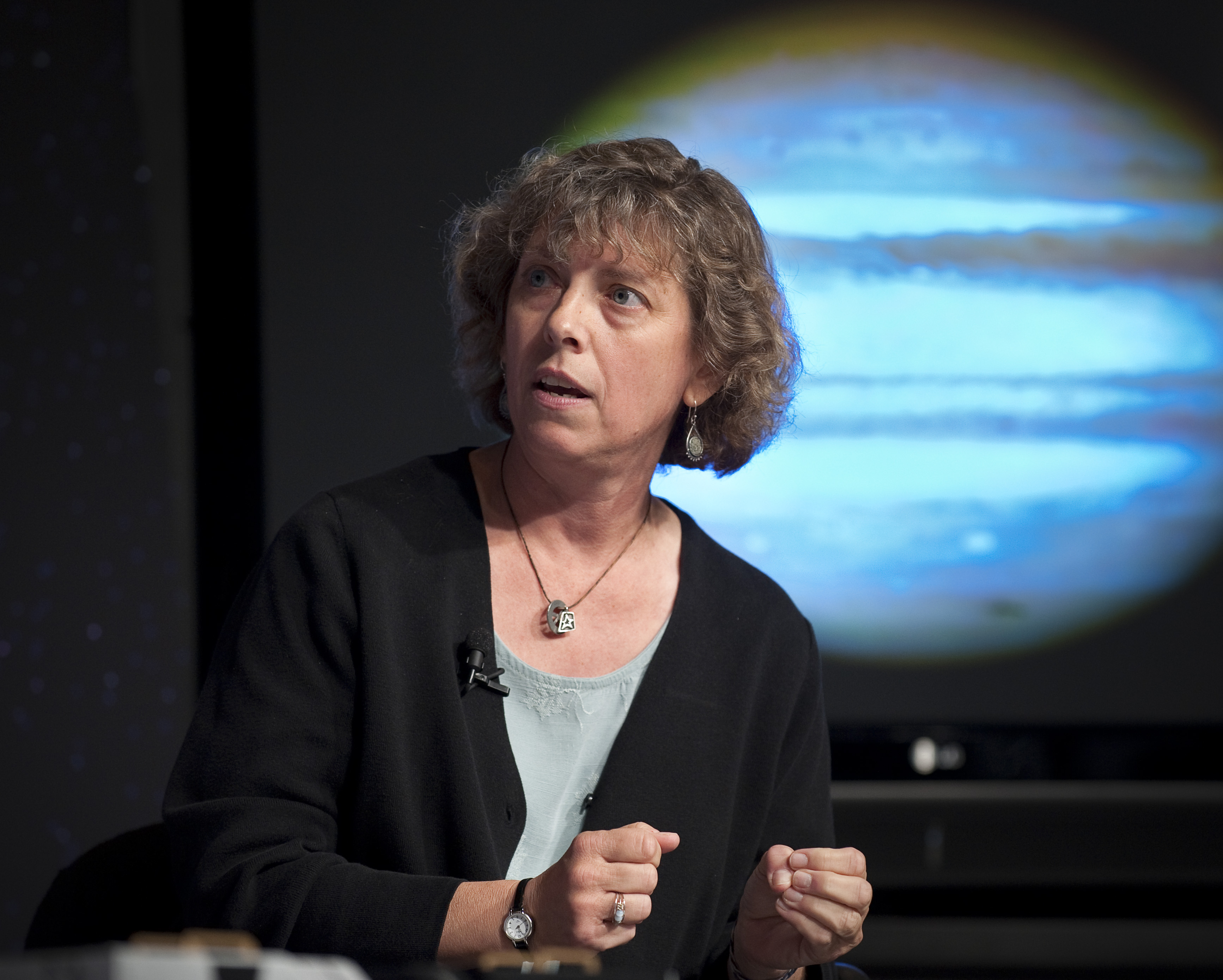
From L to R: Anne Kinney, NASA Goddard Space Flight Center, Greenbelt, Md.; Vera Rubin, Dept. of Terrestrial Magnetism, Carnegie Institute of Washington; Nancy Grace Roman Retired NASA Goddard; Kerri Cahoy, NASA Ames Research Center, Moffett Field, Calif.; Randi Ludwig. University of Texas, Austin, Texas.
Vera Cooper Rubin was making advancements decades ahead of popularity of her research topic. She received her B.A. from Vassar College, M.A. from Cornell University, and her Ph.D. from Georgetown University in the 1940s and 50s. She continued at Georgetown University as a research astronomer then assistant professor, and then moved to the Carnegie Institution. Among her honors is her election to the National Academy of Sciences and receiving the National Medal of Science, Gold Medal of the Royal Astronomical Society.  She was only the second female recipient of this medal, the first being  Caroline Herschel. She has had an asteroid and the Rubin-Ford effect named after her. She is currently enjoying her retirement.

Dr. Nancy Roman
Nancy Grace Roman has a lifetime love for astronomy. She received her B.A. from Swarthmore College and Ph.D. from the University of Chicago in the 1940s. She started her career as a research associate and instructor at Yerkes Observatory, but moved on due to a low likelihood of tenure because of her gender. She eventually moved through chief and scientist positions to Head of the Astronomical Data Center at NASA. She was the first female to hold an executive position at NASA. She has received honorary D.Sc. from several colleges and has received several awards, including the American Astronautical Society’s William Randolf Lovelace II Award and the Women in Aerospace’s LIfetime Achievement Award. She is currently continuing to inspire young girls to dream big by consulting and lecturing by invitation at venues across the U.S.

Catharine (Katy) D. Garmany researches the hottest stars. Dr. Garmany earned her B.S. from Indiana University and her M.A. and Ph.D. from the University of Virginia in the 1960s and 70s. She continued with research and teaching at several academic institutions. She has served as past president of the Astronomical Society of the Pacific and received the Annie Jump Cannon Award. She is currently associated with the National Optical Astronomy Observatory with several projects.

Dr. Elizabeth Roemer
Elizabeth Roemer is a premier recoverer of “lost” comets. She received her B.A. and Ph.D. from University of California – Berkeley in the 1950s. She spent some time as a researcher at U.S. Observatories before going to the University of Arizona and moving through the professorial ranks. She has received several awards, including Mademoiselle Merit Award, one of only four recipients of the Benjamin Apthorp Gould Prize from the National Academy of Sciences, and a NASA Special Award. She is currently Professor Emerita at the University of Arizona with research interests in comets and minor planets (“asteroids”), including positions (astrometry), motions, and physical characteristics, especially of those objects that approach the Earth’s orbit.

Margaret Joan Geller is a widely respected cosmologist.  She received her A.B. from the University of California-Berkeley, and M.A. and Ph.D. from Princeton University in the 1970s. She moved through the professorial ranks at Harvard University and is currently an astrophysicist at the Smithsonian Astrophysical Observatory. Some of her awards include the MacArthur “Genius” Award and the James Craig Watson Award from the National Academy of Sciences. She continues to provide public education in science through written, audio, and video media.

In 1995, the majestic spiral galaxy NGC 4414 was imaged by the Hubble Space Telescope as part of the HST Key Project on the Extragalactic Distance Scale. An international team of astronomers, led by Dr. Wendy Freedman of the Observatories of the Carnegie Institution of Washington, observed this galaxy on 13 different occasions over the course of two months.


Wendy Laurel Freedman is concerned with the fundamental question”How old is the universe?”    She received her B.S., M.S., and Ph.D. from the University of Toronto in the 1970s and 80s. After earning her Ph.D. she joined Observatories of the Carnegie Institution in Pasadena, California as a postdoctoral fellow and became faculty a few years later, as the first woman to join the Observatory’s permanent scientific staff. She has received several awards and honors, among them the Gruber Cosmology Prize. Her current work is focusing on the Giant Magellan Telescope and the questions it will answer.

Sandra Moore Faber researches the origin of the universe.  Dr. Faber earned her B.A. from Swarthmore College and her Ph.D. from Harvard University in the 1960s and 70s. She joined the Lick Observatory at the University of California – Santa Cruz and moved through the Astronomer and Professorial rankings. Her achievements include being elected to the National Academy of Sciences, the Heineman Prize, a NASA Group Achievement Award, Harvard Centennial Medal, and the Bower Award. She continues to research the formation and evolution of galaxies and the evolution ofstructure in the universe.


Dr. Heidi Hammel

Heidi Hammel is known as an excellent science communicator, researcher, andleader. She earned her B.S. from Massachusetts Institute of Technology and Ph.D. from the University of Hawaii in the 1980s. At NASA she led the imaging team of the Voyager 2’s encounter with Neptune and became known for her science communication for it. She returned to MIT as a scientist for nearly a decade. Among her honors, she has received Vladimir Karpetoff Award , Klumpke-Roberts Award, and the Carl Sagan Medal. She is currently at the Space Science Institute with a research focused on ground- and space-based studies of Uranus and Neptune.


Judith Sharn Young was inspired by black holes. She earned her B.A. from Harvard University and her M.S. and Ph.D. from the University of Minnesota in the 1970s. She began her academic career at the University of Massachusetts – Amherst, proceeding through the professorial ranks. She has earned several honors, including the Annie Jump Cannon Prize, the Maria Goeppert-Mayer Award, and a Sloan Research Fellowship. She is currently teaching and researching galaxies and imaging at the University of Massachusetts.


Jocelyn Bell Burnell is the discoverer of pulsars. She earned her B.Sc. from the University of Glasgow and her Ph.D. from Cambridge University in the 1960s. After her graduation, she worked at the University of Southampton in research and teaching, and continued to work in research positions at several institutions. She is well known for her discovery of pulsars, which earned her research advisor a Nobel Prize. Among her awards are the Albert A. Michelson Prize, Beatrice Tinsley Prize, Herschel Medal, Magellanic Premium, and Grote Reber Metal. She has received honorary doctorates from Williams College, Harvard University, and the University of Durham. She is currently Professor of Physics and Department Chair at the Open University, England.


Awards Mentioned:
The National Academy of Sciences is composed of select scientists who are leaders in their fields.
The National Medal of Science is a presidential award given to physical, biological, mathematical, or engineering scientists who have contributed outstanding knowledge to their field.
The Gold Medal of the Royal Astronomical Society is the society’s highest honor given in astronomy
American Astronautical Society’s William Randolf Lovelace II Award recognizes outstanding contributions to space science.
The Women in Aerospace’s Lifetime Achievement Award is given for contributions to aerospace science over a career spanning 25 years.
The Annie Jump Cannon Award is given for outstanding research a doctoral student in astronomy with promise of future excellence.
The Mademoiselle Merit Award was presented annually to young women showing the promise of great achievement.
The Benjamin Apthorp Gould Prize is given in recognition of scientific accomplishments by an American citizen.
The NASA Special Award is given for exceptional work.
The MacArthur “Genius” Award is given to those who show exception merit and promise in creative work.
The James Craig Watson Award is given for contributions in astronomy.
The Gruber Cosmology Prize is given for fundamental advances in our understanding by a scientists.
The Heineman Prize is given for outstanding work in the field of astrophysics.
The NASA Group Achievement Award is given for accomplishment that advances NASA mission.
The Harvard Centennial Medal is given to graduates of Harvard who have contributed to society upon graduation.
The Bower Award is given for achievement in science.
The Vladimir Karapetoff Award is given for outstanding technical achievement.
The Klumpke-Roberts Award is given for enhancing public understanding and appreciation of astronomy.
The Carl Sagan Medal is awarded for outstanding communication to the public about planetary science.
The Maria Goeppert-Mayer Award is given to a female physicist for outstanding achievement in her early career.
The Albert A. Michelson Prize is given for technical and professional achievement.
The Beatrice Tinsley Prize is given for outstanding research contribution to astronomy or astrophysics.
The Herschel Medal is given for investigations of outstanding merit in astrophysics.
The Magellanic Premium Medal is awarded for a discovery or invention advancing navigation or astronomy.


Much of the information for this post came from the book Notable Women in the Physical Sciences: A Biographical Dictionary edited by Benjamin F. Shearer and Barbara S. Shearer.

Adrienne M Roehrich, Double X Science Chemistry Editor

Historical Chemists


The twitter feed from @DoubleXSci since early December has featured Notable Historical and Modern Women in Science. Nearly 100 women were presented. Those women will be presented in a series here on the blog with the original tweeted links and information as well as with some additional information not able to be presented in 140 characters. Each woman could have multiple pages written on her; however, I have limited each to a paragraph. I hope you look up more on these women.

The International Year of Chemistry 2011 recently wrapped up, so I’d like to share a little more about some historical women in chemistry.

Miriam the Alchemist By Michael Maier (1566-1622)
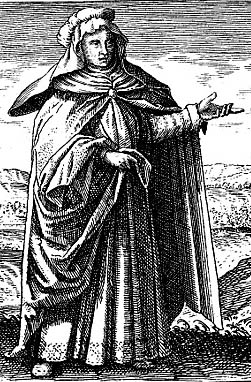
The first historical woman in chemistry is perhaps Miriam the Alchemist, who lived in the 1st or 2nd century C.E. Her writings survived centuries. She has several aliases: Mary, Maria, and Miriam the Prophetess or Jewess. Even though she was an alchemist, which was mostly a mystical field during her time, her inventions and contributions yielded long-lived practical laboratory equipment. Miriam the Alchemist contributed major inventions and improvements to existing technology, as well as the water bath. The water bath is still in use today for many chemical experiments, as was dubbed “bain-marie” in the 14th century.

Agnes Fay Morgan (1884-1968) was a pioneer in vitamin research. She earned her B.S., M.S., and Ph.D. from the University of Chicago. She also established Iota Sigma Pi, an honor society for women chemists. Morgan received the Garvan Medal and the Borden Award and was the only one of her family to attend college. Her efforts brought both nutrition and home economics to scientific disciplines. Besides her teaching position and doing research in academia, she also was an accomplished administrator and worked with the government on many occasions. She had many firsts in her research and an enormous number of publications.

Colloid Chemist Marjorie Jean Young Vold (1913-1991) was a prolific and distinguished scientist. She earned her B.S. and Ph.D. from University of California, Berkeley. Vold balanced academic and industrial chemist careers spanning over five decades. At the age of 45, she was diagnosed with multiple sclerosis but continued her dual chemistry careers despite being confined to a wheelchair. She was the LA Times Woman of the Year and received the Garvan Medal. One month before her death, Vold submitted her final paper, which was published posthumously.

Lucy Weston Pickett (1904-1997) chose a career in chemistry over marriage. She earned her B.A. and M.A. from Mt. Holyoke College and her Ph.D. from the University of Illinois and advanced through her academic career to become department chair. She received the Garvan Medal and two honorary D.Sc. degrees. She was so influential in her career that a fund was established in her name upon her retirement, which she requested be used to bring female speakers to the department.

Mary Lura Sherrill (1888-1968) was known for synthesis of antimalarial drugs. She earned her B.A. and M.A. from Randolph-Macon College and her Ph.D. from the University of Chicago. Her academic career included becoming the chair of her department. She also received the Garvan Medal.

Ellen Swallow Richards
Chemist, Ecologist, and Home Economist Ellen Swallow Richards (1842-1911) was one of Vassar College’s first graduates, with an A.B. She earned her B.S. from MIT as its first woman graduate and her M.A. from Vassar College the same year. She had many firsts, including improving the standard of living by applying chemistry to sanitation, opening up science for women, and developing the home economics movement. Richards was also the first woman member of the American Institute of Mining and Metallurgical Engineers and first woman teacher at the MIT department of sanitary chemistry. She was awarded an honorary doctorate from Smith College.

Grace Medes (1886-1967) was a pioneer in metabolism research. She earned her B.A. and M.A. from the University of Kansas and her Ph.D. from Bryn Mawr. Her academic career progressed until she became a department head and chairman. She earned the Garvan Medal and several Distinguished Service Citations. Dr. Medes was at the forefront of cancer research and named a rare disease, tyrosinosis [PDF].

Marguerite Perey (1909-1975) was the first woman to enter the French Academy of Science in 300 years. She earned her Diplôme d’État de chimiste from École d’enseignement technique féminine and her doctorate from Sorbonne. She worked with Marie Curie and discovered the element francium. Perey received the Lavoisier Prize from the Academie des Sciences and the Silver Medal from the Societe Chimique de France.

Mary Engle Pennington
Bacteriologist and Chemist Mary Engle Pennington (1872-1952) was a food preservation pioneer. Despite completing the requirements for a B.S. degree at the University of Pennsylvania, she was granted only a Certificate of Proficiency. She earned her Ph.D. from the University of Pennsylvania. Dr. Pennington worked with the government although she hid her gender to receive her credentials. Called “ice woman” due to her advances in food preservation and refrigeration, she was known for a warm personality. Pennington was awarded numerous fellowships and was a member of many other professional organizations and honoraries, and received the Notable Service Medal and the Garvan Medal.

Pauline Beery Mack (1891-1974) was an instructor and publisher and loved chemistry. She earned her B.A. from Missouri State University, M.A. from Columbia University, Ph.D. from Pennsylvania State College, and a D.Sc. from Moravian College for Women, Western College for Women. She began the publication the Chemistry Leaflet which eventually became published by the American Chemical Society. She received the Distinguished Daughters of Pennsylvania Medal, the Garvan Medal, and the Astronauts Silver Snoopy Award. Dr. Mack also maintained a busy life outside of science, including basketball and music. She taught more than 12,000 undergraduates over her 30 years at Penn State. She was adept at securing funding for her research, no small feat for a woman in the 1930s. Mack continued into an administrative career and worked full time until she was 79.

Awards Mentioned:
The Garvan Medal is an award from the American Chemical Society to recognize distinguished service to chemistry by women chemists.

The Borden Award is given in recognition of distinctive research by investigators in the United States and Canada which has emphasized the nutritive significance of milk or any of its components.

LA Times Woman of the Year began as annual awards ceremony to honor women for individual achievement and was awarded from 1950 to 1976.

Lavoisier Prize (Lavoisier Medal) is awarded by the SCF to an individual or institution to distinguish the work or activities involving the chemistry honor.

Distinguished Daughters of Pennsylvania are those whose achievements on a national and statewide scale have been so outstanding that they have brought honor and respect to the commonwealth.

Astronauts Silver Snoopy Award candidates will have made contributions toward enhancing the probability of mission success, or made improvements in design, administrative/technical/production techniques, business systems, flight and/or systems safety or identification and correction or preventive action for errors.

Much of the information for this post came from the book Notable Women in the Physical Sciences: A Biographical Dictionary edited by Benjamin F. Shearer and Barbara S. Shearer.

Adrienne M Roehrich, Double X Science Chemistry Editor


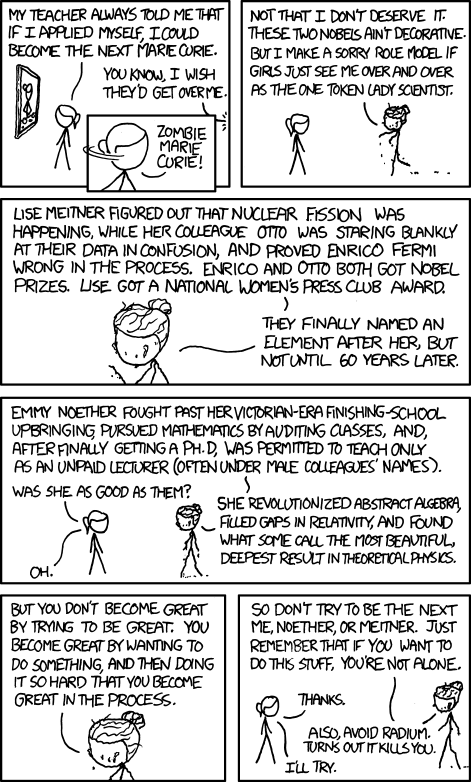
There will never be another Curie…and that’s a good thing

For your serious Sunday consideration, from Double X Science physics editor, Matthew Francis.


The above courtesy of xkcd, a webcomic of romance,
sarcasm, math, and language.

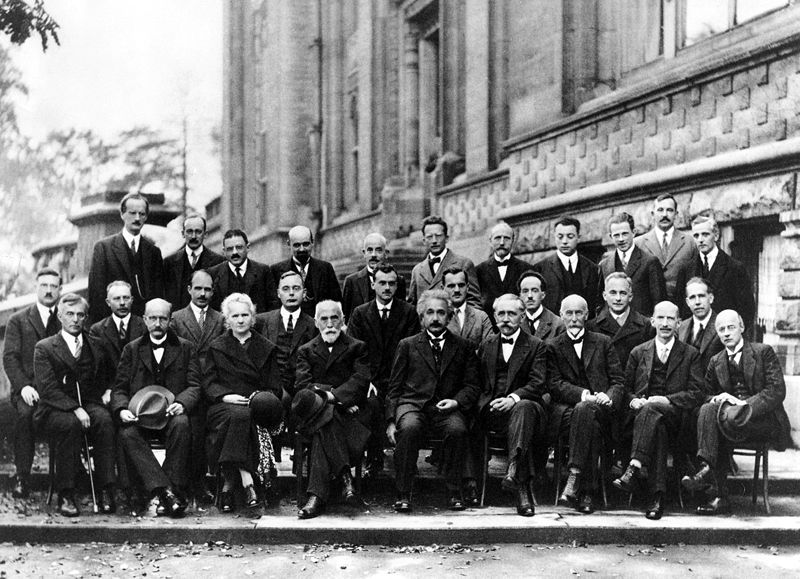
If you had to name the top scientists of the 20th century, any reasonable list must include Polish-French scientist Marie Sklodowska Curie. She won the Nobel Prize twice, a feat only matched by three others: once in physics (in 1903) for her work in radioactivity, a term she coined; and once in chemistry (in 1911) for her discovery of the two chemical elements radium and polonium. Her first prize was shared with her husband Pierre, himself an excellent physicist. She went on hiking trips with Einstein, who complained that she was too energetic in her walking style, as he preferred to dawdle. She was also the only female participant in the great Solvay Conference of 1927, which included many of the great innovators in modern physics. The element curium (96 on the periodic table) and several research institutes are named for her.

How can you not admire Curie? Let’s face it: she kicks all of our butts.

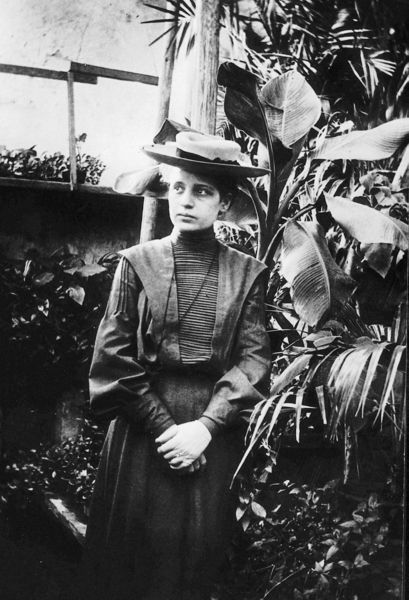
Lise Meitner. Photo in US public domain,
via Wikimedia Commons.

It’s easy to think of her as one of the Great Woman Scientists, but without a doubt she was a greater scientist than most of us can ever hope to be, male or female. At the same time, anyone thinking they aren’t great because they aren’t a Madame Curie should stop worrying. One side effect of tokenism — letting one or two representatives from non-majority groups stand in for their entire group — is that it truly sets standards far higher than are reasonable. Curie was an outstanding scientist by any Continue reading

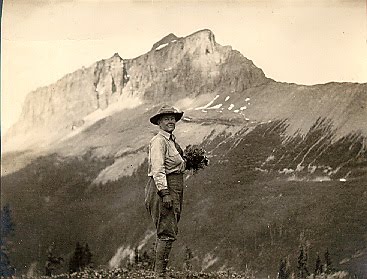
(Almost) Wordless Wednesday: Mary Vaux Walcott

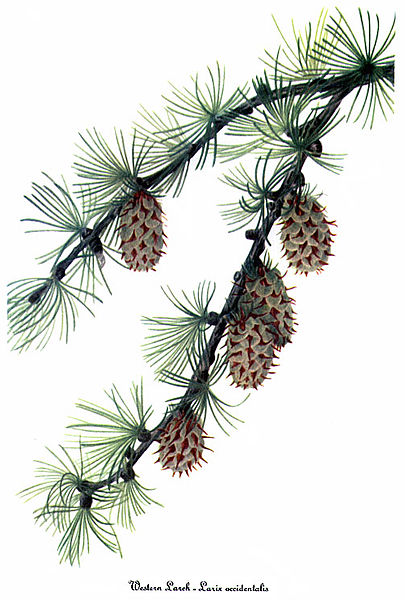
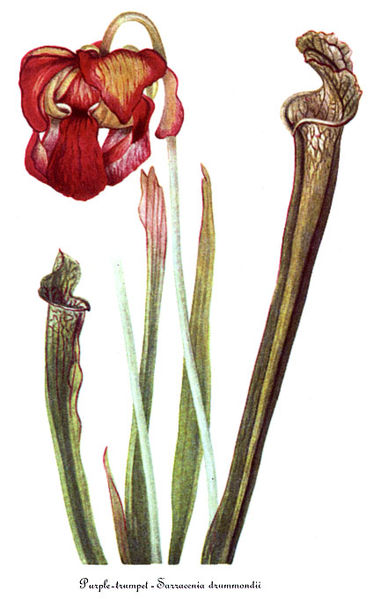
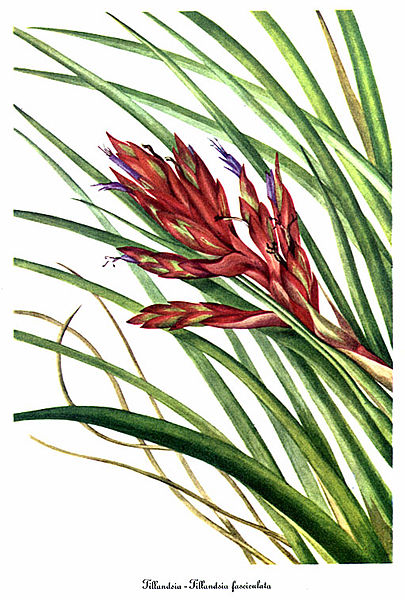
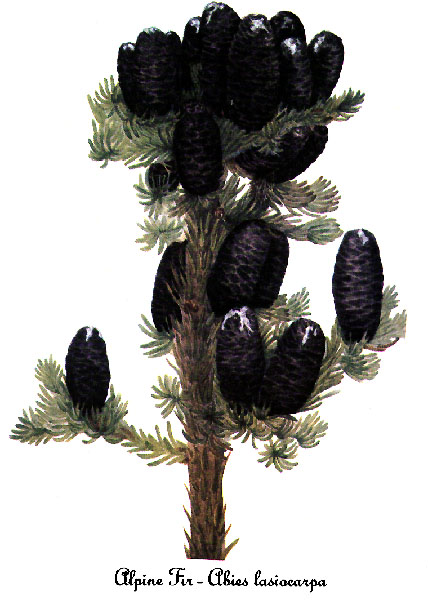
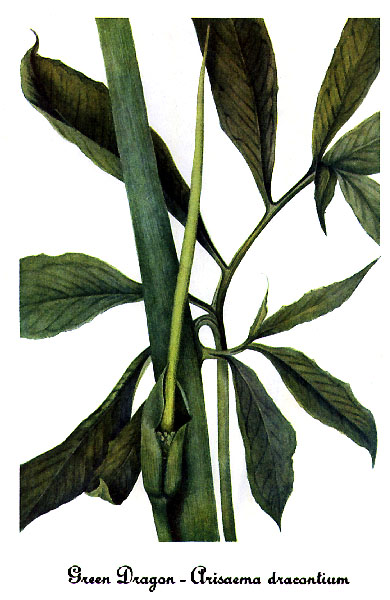
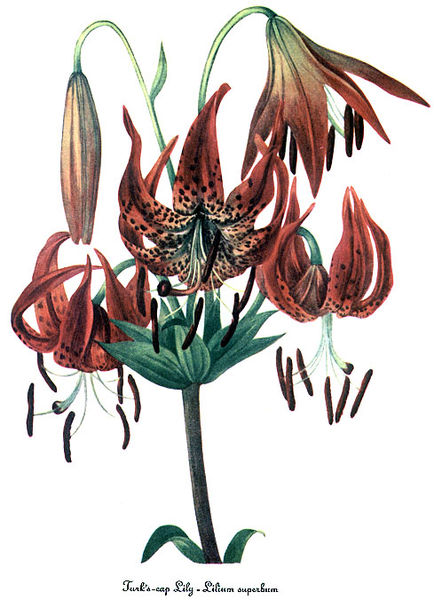
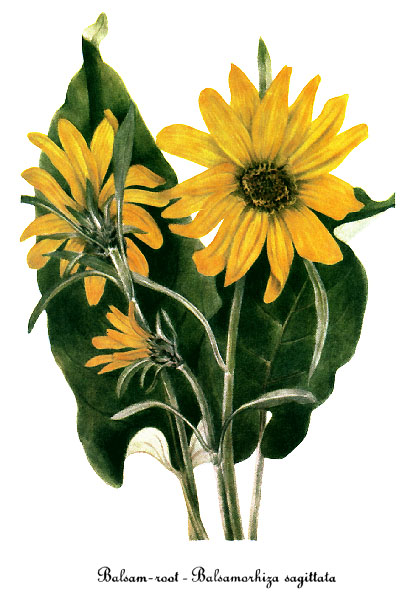
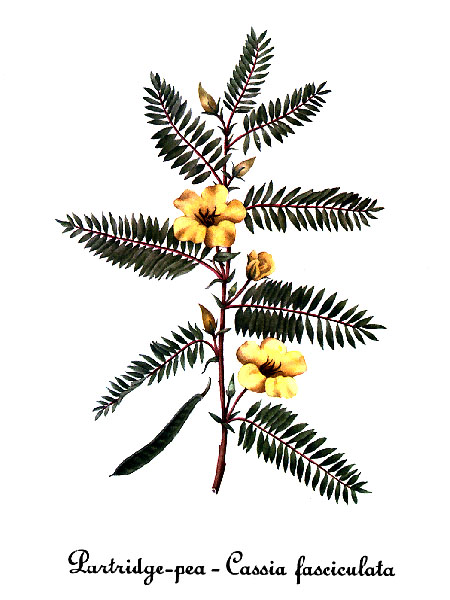
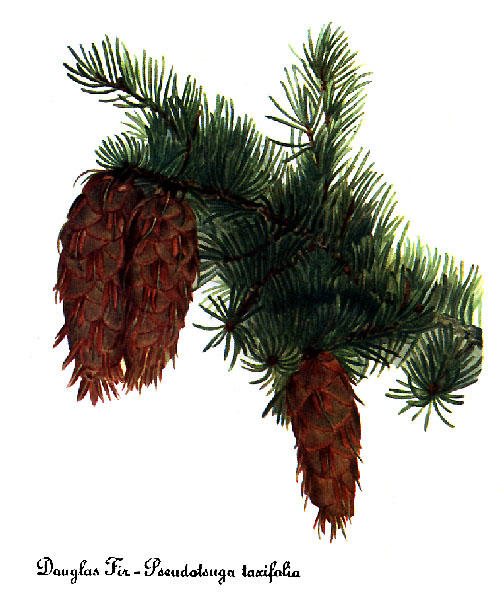
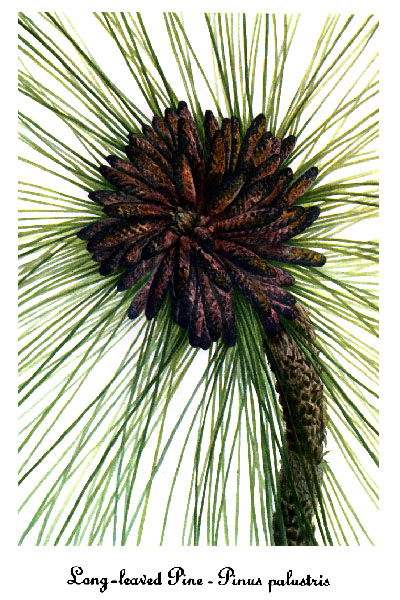
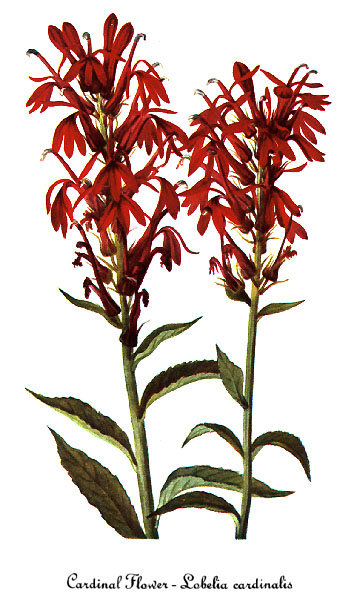
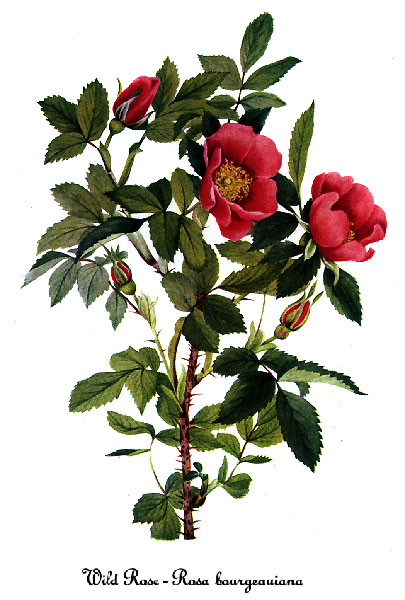
While the men who wandered the Rockies spent their time investigating the fauna, a few women took over the study of the flora. One of those women was Mary Vaux Walcott, who published a book on wildflowers that became known as the “Audubon of Botany.” Vaux has a peak named after her in Jasper National Park, an honor that explorer Mary Schaffer, her friend, bestowed upon her. Mary Vaux’s husband, Charles D. Walcott, was a geologist and Secretary of the Smithsonian Institution. Mary Vaux accompanied him on his expeditions, making sketches along the way of flowers, works that she colored in with watercolors when she returned home. While she also gained expertise in glaciers and recognition for her photography, her most lasting legacy is her collection of paintings of the trees and flowers she cataloged. Below, a visual bouquet of those flowers for today’s (almost) Wordless Wednesday.


Mary Vaux Walcott
1860-1940


Wordless Wednesday: Marie Curie, scientist, sister, and mother


Today’s Wordless(ish) Wednesday

Marie Curie, November 7, 1867-July 4, 1934

“We must believe that we are gifted for something.”

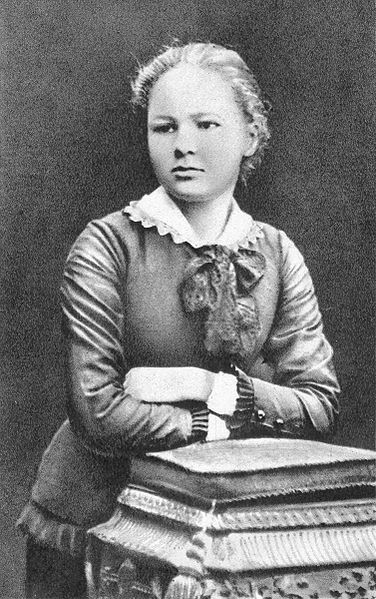
The future scientist and mother as a girl of 16.

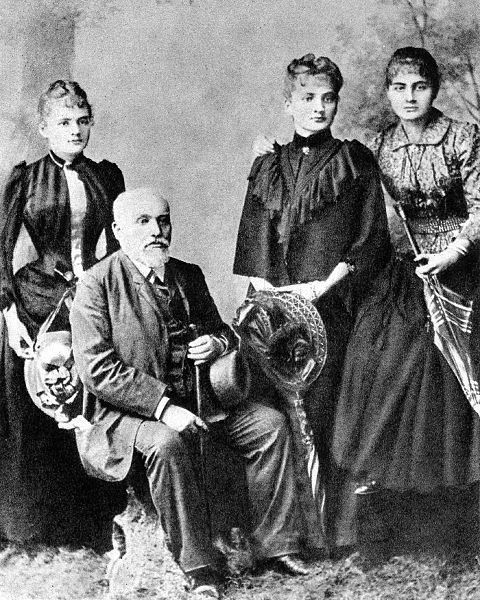
Marie (far left) with her sisters and father. How did they breathe in those corsets? We don’t know.

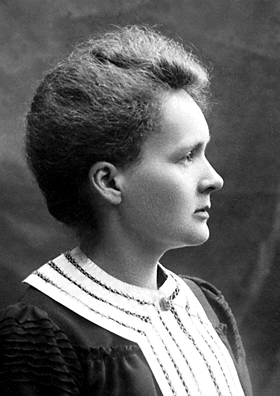
Marie in 1903, the year she won the Nobel prize in physics. She turned 36 that year.

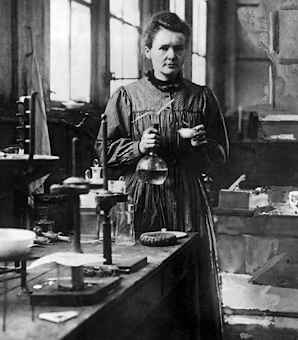
The scientist in her lab.

Marie in 1911, the year she won the Nobel in chemistry and turned 42.


The only woman.

The anniversary of Marie Curie’s birthday was this week. In celebration, yesterday, we posted a link to a BrainPop video about her and how her story inspired a young boy, and tomorrow, we’ll have more about Marie Curie and other women scientists as inspiration. Marie Curie’s daughter, Irene Joliot-Curie, also was awarded a Nobel prize, in chemistry.

Some more links to information about Marie Curie, scientist and mother:
An original 1911 paper from Scientific American about Marie and her scientific accomplishments
A review of a biography about the great scientist
Finally: What does Alan Alda have to do with Marie Curie? Find out here.


Photo credits: All photos except the one of Marie in her lab are from Wikimedia Commons. The photo of Marie in her lab is via the SchoolworkHelper site of the St. Rosemary Educational Institution.