
It could be Andrew Wakefield or a brain-hijacking microbe.
by Meredith Swett Walker
I’m a scientist, but I’ve learned that when we become parents, paranoia can trump the powers of rational analysis I’ve so carefully nurtured and developed. For some parents, media-whipped fears about vaccines take front and center in the anxiety lineup. For me, a brain-infecting microbe that makes mice hang around cats is at the top of my parenting paranoia list.
Parenting requires making many, many choices. Some seem inconsequential, like whether your child will wear overalls or sweatpants, pigtails or a pixie cut. But other choices have to do with health issues such as circumcision, immunization, and breast milk vs. formula – just a few in an endless list. For geeks like me, the first impulse is to research each issue, make a choice, and prepare an argument for anyone who questions the decision (and believe me, someone will.) My response usually goes something like this: “Well, recent studies have shown that yada yada yada…” Then I pat myself on the back for being so informed and making such a well-reasoned decision.
My process ran into trouble, though, when my relationship with a university and its online library access ended. What happens when you can’t get your hands on peer-reviewed scientific journal articles? One consolation should be that we live in the “Information Age.” Surely, Google, a fast internet connection, and an overwhelming flood of information should lead to what we need to make well-reasoned, science-based parenting choices. Surely.
Maybe not. A friend recently shared with me an article from the open-access (i.e., free) online journal PLoS: “Why Most Biomedical Findings Echoed by Newspapers Turn Out to be False: The Case of Attention Deficit Hyperactivity Disorder.” The gist is that the news media preferentially cover initial findings described in the most prominent scientific journals. The key word there is initial. No initial result is going to be the final word in science, and all results require confirmation from other researchers repeating or extending the experiments. Sadly, in practice, many of the follow-up studies don’t get published in the most prominent journals because they are not “a big scoop.” Yet they often show that the initial, Big Headline Finding was overblown or even incorrect.
That brings me to an example that really pushes my buttons — childhood immunizations. In 1998, Andrew Wakefield and colleagues published a study in the prominent British medical journal the Lancet. The paper examined a hypothesized association between the MMR (measles, mumps, rubella) vaccine and autism, but the authors used fairly moderate language in their conclusions. But then, Wakefield participated in a press conference about the paper and asserted in much stronger language that the MMR combined vaccine and autism were linked and that parents should turn to single shots for measles, mumps, and rubella. The news media ate it up.
The scientific community immediately pointed out a number of glaring flaws in the study, and subsequent investigations over the next decade failed to reproduce or confirm the results. But it was too late. The popular media and celebrities like Jenny McCarthy had already done the damage. Parents were terrified, vaccination rates dropped, and deadly measles and whooping cough outbreaks starting cropping up.
Yes, the news media covered subsequent studies reporting no link between vaccines and autism, but let’s face it: Science is slow, and news is fast. In the interval, scary information takes root. The Lancet retracted the article 12 years after its publication, and in 2011, British investigative journalist Brian Deer demonstrated that Wakefield actively falsified data. Still, to this day, vaccination rates have not fully recovered, and many parents remain misinformed and concerned about vaccinating their children. Indeed, the Wakefield debacle has been directly blamed for a huge and ongoing measles outbreak in Wales.
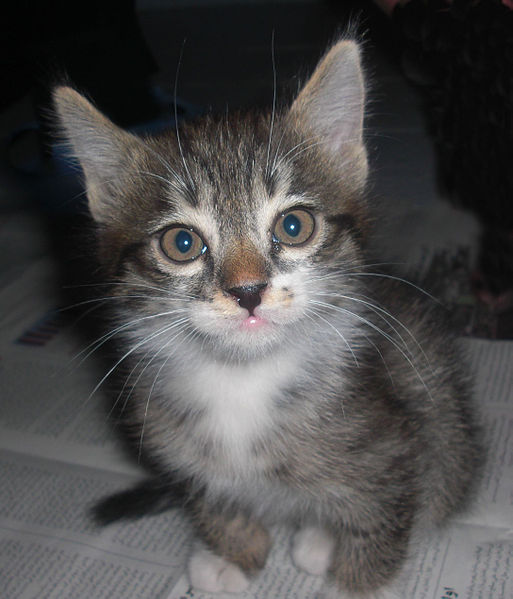
I could haz Toxoplasmodium in my poop, so be careful.
Admittedly, the MMR case is an extreme example but also a good one of how a single initial study and the ensuing media hysteria can have a huge effect on parents — and on children’s health.
And we all have our trigger points for fear. One (of the many) things in our family tree is schizophrenia. A member of our extended family developed schizophrenia as an adolescent and has never recovered. Schizophrenia can run in families, so my two children have up to a 4% chance of developing this disorder compared to the 1.1% chance of someone without close relatives who have it.
So along comes my March 2012 issue of The Atlantic featuring “How Your Cat Is Making You Crazy” by Kathleen MacAuliffe. I would have found this article fascinating even if schizophrenia weren’t a concern. Its subject is a parasite called Toxoplasmosis gondii, which usually cycles through two hosts: cats and rodents. Toxo, as I’ll call this beast, starts life as an egg in a cat, is pooped out, and then gets picked up by a new cat. How does it get into a new cat? Cats, unlike dogs, are pretty fastidious and don’t tend to eat or otherwise mess around with cat poop. So Toxo gets itself into a less fastidious but tasty morsel like a mouse, instead, making its way into the cat when the mouse becomes dinner.
That seems simple enough, but there’s more. Toxo infection ups the odds of a mouse–cat encounter by hijacking the mouse’s brain and changing its behavior. The mouse’s activity level increases (cats love to chase fast-moving objects), and the rodent might become less wary in exposed areas and even attracted to the smell of cats. Watch these videos, and you’ll see how the infected mice move faster and wander into unknown spaces, seemingly without fear, as you can see in this video and this one.
The trouble for humans is that we also can pick up Toxo through contact with cat poop or eating undercooked meat or unwashed veggies from a garden where cats poop. Becoming infected with Toxo during pregnancy can be very harmful to a fetus, so pregnant women have long been warned off cleaning kitty litter boxes. But healthy, non-pregnant adults infected with Toxo weren’t thought to experience any detrimental effects — until recently. According to MacAuliffe’s article, which focuses on the work of Czech biologist Jaroslav Flegr, Toxo might alter human behavior, too, in mouse-like ways, such as reducing fearfulness. In most people, these purported behavioral shifts are probably very subtle and unremarkable. But Flegr suggests that in some people, Toxo infection serves as the trigger for mental illness, including schizophrenia.
Schizophrenia likely develops because of interactions between genes and the environment. Having risk gene variants isn’t a guarantee a person will develop schizophrenia, and it can arise in people without those risk variants. The list of potential environmental triggers is long and includes childhood stress, prenatal undernutrition, drug abuse, and … infections with microbes like Toxo.
Reading this article set me off on a tear of worrying. We have a cat, but I wasn’t worried about her. She is an indoor cat (we love birds), and there is a very low incidence of Toxo infections in indoor cats. But we have outdoor cats and feral cats in our neighborhood. They sometimes hang out in our yard, where my kids like to play in the dirt and eat things out of the garden, including the dirt itself. Oh, poop.
I took to Google and researched cat traps and repellents and how to get kids to wash their hands. I laid awake at night for hours strategizing about how to keep my home and yard Toxo free. And then I realized, even if I managed to exclude all cats from my yard and the totally impossible feat of getting my children (ages 1 and 2) to wash their hands before they touched their faces or food every time, I was still doomed to failure. My kids would go to friend’s houses and play in their Toxo-infested yards. Or they might already have encountered Toxo anyway.
Toxo was something I couldn’t control, and I needed to let it go. At our next check-up, I talked to our pediatrician about it, who had never heard about the potential Toxo–schizophrenia link. She graciously concealed her “Oh, Lord, another parent with a loony theory” reaction and calmed me down. As she put it, my only real option to prevent Toxo infection was to never allow my children to play outdoors or in the dirt, and the detrimental effects of that were likely far greater than the risk of schizophrenia, Toxo or no Toxo.
And she also reminded me of what I already knew and should have remembered: These findings about Toxo are initial findings.
As a scientist, I know that the schizophrenia–Toxo link needs more study. A lot more study. As a parent, well … yeah. I still worry, and no lack of replication or confirmation is likely to stop me.
[Image credits: cat on this page by Sasan Geranmehr under Creative Commons 3.o license; mouse under same license.]
Pingback: Parenting Paranoia | Pica hudsonia