
What not to assume about “race” and parenting.
by Rebecca Schwarzlose
I get tired of strangers stopping to ask me where I got my daughter. She’s cute, they say. Adopted, I assume? Or, is she from Guatemala? My neighbor got a baby from there that looks just like her. The head teacher at my daughter’s day care decided not to comment when we first visited the facility, but she recalls wondering: Where did that white woman get that brown baby from?
Tempted as I may be, I never give the snarky reply that my daughter came from my uterus. I explain that her father is from India. Her black hair and caramel skin just happen to resemble his (in sharp contrast to my own light hair and seriously pale complexion). At times, people have reacted with disbelief. Not adopted? But she’s so much darker than you! At moments like these, I try to think of myself as a representative of the modern American family, an institution that increasingly straddles racial and cultural divides. And one thing I have learned in the course of my grocery-store diplomacy is that we all fancy ourselves geneticists — when in fact we are anything but.
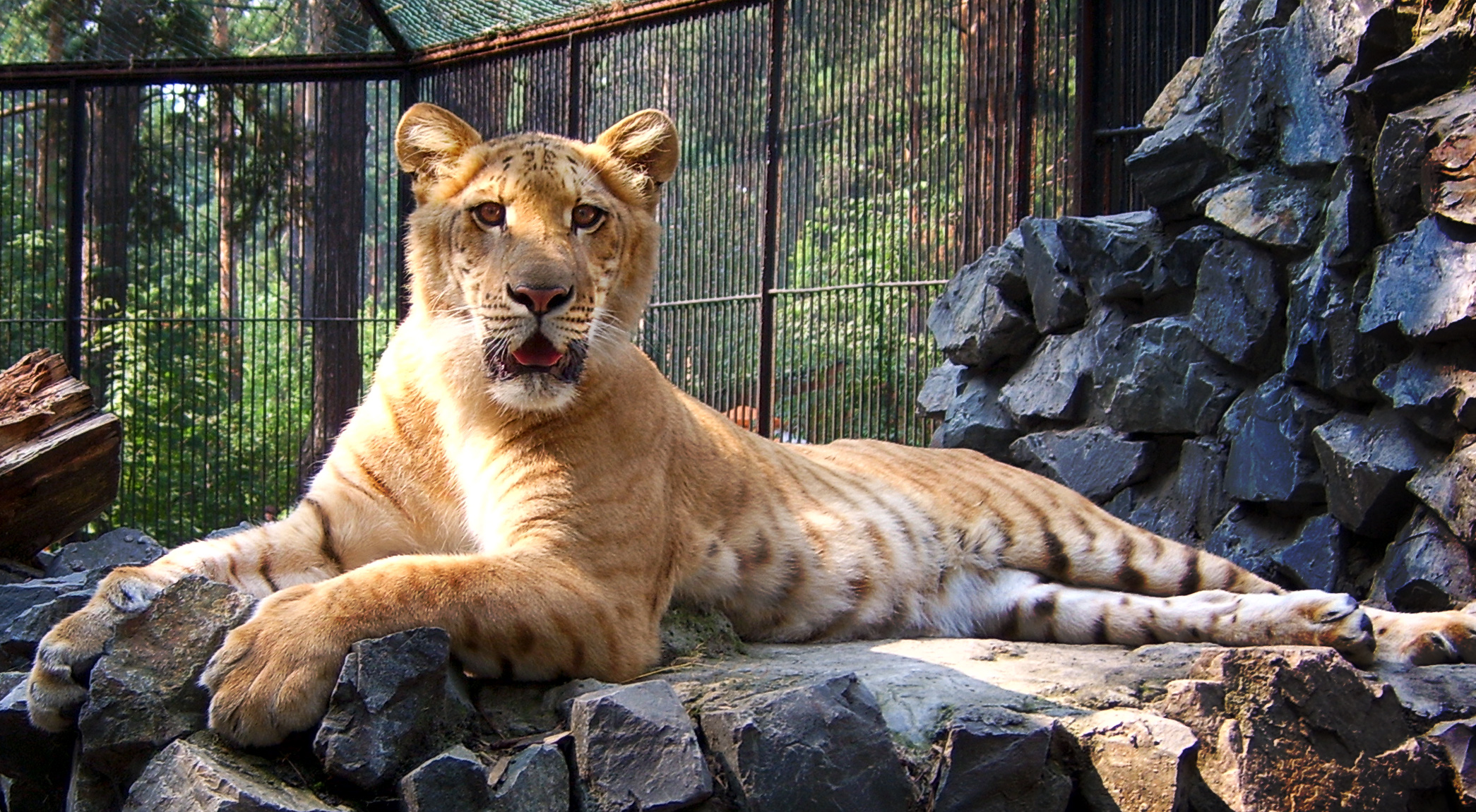
A liger.
Armchair genetics is nothing new in America. It is older than the nation itself. Colonial politicians, mostly businessmen and landowners, tasked themselves with the job of defining and determining what some call ‘race’. In the book Tell the Court I Love my Wife, author Peter Wallenstein describes the fascinating history of our laws on biracial children and interracial marriage (called anti-miscegenation laws). The first of these laws hit the books in 1662 in Virginia’s colonial assembly, and the last was removed from the Alabama state constitution in 2000. In the intervening years, legislatures revised their definitions of race based on political expediency and the misguided genetic ideas of the day. In the 17th and early 18th centuries, many believed that what they thought of as races represented separate species. This concept is the basis for the label mulatto, which was used in Virginia law as early as 1705. The term mulatto comes from the mule, a sterile animal created when animals of two species — the horse and the donkey — mate. According to this misguided way of thinking, my daughter is a hybrid like the mule, the cama, or (perhaps more fittingly) the badass liger.
Popular theories of inheritance and speciation began to change when On the Origin of Species was published, four years before the Emancipation Proclamation. The eugenics movement that grew out of Darwin’s bold theory swept up the developed world by the early 20th century. Paradoxically, American anti-miscegenation laws became stricter after slavery ended because politicians, in all their genetic wisdom, redefined race to safeguard the “purity” of white inheritance. Virginia, which had traditionally defined people as black if they had one or more black grandparents, changed the definition in 1910 to be one or more black great-grandparents. In 1924, they switched to the one-drop rule: Any amount of African heritage, however remote, was enough to categorize a person as black.
In 1947, Sylvester Davis, a black man, and Andrea Perez, a Hispanic woman, applied for a marriage license in Los Angeles. Their request was denied. A long-standing California law banned marriages between blacks and whites — and as a Hispanic woman, Perez was counted as white. The couple sued the LA county clerk’s office, and the trial went all the way to the California Supreme Court. The attorney representing LA County at that trial defended California’s anti-miscegenation law with this pseudoscientific gem:
. . . it has been shown that the white race is superior physically and mentally to the black race, and the intermarriage of these races results in a lessening of physical vitality and mentality in their offspring.
No kidding. Los Angeles was making that argument fewer than 70 years ago. It is all the more bizarre in light of our modern understanding of inheritance, the biological meaningless of “race,” and the value of a large and diverse breeding population. But I digress. Thankfully, our state governments got out of the business of defining and protecting race in 1967 with the ruling of the U.S. Supreme Court case Loving v. Virginia. It has been illegal for states to enforce anti-miscegenation laws ever since. Each year around June 12, people commemorate the ruling and the courageous couple who made it happen by celebrating Loving Day.
While anti-miscegenation laws are now a thing of the past, the bustling field of armchair genetics lives on. The strangers who approach me about my daughter probably never penned a dissertation on population genetics. The schoolchildren who once labeled actress-to-be Rashida Jones as white and her sister Kidada as black were too young to have science credentials. And I am quite sure that Scott Brown, former Senator from Massachusetts, is no biology professor. Yet last year at a debate, he attacked his opponent, Elizabeth Warren, because she once marked on a form that she’s part Native American. “And as you can see,” he said, “she’s not.” Inheritance, it seems, is something we can all see at a glance.
Anyone who can see thinks she knows what ‘race’ is. But race is a cultural concept, not a biological or genetic one. Yes, we have divergent ancestral pasts, but these differences are miniscule and impossible to categorize at a genetic level. Yet we use race and appearance as a preeminent indicator of inheritance. In a 2009 University of Michigan phone survey [PDF] of 1,200 Americans, 75% incorrectly agreed with the statement: “Our genes tell us which race we belong to.” Fifty-seven percent also agreed that “two people from the same race will always be more genetically similar to each other than two people from different races.” Consider the example of my daughter here; people would categorize her as Indian (or certainly nonwhite) like my husband, yet she gets as much of her DNA from me as from him. And this one, the kicker, strikes particularly close to home: Nearly two-thirds of the survey participants agreed that “a mother and a daughter who look alike have more genes in common than a mother and a daughter who do not look alike.” Ouch.
The problem may be that we learn about the idea of race before we learn about genetics, and we try to fit the latter into our understanding of the former rather than the other way around. Our definitions of race largely come from early experiences and associations. They can be hard to explicitly state. In a sense, race is like good art and bad cheese: You can’t always describe it but you know it when you see it. Even if you know better, this simple way of thinking can be very hard to shake. When my daughter was a newborn, even I had trouble believing that she was mine. Despite the nine months of pregnancy, the memorable delivery, and the color of my husband’s skin, there were still times when I looked at her little brown body nestled in my white arms and wrestled with the feeling that she was my beloved adopted daughter rather than my biological child. That’s how deep these associations go.
We are entering interesting times for our society — times that will challenge our assumptions about race, appearance, and identity. Today, based on existing government classifications that still use the terminology, one in seven new US marriages is interracial. According to the 2010 Census, the number of mixed-race Americans is growing faster than any other race over the last 10 years. Whether everyone likes it or not, multiracial and multiethnic families are on the rise. The more people see our families, the more their assumptions will change. It will take visibility at events, in advertisements, and at grocery stores. It will mean questions from strangers that might seem dumb or even rude. But if enough people ask me where my daughter’s from, I’m sure we’ll get there someday.
[Rebecca Schwarzlose is a scientist and writer. She received her PhD in Neuroscience from MIT and did her postdoctoral research at UCLA. These days she splits her time among doing neuroscience research at Wayne State University, writing about science, and running after a rambunctious toddler. Find her on her blog, Garden of the Mind, or on Twitter @gothemind.]
[Liger image credit, Restle. Public domain image via Wikimedia Commons.]
Thanks for the science view, we certainly need more of this info out there. I too have a toddler with a South Asian dad and a pale redheaded mom (me), but fortunately I have never come across anyone rude enough to ask if she’s adopted, either in small towns or big cities. Sheez, what comes out of people’s mouths in this day and age. As the statistics you cite show, it’ll all be quite different in a generation. Have you seen this? I randomly saw it linked from HuffPo the other day. http://wearethe15percent.com
I hope you find a way to get past any occasional subconscious glimmers that she’s not ‘yours’ — I find mine is so comprehensively and uniquely a complete stranger anyway (her looks, her behaviors, her likes and dislikes, etc) that her skin color is the least of it. We often joke that she’s a little visiting alien who decided to stay. ?
Thanks for your comment! I’m glad people don’t ask if your daughter’s adopted. To be fair, those who ask me have always meant well. They are just curious and underinformed. You make a good point about the many ways aside from appearance that our children can take after us (or not). It’s funny because my daughter is just like me in her personality and facial expressions. My husband says she even smells just like me (weird but true). Yet these many other manifestations of inheritance are invisible to the stranger on the street. In the end, skin color trumps all.
Thank you for putting into words so eloquently with both emotion and facts something I too experianced. Your technique is logical and motivational. My best to you and your family. I think she is the cutest little girl and so expressive. My son being 12 now doesn’t understand why people have to label at all. In his own words “mom we are all just kids.” I picked him up from a park where he was playing recently and he was sitting on a bench with two friends all mixed ethnicities. All different. I said to myself this must be Utopia.
Pingback: Genetics Post on DoubleXscience « Garden of the Mind
Hi Rachel, Thanks for reading and commenting. I’m so glad the post resonated with you. Your son is wise. Hopefully more of the world will see racial labels as he does in the near future. It’s funny how kids sometimes see as obvious concepts that have become so muddled and complex for us adults. While I’m tempted to extoll the wisdom of youth, I can’t quite bring myself to do it – not while my daughter thinks stickers are food. But clearly you’ve got a smart guy on your hands.
All the best to you and your family too. Let’s hope we see much more of utopia in the coming years!
Pingback: A New America of Mutts? « Garden of the Mind
Thank you for your wonderful insights into an important story. The white race in America, of which I’m a part, has no idea what it’s like to be discriminated against. Perhaps that’s one of the reasons why they often say inappropriate things to bi-racial couples. But our time in coming. And that’s karma. Though perhaps we should hope that when we become a minority, the “mixed races” will be more generous to us and more worldly.