Matthew R Francis

About Matthew R Francis

Double X Science Physics Editor Matthew Francis is a physicist, science writer, former college professor, ex-planetarium director, occasional musician, and frequent wearer of jaunty hats. He blogs about science and science communication at Galileo’s Pendulum, and a regular contributor to Ars Technica’s science site, Nobel Intent. He has also written for Scientific American Blogs, Culture of Science, and the 365 Days of Astronomy podcast. You can’t get him to shut up when he starts talking about how complex ideas in science can be understood by anyone. The cat in the photo is Pascal, named for the physicist/mathematician/ philosopher who (appropriately enough) studied randomness.

The World Will Not End Tomorrow

The world will not end tomorrow.

The Sun will rise on the morning of December 22 and find most of humanity still living. I can say that with a great deal of confidence, though my scientist’s brain tells me I should say the world “probably” won’t end tomorrow. After all, there’s a tiny chance, a minuscule probability…but it’s so small we don’t have to worry about it, just like we don’t have to worry about being struck down by a meteorite while walking down the street. It could happen, but it almost certainly won’t.

My confidence comes from science. I know it sounds hokey, but it’s true. There’s no scientific reason—absolutely none—to think the world will end tomorrow. Yes, the world will end one day, and Earth has experienced some serious cataclysms in the past that wiped out a significant amount of life, but none of those things are going to happen tomorrow. (I’ll come back to those points in a bit.) We’re very good at science, after centuries of work, and the kinds of violent events that could seriously threaten us won’t take us by surprise.

Why the World Won’t End

So where does this stuff come from? Whose idea was it that “the end of the world will be on December 21, 2012”? The culprit, according to those who buy into the idea, is that the end of the world was predicted by the Mayas in their mythology, and codified in their calendar. However, it’s pretty safe to say that the Mayas didn’t really predict the end of the world, even though I don’t know much about the great Mayan civilization that existed on the Yucatan peninsula in what is now Mexico from antiquity until the Spanish conquest.
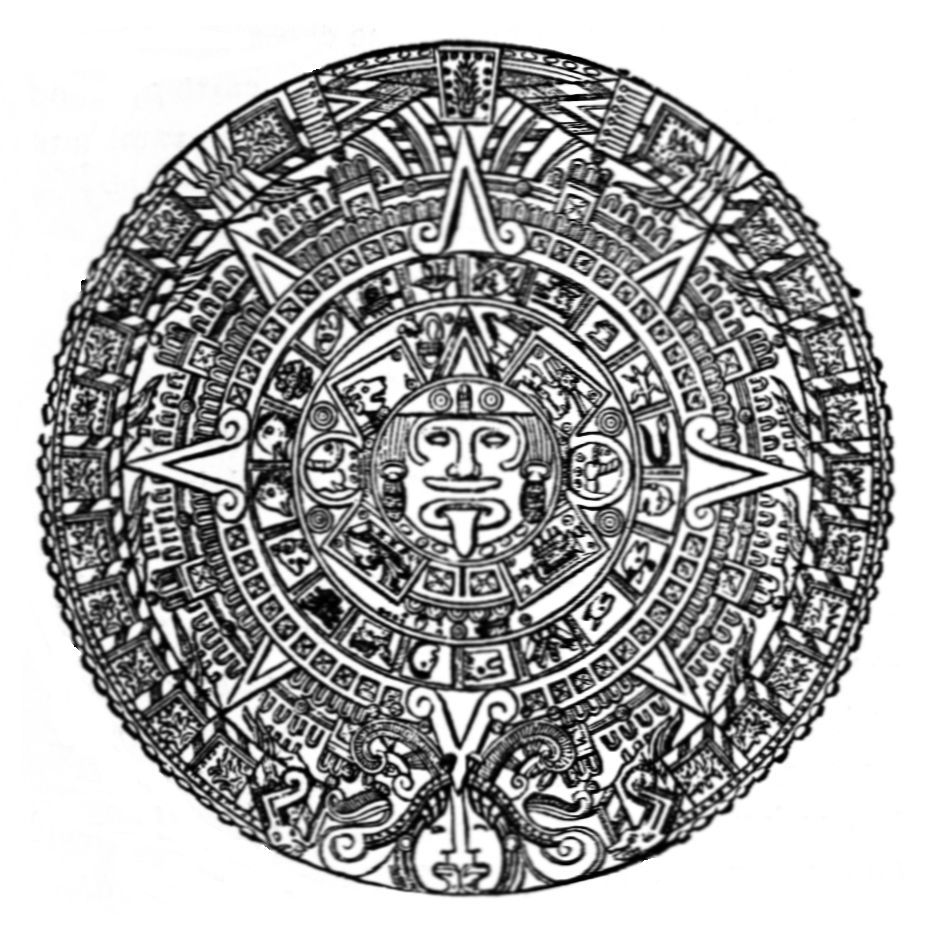
See this calendar? It’s being touted as a Mayan
calendar in articles about the “end of the world”,
but it ain’t Mayan. It’s an Aztec calendar. Please
don’t mix up civilizations.

The Mayas were the only people in the Americas known to have developed a complete written language, which is part of how we know a lot about them despite their destruction by the hand of European invaders. In particular, we know about their calendar, and the divisions they used. We use what’s called a decimal system for numbers, based on the 10 fingers of our hands. That’s why we break things up into decades (ten years) and centuries (ten decades), as well as a millennium (ten centuries). The Mayas liked different divisions of time: their b’ak’tun is approximately 394 years, and they placed a certain significance on a cycle of 13 b’ak’tuns. (I suspect the Klingon language in Star Trek borrowed some of its vocabulary from ancient Mayan.)

In the “Long Count,” one version of the Mayan calendar known to us, the present world came to be on August 11, 3114 BC. That world will end at the close of the 13th b’ak’tun from that creation day, which happens to be December 21, 2012. However, there’s good reason to think that the Mayas didn’t believe this would be the end of all things: other calendars exist that refer to an even longer span of years, stretching thousands of years into the future!

Even more importantly, though: the Mayan cosmology (their view of the universe) was cyclic, as in many other religions. This world was not the first in this cosmology, and it won’t be the last. In such a view, the true universe is eternal, and the cycles of time are a kind of divine rebooting, which don’t really end anything. The end of the 13th b’ak’tun might be a transformative event in the Maya cosmology, but it’s not the end of the world.

Frankly, I’m not sure why we should care even if the Mayas did believe this was the end of the world. As I said previously, there’s no scientific reason to think the world will end tomorrow. But maybe you might think there’s a non-scientific reason—divine intervention to wipe out the Earth, perhaps. However, I’d venture to guess that most of us don’t adhere to the Mayan religion. Their gods are not the gods most people worship. The prophesied arrival on Earth of Bolon Yookte’ K’Uh, the Nine-Footed God is not something central to my belief system, and probably not yours either.

In fact, millennial thinking is far more a Christian thing than it is a Mayan thing—or frankly most other religions. When people talk about the supposed end of the world tomorrow, they use the Christian terminology: Armageddon (referring to Megiddo, a place in northern Israel, named in the Book of Revelation as the site of the last battle) or the apocalypse (literally the “uncovering”, when all that was hidden becomes revealed). These weren’t concepts in the Mayan religion, and nothing in the Christian religion says the world will end on December 21, 2012.

The World Will End…Eventually

Some say the world will end in fire,
Some say in ice.
From what I’ve tasted of desire
I hold with those who favor fire.
–Robert Frost

Science tells us the world won’t end tomorrow. It also tells us the Mayan cosmology is wrong: time doesn’t go in cycles forever. Earth began 4.5 billion years ago, and will end in about 5 billion years more—at least as a livable world, which is what counts for us. In between its beginning and end, it is defined by cycles: the length of rotation (days) and the time to travel around the Sun (years), with its associated seasons. Other cycles are pretty arbitrary: centuries and b’ak’tuns don’t have any particular significance in terms of astronomical events.

The end of the world as we know it will happen in about 5 billion years, when the Sun ceases fusing hydrogen into helium in its core. When that happens, the Sun will grow into a red giant star, swallowing up Mercury and Venus. Earth probably won’t be devoured, but with the Sun’s surface so much closer, things will become distinctly unpleasant. It’s unlikely the atmosphere or oceans could survive, meaning the end of most life. (Some microbes could probably continue to live underground. That kind of thing is a story for another day.) However, 5 billion years is a long time from now.
Could another cataclysm overtake us before that time? Yes. As you may know, about 65 million years ago, a large asteroid smashed into Earth, an event that at least helped end the reign of dinosaurs, and ushering the extinction of many other species.

Unfortunately, we can’t rule out the possibility that could happen again. There are enough asteroids and comets in our Solar System that could eventually cross orbital paths with Earth; if a large specimen collided with us, it would be devastating.

However, we’re talking about tomorrow. No asteroid will strike Earth on December 21: astronomers keep careful track of everything near our planet, and nothing we know of is on a collision course with Earth for the near future. Asteroids and comets are really the only things we have to worry about doing serious damage for life on Earth, but you can sleep easy tonight and tomorrow night: we’re safe.
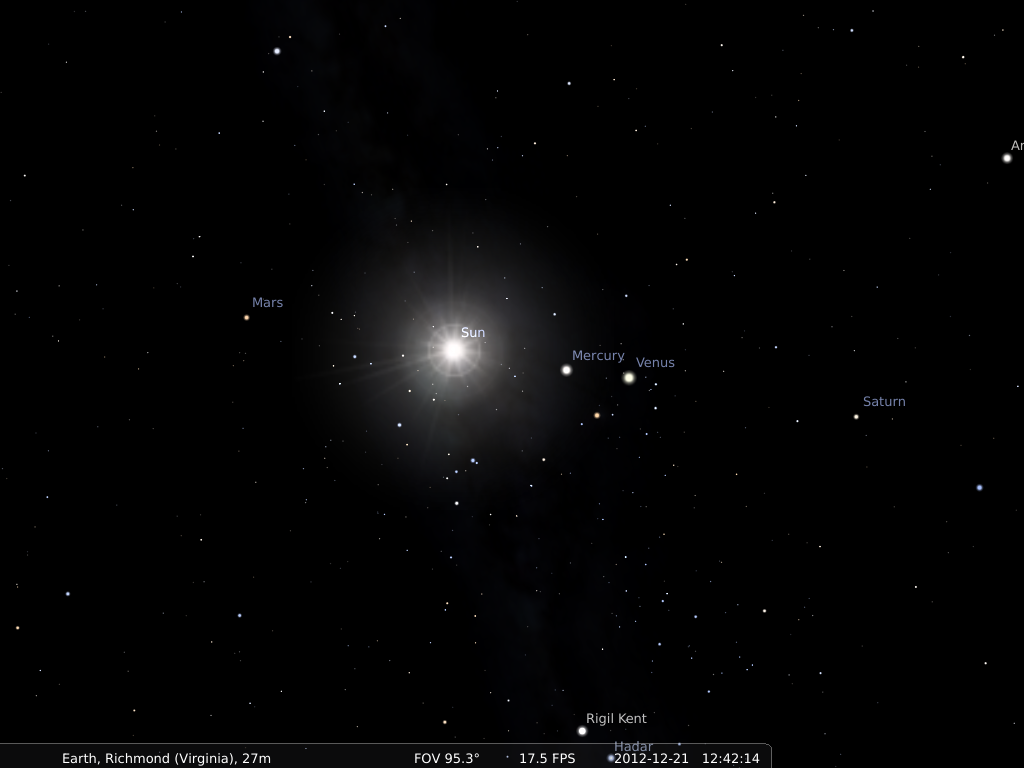
If you could somehow see the planets during
daylight hours, here’s how they would
appear tomorrow at noon. There’s no
alignment. (You can see this for yourself
using the free planetarium program
Stellarium.)

Some people have talked about fairly far-fetched ideas: alignments of planets, or lining up Earth, the Sun, and the center of the galaxy. The planets of the Solar System aren’t aligned tomorrow—the image shows where several of them are in relation to the Sun at noon. Jupiter isn’t anywhere close to the planets you see. You’d need a pretty strong imagination to say they’re lined up in any way: while they do lie along a line, that’s the way they always are, since they all orbit the Sun more or less in the same plane. Alignment with the galactic center is even more simple to dismiss: about once a year, the Sun appears aligned with the galactic center in the sky. And nothing happens.

Another explanation I’ve seen involves a mysterious planet called “Nibiru” or “Planet X,” which either will collide with Earth or otherwise generate a baleful influence. Phil Plait, the Bad Astronomer, has a lot about the Nibiru nonsense, so I won’t repeat what he says. Suffice to say Nibiru doesn’t exist: there’s no evidence for it, and (surprise!) it’s not anything that came from Mayan mythology to begin with, so there’s no reason to associate it with a December 21 apocalypse.

A Positive Conclusion

Science, I think, is reassuring in the midst of panic. Why people like to scare themselves and others with misguided ideas of the world’s end, I am not qualified to say. I don’t know how many people are convinced the world will end tomorrow, compared with the number of people who are either wholly skeptical or those who might be a little worried. However, let me reassure you again: the world will not end tomorrow. We can take comfort in the knowledge that December 22 will come, 2012 will end, and a new year—a new cycle—will begin. Any remaking of the world is up to us, so rather than worrying about imaginary apocalypses, let’s commit to improving the lives of those who live on our magnificent planet.
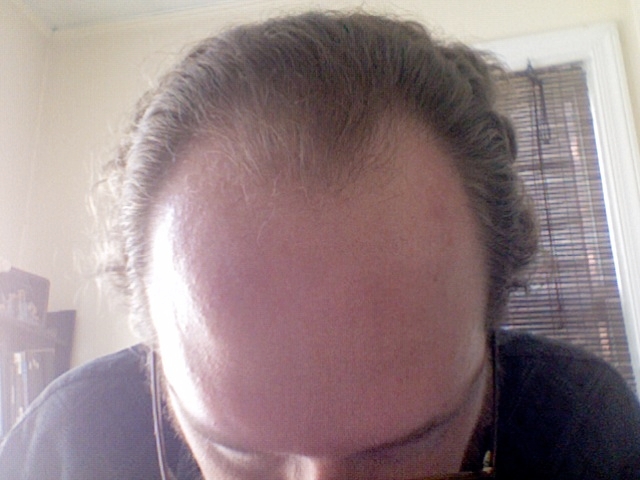
As Seen on TV! Restoring Hair with LASERS!!!!!!

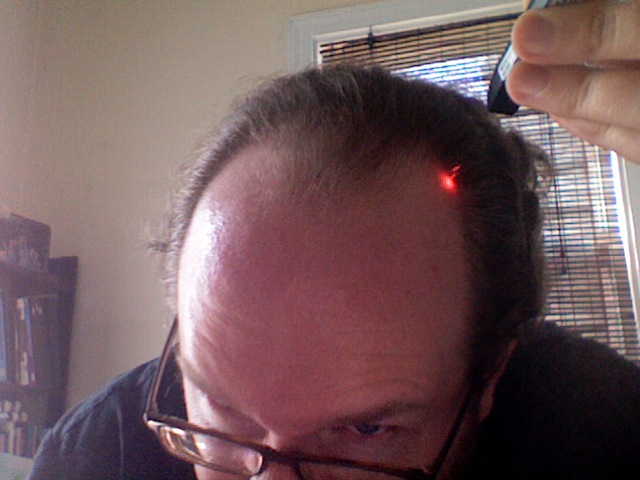
The author’s rapidly-expanding forehead.

Anyone who watches TV, reads magazines, or flips through catalogs has seen some interesting products. Maybe they seem plausible to you, maybe they don’t. However, a little investigation shows they are based less on science and well…actually working, and more on wishful thinking. At worst they’re actual con-jobs, designed to separate you from your money as efficiently as possible (which I guess is a certain standard of success). As a result, we at Double X Science bring you “As Seen on TV!” In these features, we’ll look at some of the products shilled on talk shows and infomercials, items lurking between the articles you read in magazines, or things you might find on the shelves of the stores where you shop.

I admit it, I’m a balding dude. My forehead is gradually taking over my entire scalp, replacing my formerly thick and curly hair with a vast expanse of pink skin. Yes, dear readers: My hair was once so thick and curly that, when I wore it long and in a ponytail, ladies would ask me for my secret. (The answer: Wash it every other day with some brand of cheap shampoo and let it air dry. Don’t tell.) I don’t like the fact of my impending baldness, so I’m sympathetic toward defoliation-sufferers who want to bring their hair back at any cost.

On the other hand, I don’t think I’ll invest in any of the hair restoration products advertised in the SkyMall catalog I picked up on my flight to my brother’s wedding in San Francisco. I counted seven products in this single catalog promising to restore hair in one way or another, either reversing baldness or filling in thin patches on the scalp –- and that doesn’t include hair-coloring, extensions, or other options. I won’t cover all of them, but no fewer than three products pledge to bring hair back through the magic of lasers.

Ah, lasers. They may not have the mystique of magnets or the nous of “natural”, but they are a frequent ingredient in modern snake oil. (Come to think of it, one of the hair-restoration products may have contained snake oil. I don’t want to ask.) But while lasers can help correct nearsightedness in some cases, perform minimally invasive surgeries, and remove hair, color my scalp skeptical about their ability to restore hair.

First, a disclaimer: I’m not a biologist, a doctor, medical researcher, or in any field related to those. I’m a physicist, so the closest I ever get professionally to this topic is the “no-hair” theorem in black hole physics. The “no-hair” theorem says that black holes have very few distinguishing characteristics: only mass and rotational rate (and technically electric charge as well, though it’s hard to build up enough charge to make a difference). The analogy is that, if all humans were completely hairless, we would have a lot fewer ways to tell each other apart. In other words, this ain’t my area, so bear (bare) with me!

Night on Baldhead Mountain

Hair loss can occur for a wide variety of reasons: chemotherapy, a number of unrelated diseases, even stress. However, as humans (both men and women!) age, we all tend to lose our hair to some degree. The effect is most pronounced in male pattern baldness (a bare patch on the top of the head merging over time with the growing forehead to leave a fringe around the edges of the scalp) or female pattern baldness (a general loss of hair at the top of the scalp). However, past the age of 80, nearly everyone starts losing hair, regardless of genetics, diet, or health.

The reasons, as with so many other things, are hormonal. Hair production is governed by sex hormones: most famously testosterone, but also a less well-known cousin known as dihydrotestosterone (DHT). In some people, DHT commands the follicles — the small organs in the skin that produce and feed hair — to shrink, producing ever-finer hair until they cease operating entirely. Thus, gradual hair loss of the usual (as opposed to disease- or circumstance-derived) variety is generally preceded by the hair itself becoming thinner and fuzzier.

My naive understanding of the biology of hair loss leads me to suspect that since hormones are the culprit behind hair loss, then any hair restoration should address those hormones in some way. That alone makes me suspicious of the laser-based products SkyMall peddles. To see why, let’s look at lasers themselves.

Lasers (without sharks)

The word “laser” began as an acronym: Light Amplification by the Stimulated Emission of Radiation. The details could be an Everyday Science or Double Xplainer post in their own right, but here’s the short version. The lasers used in the SkyMall products are LED lasers, meaning they are based on the underlying physics as LED lights. An electric current kicks electrons or other electric charge carriers from one type of material to another across a junction. The excess energy the electric charge sheds during this process is given off in the form of a photon, a particle of light. Since the same amount of energy is involved every time, light from LEDs is nearly monochromatic, meaning it is almost purely one color.

The “amplification” part of the name comes by putting the LED into a special kind of cavity with reflective walls. These walls set up standing waves for the light, which interfere constructively like vibrations in a guitar string, making them brighter. However, unlike guitar strings, the production of the light in lasers is a self-feeding process, resulting in the different parts of the system synchronizing until they emit photons in concert with each other. It’s really interesting stuff, and while it’s somewhat complicated, there’s nothing really mysterious or magical about it, any more than magnets are magical.

In fact, LED lasers are so unmagical that you can buy them as cat toys. LED lasers are the inner workings of laser pointers, which you can buy very inexpensively at any number of shops.

The smell of frying follicles

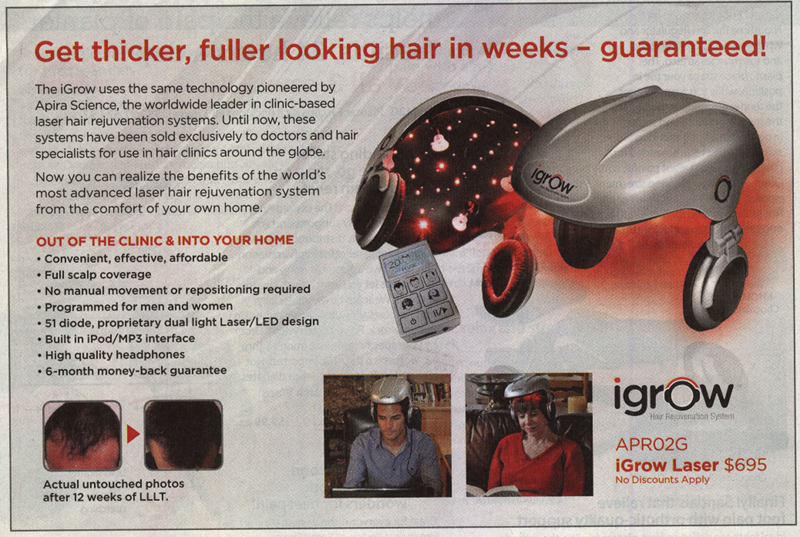
One of three laser-based hair-restoration products from SkyMall.
This one features built-in headphones, so you can at least listen
to music while you sit around looking like a fool. However,
I recommend a cheaper set of headphones, since the $700
price tag is a bit steep, and you’d get the same result with
regards to hair restoration.
Laser hair removal uses intense lasers to selectively heat the follicles in the skin, hopefully avoiding damage to the rest of the skin. This process can slow down hair growth and cause the hair to fall out of the treated follicles, but it doesn’t always actually stop it: the treatment must be continued for a long term. Basically, the laser is damaging the follicle.

As you can imagine, that also makes me skeptical that lasers can stimulate new hair growth. Lasers produce light…and that’s it! In addition to the usual red lasers like in laser pointers, manufacturers also make infrared lasers, which are useful for surgery. While we perceive infrared as heat (which is why sunshine feels warm), I don’t think merely warming the scalp is going to make hair grow faster, or else you wouldn’t need lasers at all — an electric blanket would do just as well. Too much heating and we’re back at laser hair removal.

Similarly, visible-light lasers like the kind that seem to be in these SkyMall products simply produce red light. Because ordinary light bulbs produce a broad range of colors (white light is a mixture of all the visible-light wavelengths), sitting under a desk lamp would expose your scalp to red light. Yes, it wouldn’t be as intense as lasers, but you could do the same trick with a laser pointer from Schtaples (the Scmoffice Schmupply Schtore), provided you have the patience to hold it against your scalp for long periods of time.

The author engages in home laser hair restoration, while his cats
meow around his feet.
So, to summarize:
  • Hair loss in its most common forms is hormonal, so it’s unclear to me that light (whether laser or otherwise) has anything to do with it. Hair removal can be achieved with lasers, but that involves causing damage to hair follicles, not using anything intrinsic to light.
  • Lasers are simply very monochromatic light sources, that use synchronization of atoms on the microscopic level to do their business. There’s nothing in a laser that isn’t in ordinary light bulbs, though you can make things far more intense with a laser. However, high intensity brings us back to laser hair removal, not restoration.
  • As always, if a product sounds miraculous, it’s probably bunkum. If all it took to regrow hair was a glorified laser pointer, nobody would be bald! LED lasers are cheap and ubiquitous; we could all restore our hair without paying a company $700 (and listen to the music on inexpensive headphones, to boot).
Now if you’ll pardon me, I’ll get back to shining this laser pointer at my scalp.

Double Xplainer: Once in a Blue Moon

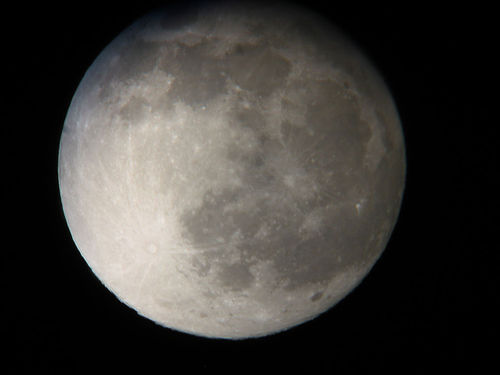
Full Moon, from Flickr user Proggie under
Creative Commons license.
Tonight—August 31, 2012— is the second full Moon of August. The last time two full Moons occurred in the same month was in 2010, and the next will be in 2015, so while the events are rare, they aren’t terribly uncommon either. In fact, you’ve probably heard the second full Moon given a name: “blue moon”. (The Moon will not appear to be a blue color, though, cool as that would be. More on that in a bit.) What you may not know is that this term dates back only to 1946, and is actually a mistake.

According to Sky and Telescope, a premiere astronomy magazine (check your local library!), the writer James Hugh Pruett made an incorrect assumption about the use of the term “blue moon” in his March 1946 article. His source was the Maine Farmers’ Almanac, but he misinterpreted it. The almanac used “blue moon” to refer to the rare occasion when four full Moons happen in one season, when there are usually only three. By the almanac’s standards, tonight’s full moon is not a blue moon (though there will be one on August 21, 2013).

However, even that definition of “blue moon” apparently only dates to the early 19th century. In its colloquial, non-astronomical sense, a “blue moon” is something that rarely or never happens: like the Moon appearing blue. The Moon is white and gray when it’s high in the sky, and can appear very red, orange, or yellow near the horizon for the same reason the Sun does. As far as I can tell, the only time the Moon appears blue is when there’s a lot of volcanic ash in the air, also a rare event (thankfully) for most of the world. The popular song “Blue Moon” (written by everyone’s favorite gay misanthrope, Lorenz Hart) uses “blue” to mean sad, rather than rare.

I’m perfectly happy to keep the common mistaken usage of “blue moon” around, though, since it’s not really a big deal to me. Call tonight’s full Moon a blue moon, and I’ll back you up. However, because it’s me, let’s talk about the Moon and the Sun and why this stuff is kind of arbitrary.

The Moon and the Sun Don’t Get Along

The calendar used in much of the world is the Gregorian calendar, named for Pope Gregory XIII, who instituted it in 1582. The Gregorian calendar, in turn, was based on the older Roman calendar (known as the Julian calendar, for famous pinup girl Julie Callender Julius Caesar). The Romans’ calendar was based on the Sun: a year is the length of time for the Sun to return to the same spot in the sky. This length of time is approximate 365.25 days, which is why there’s a leap year every four years. (Experts know I’m simplifying; if you want more information, see this post at Galileo’s Pendulum.)

A problem arises when you try to break the year into smaller pieces. Traditionally, this has been done through reference to the Moon’s phases. The time to cycle through all the phases of the Moon is called a lunation, which is about 29 days, 12 hours, 44 minutes, and 3 seconds long. You don’t need to pull out a calculator to realize that a lunation doesn’t divide into a year evenly, but it’s still a reasonable way to mark the passage of time within a year, so it’s the foundation of the month (or moonth).

Many calendars—the traditional Chinese calendar, the Jewish calendar, and others—define the month based on a lunation, but don’t fix the number of months in a year. That means some years have 12 months, and others have 13: a leap month. It also means that holidays in these calendars move relative to the Gregorian calendar, such that Yom Kippur or the Chinese New Year don’t fall on the same date in 2012 that they did in 2011. (The Christian religious calendar combines aspects of the Jewish and the Gregorian calendars: Christmas is always December 25, but Easter and associated holidays are tied to Passover—which is coupled to the first full Moon after the spring equinox, and so can occur in a variety of dates in March and April.)

Another resolution to the problem of lunations vs. Sun is to ignore the Sun; this is what the Islamic calendar does. Months are defined by lunations, and the year is precisely 12 months, meaning the year in this calendar is 354 or 355 days long. This is why the holy month of Ramadan moves throughout the Gregorian year, happening sometimes in summer, and sometimes in winter.

The Gregorian calendar does things oppositely to the Islamic calendar: while months are defined, they are not based on a lunation at all. Months may be 30 days long (roughly one lunation), 31 days, or 28 days; the latter two options make no astronomical sense at all. Solar-only calendars have some advantages: since seasons are defined relative to the Sun, the equinoxes and solstices happen roughly on the same date every year, which doesn’t happen in lunation-based calendars. It’s all a matter of taste, culture, and convenience, however, since the cycles of Sun and the Moon don’t cooperate with the length of the day on Earth, or with each other.

Blue moons in the common post-1946 usage never happen in lunation-based calendar systems because by definition each phase of the Moon only occurs once in a month. On the other hand, the version from the Maine Farmers’ Almanac is relevant to any calendar system, because it’s defined by the seasons. As I wrote in my earlier DXS post, seasons are defined by the orbit of Earth around the Sun, and the relative orientation of Earth’s axis. Thus, summer is the same number of days whatever calendar system you use, even though it may not always be the same number of months. In a typical season, there will be three full Moons, but because of the mismatch between lunations and the time between equinoxes and solstices, some rare seasons may have four full Moons.

The Moon and Sun have provided patterns for human life and culture, metaphors for poetry and drama, and of course lots of superstition and pseudoscience. However, one thing most people can agree upon: the full Moon, blue or not, is a thing of beauty. If you can, go out tonight and have a look at it—and give it a wink in honor of the first human to set foot on it, Neil Armstrong.

Rest in peace, Sally Ride

Photo public domain image, via Wikimedia Commons.

By Matthew Francis, DXS Physics Editor


This week—on Monday, July 23—Sally Ride passed away after a battle with pancreatic cancer. She was 61.


Dr. Ride was a physicist and passionate advocate for STEM education for girls, a position she bolstered through her fame as a former Space Shuttle astronaut. In fact, she was the first American woman in space, and only the third woman worldwide to travel into space. She flew twice aboard the Challenger, first in 1983 and then again in 1984, when she controlled the Shuttle’s robotic arm to deploy a satellite. Later, she served in the investigations after both the Challenger and Columbia disasters, the only person to sit on both committees. After retiring from NASA, she started Sally Ride Science, a company devoted to providing educational materials and classroom presentations to schools, specifically with an eye toward encouraging girls in the fields of science and engineering.


I remember her flights well, as I paid a lot of attention to the space program when I was young. (I also loved the robotic arm on the Shuttle, and wanted a chance to play with it. Now I understand that, while it might resemble a video game, it’s a video game with millions of dollars in equipment at stake. However, I still haven’t gotten over wanting to play with robotic arms. I can admit that, right?) I was the kid who wrote letters to NASA, asking for photos and information about their spacecraft. I have the pictures they sent me in a stack on my desk right now, in fact, and I’m looking at them as I write this post. While the photos themselves predated Dr. Ride’s trips into space (the last group photo in the batch comes from the third flight, STS-3, while she first flew on STS-7), my greatest interest in the Shuttle peaked during her time as as an astronaut.


Much digital ink has been spilled over the revelation about her sexual orientation—her partner in business, writing, and life for the last 27 years was Tam O’Shaughnessy, which was no secret to her family and friends but not widely known beyond. I can’t really blame Dr. Ride for keeping mostly quiet about it. After all, in the 1980s, it could have been grounds for dismissal from NASA; she faced enough sexism as it was. Her very existence as a woman astronaut was symbolic, and even today the default American astronaut is a white, (presumably) heterosexual male. Although the astronaut corps is a lot more diverse than it used to be, NASA’s close ties with the military and its historical homophobia have no doubt made it difficult for any astronaut to acknowledge their sexual identity openly. For Dr. Ride and her primary mission in life to encourage girls in science, I can understand her reluctance to make herself into another symbol. However, that very fact is a sad comment, that being a woman in the public sphere is enough to be considered unusual that she didn’t want to bring her sexual orientation into the picture. (I don’t even presume to call her a lesbian, since human sexual identity is more fluid than many of us like to admit.)


Over the last two days, many people have written eulogies, reminiscences, tributes, and biographies; I’m not sure I can add much to those. Here are some of the best:

  • Nadia Drake’s personal story from her childhood brought tears to my eyes. Similarly, I love astronomer Meg Urry’s tribute.
  • Here’s the big New York Times official obituary, which (as you might expect) is quite good and thorough.
  • While we rightfully celebrate Sally Ride’s accomplishments, let’s face it: the United States was really late in sending women into space. Institutional sexism delayed women astronauts far longer than should be acceptable in any civilized nation, and the locker-room culture at NASA during that era bears a lot of responsibility for the problem. Thirteen women trained to be part of the Mercury program, but were barred from ever flying. I lost a lot of respect for John Glenn when I found out he actively worked against allowing women to fly.
  • Natalie Wolchover at Space.com examines why there aren’t openly gay astronauts in much more detail; here’s another post on a similar personal note, from a lesbian astronomer.
  • An obituary from BuzzFeed, with comments from Ride’s sister, Bear. (Seriously, isn’t it also awesome to have a sister nicknamed “Bear”?)

Please leave your recollections of Sally Ride in the comments.

So What’s the Big Deal About the Higgs Boson, Anyway? A Physics Double Xplainer

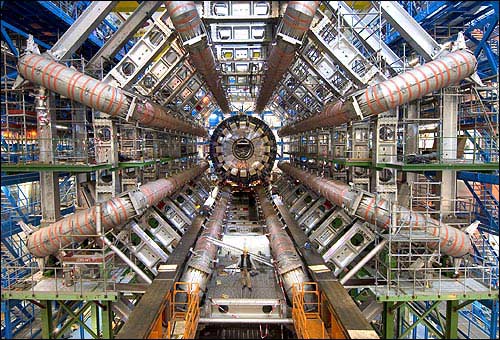
The ATLAS detector at the Large Hadron Collider, one of four
detectors to discover a new particle.
By Matthew Francis, physics editor

After decades of searching and many promising results that didn’t pan out, scientists working at the Large Hadron Collider in Europe announced Wednesday they had found a new particle. People got really excited, and for good reason! This discovery is significant no matter how you look at it: If the new particle is the Higgs boson (which it probably is), it provides the missing piece to complete the highly successful Standard Model of particles and interactions. If the new particle isn’t the Higgs boson, well…that’s interesting too.

So what’s the big deal? What is the Higgs boson? What does Wednesday’s announcement really mean? What’s the meaning of life? Without getting too far over my head, let me try to answer at least some of the common questions people have about the Higgs boson, and what the researchers in Europe found. If you’d rather have everything in video form, here’s a great animation   by cartoonist Jorge Cham and an elegant explanation by Ian Sample. Ethan Siegel also wrote a picture-laden joyride through Higgs boson physics; you can find a roundup of even more posts and information at Wired and at Boing-Boing. (Disclaimer: my own article about the Higgs is linked both places, so I may be slightly biased.)

Q: What is the Higgs boson?
A: The Higgs boson is a particle predicted by the Standard Model. It’s a manifestation of the “Higgs field”, which explains why some particles have mass and other particles don’t.

Q: Whoa, too fast! What’s a boson?
A: A boson is a large mammal indigenous to North America. No wait, that’s bison. [Ed note: Ha. Ha. Ha.] On the tiniest level, there are two basic types of particles: fermions and bosons. You’re made of fermions: the protons, neutrons, and electrons that are the constituents of atoms are all fermions. On a deeper level, protons and neutrons are built of quarks, which are also fermions. Bosons carry the forces of nature; the most familiar are photons-particles of light-which are manifestations of the electromagnetic force. There are other differences between fermions and bosons, but we don’t need to worry about them for now; if you want more information, I wrote a far longer and more detailed explanation at my personal blog.

Q: What does it mean to be a “manifestation” of a force?
A: The ocean is a huge body of water (duh), but it’s always in motion. You can think of waves as manifestations of the ocean’s motion. The electromagnetic field (which includes stuff like magnets, electric currents, and light) manifests itself in waves, too, but those waves only come in distinct indivisible chunks, which we call photons. The Higgs boson is also a manifestation of a special kind of interaction.

Q: How many kinds of forces are there?
A: There are four fundamental forces of nature: gravity, electromagnetism, and the two nuclear forces, creatively named the weak and strong forces. Gravity and electromagnetism are the forces of our daily lives: Gravity holds us to Earth, and electromagnetism does nearly everything else. If you drop a pencil, gravity makes it fall, but your holding the pencil is electromagnetic, based on how the atoms in your hand interact with the atoms in the pencil. The nuclear forces, on the other hand, are very short-range forces and are involved in (wow!) holding the nuclei of atoms together.

Q: OK, so what does the Higgs boson have to do with the fundamental forces?
A: All the forces of nature have certain things in common, so physicists from Einstein on have tried to describe them all as aspects of a single force. This is called unification, and to this day, nobody has successfully accomplished it. (Sounds like a metaphor for something or other.) However, unification of electromagnetism with the weak force was accomplished, yielding the electroweak theory. Nevertheless, there was a problem in the first version: It simply didn’t work if electrons, quarks, and the like had mass. Because particles obviously do have mass, something was wrong. That’s where the Higgs field and Higgs boson come in. Scottish physicist Peter Higgs and his colleagues figured out that if there was a new kind of field, it could explain both why the electromagnetic force and weak force behave differently and provide mass to the particles.

Q: Wait, I thought mass is fundamental?
A: One of the insights of modern physics is that particles aren’t just single objects: They are defined by interactions. Properties of particles emerge out of their interactions with fields, and mass is one of those properties. (That makes unifying gravity with the other forces challenging, which is a story for another day!) Some particles are more susceptible to interacting with the Higgs. An analogy I read (and apologies for not remembering where I read it) says it’s like different shoes in the snow. A snowshoe corresponds to a low-mass particle: very little snow mass sticks to it. A high-mass particle interacts strongly with the Higgs field, so that’s like hiking boots with big treads: lots of places for the snow to stick. Electrons are snowshoes, but the heaviest quarks are big ol’ hiking boots.

Q: Are there Higgs bosons running around all over the place, just like there are photons everywhere?
A: No, and it’s for the same reason we don’t see the bosons that carry the weak force. Unlike photons, the Higgs boson and the weak force bosons (known as the W and Z bosons — our particle physics friends run out of creative names sometime) are relatively massive. Many massive particles decay quickly into less massive particles, so the Higgs boson is short lived.

Q: So how do you make a Higgs boson?
A: The Higgs field is everywhere (like The Force in Star Wars), but to make a Higgs boson, you have to provide enough energy to make its mass. Einstein’s famous formula E = mc^2 tells us that mass and energy are interchangeable: If you have enough energy (in the right environment), you can make new particles. The Large Hadron Collider (LHC) at CERN in Europe and the Tevatron at Fermilab in the United States are two such environments: Both accelerate particles to close to the speed of light and smash them together. If the collisions are right, they can make a Higgs boson.

Q: Is this new particle actually the Higgs boson then?
A: That’s somewhat tricky. While the Standard Model predicts the existence of a Higgs boson, it doesn’t tell us exactly what the mass should be, which means the energy to make one isn’t certain. However, we have nice limits on the mass the Higgs could have, based on the way it interacts with other particles like the other bosons and quarks. This new particle falls in that range and has other characteristics that say “Higgs.” This is why a lot of physics writers, including me, will say the new particle is probably the Higgs boson, but we’ll hedge our bets until more data come in. The particle is real, though: four different detectors (ATLAS and CMS at CERN, and DZero and CDF at Fermilab) all saw the same particle with the same mass.

Q: But I’m asking you as a friend: Is this the Higgs boson?
A: I admit: a perverse part of me hopes it’s something different. If it isn’t the Higgs boson, it’s something unexpected and may not correspond to anything predicted in any theory! That’s an exciting and intriguing result. However, my bet is that this is the Higgs boson, and many (if not most) of my colleagues would agree.

Q: What’s all this talk about the “God particle”?
A: Physicists HATE it when the Higgs boson is called “the God particle.” Yes, the particle is important, but it’s not godlike. The term came from the title of a book by physicist Leon Lederman; he originally wanted to call it “The Goddamn Particle”, since the Higgs boson was so frustrating to find, but his editor forced a change.

Q: Why should I, as a non-physicist, care about this stuff?
A: While it’s unlikely that the discovery of the Higgs boson will affect you directly, particle colliders like the LHC and Tevatron have spurred development of new technologies. However, that’s not the primary reason to study this. By learning how particles work, we learn about the Universe, including how we fit into it. The search for new particles meshes with cosmology (my own area): It reveals the nature of the Universe we inhabit. I find a profound romance in exploring our Universe, learning about our origins, and discovering things that are far from everyday. If we limit the scope of exploration only to things that have immediate practical use, then we might as well give up on literature, poetry, movies, religion, and the like right now.

Q: If this is the Higgs boson, is that the final piece of the puzzle? Is particle physics done?
A: No, and in fact bigger mysteries remain. The Higgs boson is predicted by the Standard Model, but we know 80% of the mass of the Universe is in the form of dark matter, stuff that doesn’t emit or absorb light. We don’t know exactly what dark matter is, but it’s probably a particle — which means particle colliders may be able to figure it out. Hunting for an unknown particle is harder than looking for one we are pretty sure exists. Finding the Higgs (if I may quote myself) is like The Hobbit: It’s a necessary tale, but the bigger epic of The Lord of the Rings is still to come.

Hey Science, "How YOU doin’?"

(Guest post by Summer Ash, astrophysicist, writer, and Close Personal Friend of Neil DeGrasse Tyson. Follow her on Twitter: @Summer_Ash .)
There have been and will be much more eloquent (and rage filled) responses to this video, but for now I just want to add my voice to the dumbfounded chorus of scientists who woke up to this insanity this morning:

It’s like the only way to correct the stereotype of science being done by old guys in white lab coats with bad hair is to yank the pendulum so far in the other direction and imply that science can also be done by preteens dressed like streetwalkers. Nay, not only can, but is!
Now while I have an admittedly large obsession with fashion, and shoes in particular, it’s not representative of how most women dress for work. So why the hell is it being presented as how all women scientists should dress?
The real shame is that this flashy (and hideous) video is now the public face for what seems to be a worthwhile, and even well-produced in places, campaign by the European Union to encourage more girls to go into science. There are currently twelve profiles of real women scientists at various stages in their career that are worth watching with any clever young girls you know. Just hit the stop button before the catch phrase/website address gets written in lipstick across the screen at the end of each one.
For me the most important take away is that there exists a spectrum of not only women, but people, in science. There is no mold. It’s not a “guy thing”, but it’s not a “girl thing” either. Anyone with the passion, motivation, and dedication can become a scientist. I called my (neglected as of late) blog “Newtonianism for the Ladies” not because science needs to be dumbed down or spoon fed to women, but after a book by the same title written in 1737 by Francesco Algarotti. Algarotti wrote the book to help spread Newton’s ideas on the nature of light and optics to women of the upper class who were only beginning to be educated. The book was also one of the main channels through which Newtonianism reached the general public in continental Europe.
And yet in the intervening centuries, we’ve gone from ‘science for all’ to ‘science: it’s a girl thing’. And instead of science trying to attract girls, we’ve got girls trying to attract science like it’s some kind of horny john. The defense that this video is just a teaser for the “real” campaign on the subsequent pages of the website (some of which aren’t even up yet) is laughable. Based on the logo alone, it’s clear that they are digging in their 4″ heels on this approach. Which is just so damn frustrating when good intentions and good materials are likely to get lost in the backlash.
Now excuse me while I go channel my rage into some astrophysics.

(Ed: after the huge outcry from scientists, the offending video has been removed from the EU site.)

These views are the opinion of the author and do not necessarily either reflect or disagree with those of the DXS editorial team.

To Everything (Turn Turn Turn) There is a Season

Today – June 20 – is the northern Summer Solstice, sometimes known as the Northern Solstice, “first day of summer”, or Midsummer’s Day, depending on where you live. It’s the longest day and shortest night of the year in the northern hemisphere (where I live), though exactly howlong or short depends on how far north you live. And of course in the southern hemisphere, today is is the shortest day and longest night, since the seasons are reversed.
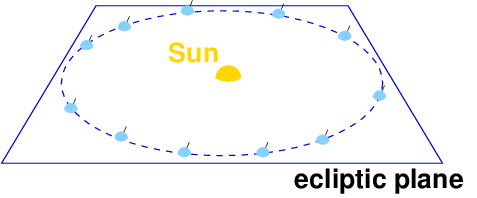
The secret to the solstice and to Earth’s seasons in general involves the tilt of Earth’s axis. Our planet orbits the Sun in an elliptical path, which you can draw on a flat piece of paper: it doesn’t move “up” or “down”, but stays in a single plane known as the ecliptic. (The name “ecliptic”, as you might guess, is related to the word “eclipse”, since ancient astronomers determined eclipses of the Moon and Sun could only occur at certain places in the sky.) Earth’s axis is tilted compared to the ecliptic, and the axis points more or less in the same direction, wherever the planet is in its orbit. The axis points almost directly at Polaris, the North Star, which is why that star is a good navigational guide for those in the northern hemisphere: no matter what time of year, it’s always in the same spot in the sky. Other stars rise and set as Earth rotates, but not Polaris. (Unfortunately, there isn’t a South Star.)
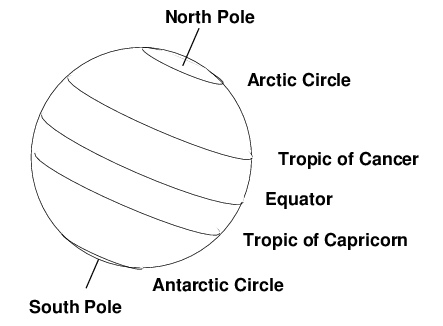
As you can see from the diagram above, during about half the year, the North Pole points more toward the Sun, while it points more away for the rest of the year. Where I live, the Sun will never be directly overhead, even at noon. The farthest north that will ever happen is a special latitude known as the Tropic of Cancer – and the northern Summer Solstice is the day that occurs. On the northern Winter Solstice, which happens on December 21 or 22, the Sun is directly overhead at noon at the latitude of the Tropic of Capricorn.
Now we can see why summers are hot! In summer, the Sun rises earlier, sets later, and reaches a higher point in the sky. Those things combined mean extra sunlight, heating up the air and the ground longer. We can also see why I put “first day of summer” in quotes: the Solstice is the apex of the process, but the increase in daylight and temperatures begins long before June 20 (at least every place I’ve lived). The Midsummer’s Day festival, celebrated throughout northern Europe, acknowledges that; Shakespeare’s play A Midsummer Night’s Dream may have been written for the English version of the festival (though from what I can tell, the historical evidence is scant).
Similarly, during winter the Sun’s light comes in at a steeper angle and days are shorter, so the time for the ground to warm is greatly reduced. The northern Winter Solstice (also known as the Southern Solstice, “first day of winter”, Midwinter’s Day, or Yule) is the shortest day and longest night of the year in the northern hemisphere. On that day, the North Pole points as far away from the Sun as it ever does. We also have the reason the tropics are warm all year around: they receive about the same amount of sunlight during both summer and winter.
Approximately halfway between the solstices, the Sun appears directly overhead at noon at the Equator. On those days, everywhere on Earth gets about 12 hours of daylight and 12 hours of night. These days are the equinoxes, meaning “equal night”. (The spell to extinguish light in the Harry Potter books is “nox”, for what it’s worth. Yes, I remember such things. I’m still waiting for my “accio!” summoning spell, though.) The two days are known as the Vernal(or spring) and the Autumnal (or autumn) Equinox, again based on the seasons in the northern hemisphere. From an astronomical point of view, Earth’s “solar year” is marked between successive vernal equinoxes. (A second measurement of the year, known as the sidereal year, is measured with respect to the stars. These two year measurements are almost, but not quite, the same length!)
Now let’s put all of this together in a movie! (For some reason, the Sun – which was a gently glowing lamp in my original simulation – came out looking flat and boring in the final movie. I guess I still have more to learn about creating three-dimensional animations.) For best results, please view this full-screen.

Survival is Gendered, According to Scholastic

[Editor’s note: We were going to write this as a she said/he said sort of thing with Emily Willingham and Matthew Francis, but then Francis got all serious and did an analysis and stuff. So his smart analysis appears first, and Willingham’s (not quite) equally sober chapter-by-chapter evaluation of the “girls” book follows.]

  Last week Ryan North, purveyor of the excellent webcomic Dinosaur Comics, stumbled across a pair of books published by Scholastic. The books are titled For Boys Only: How to Survive Anything and For Girls Only: How to Survive Anything, which already should be a tip-off, but the tables of contents really hammer home a message. As North says, “Maybe – MAYBE – How To Pick Perfect Sunglasses is actually in the same class as Surviving When Your Parachute Fails.” However, it’s obvious that boys and girls are not expected to want to survive the same things, and that the very idea of survival is gendered in these books.

  Thanks to the outcry, Scholastic has already announced they will discontinue the titles, which is great. However, I wonder why they approved them in the first place, and their announcement shows that they don’t really understand what the big deal is. My friend JeNel, who is a children’s librarian, points out that Scholastic’s displays are always gendered, with a lovely regressive social agenda. So, shall we break it down for Scholastic?

  First, anytime you name two books “For Boys Only” and “For Girls Only”, put an alligator on the cover of one and a pink cell phone on the cover of the other, you’re telling your audience of impressionable children that these books aren’t going to be equivalent. It’s almost inevitable that the “boy” book is going to be full of adventure and the “girl” book is going to be full of social stuff, and that’s the case here. “Survival” for boys includes broken legs, tornadoes, and earthquakes (since boys are obviously the only ones who will ever experience those), while “survival” for girls includes frenemies, brothers, and teaching your cat how to sit. (I suppose treating cat scratches and bites is kind of a survival skill.) In other words, “survival” for girls is a set of potentially useful social skills – which I guess boys don’t need to know. I split the contents into five categories, and assigned each chapter to one of the categories.

  Here’s the breakdown:

  1. True survival skills, where the knowledge could save your life or at least help you cope with injuries (forest fires, flash floods, snakebites, etc.). Not all of these are likely to be experienced (such as polar bear attack), but at least they could happen. The score: “boys” 22, “girls” 0.
  2. Survival skills for science fiction or fantasy scenarios, which are fun, but will never happen in real life (ghost attack, vampire attack, dinosaur attack, etc.). The score: “boys” 4, “girls” 3.
  3. Useful skills and advice for daily life or unusual situations (dealing with annoying people, getting over rejection, etc.). Not all of these are of equal um…significance, unless you think picking the right sunglasses is equivalent to coping with bullies, but I didn’t want to break the categories up too much. The score: “boys” 0, “girls” 23.
  4. Skills and advice for sudden stardom or suddenly becoming rich, which are fun to dream about, I suppose. The score: “boys” 0, “girls” 3.
  5. Teaching your cat how to sit. The score: “boys” 0, “girls” 1.

Let’s ignore the hyperbolic titles, since obviously neither book is intended to actually teach you to survive everything. However, the implications are clear: Boys need to know how to survive broken legs and earthquakes, but girls evidently will never experience that sort of thing. (Or perhaps Scholastic is assuming the girls will always have a knowledgeable boy around to help out. That sentence caused me psychological pain to even type.) Similarly, boys won’t ever need help dealing with bullies, frenemies, or learning how to camp. Either that, or (as Greg Gbur suggests) girls already know how to deal with the hard survival stuff, so they don’t need the book.


———————————————————————-

So, like, talking on a cell phone held in
one hand while engaged in this activity is so
totally NOT a survival technique.

GIRLS ONLY: How to Survive Anything!
Table of Contents

  • How to survive a BFF Fight (Boys don’t have friends and fight with them? What is that thing they’re doing when they’re rolling around all over the floor trying to kill each other?)
  • How to Survive Soccer Tryouts (assuming very male David Beckham once had to do this)
  • How to Survive a Breakout (like this?)
  • How to Show You’re Sorry (because being a boy means never having to show you’re sorry)
  • How to Have the Best Sleepover Ever (My sons have sleepovers; just discreetly double-checked their gonads)
  • How to Take the Perfect School Photo (like this guy did?)
  • How to Survive Brothers (My sons have brothers, two each; they could really use some tips on this)
  • Scary Survival Dos and Don’ts (if it’s scary, don’t do it)
  • How to Handle Becoming Rich (Nooo! Not RICH!)
  • How to Keep Stuff Secret (It’s like, so hard, to like, keep your mouth shut, you know?)
  • How to Survive Tests (At first I thought this said “testes,” and I was confused. That said, apparently females do have more test anxiety than males. It’s because we’re too stressed about that perfect school photo).
  • How to Survive Shyness (Have you met my husband? No? That’s because he’s shy)
  • How to Handle Sudden Stardom (Boys and men never suddenly become stars. Ever)
  • More Stardom Survival Tips (because one chapter on stardom just isn’t enough)
  • How to Survive a Camping Trip (Boys never go camping. Or they automatically know how because they have testes. Or something like that)
  • How to Survive a Fashion Disaster (You see, fashion is an equal-opportunity threat, people)
  • How to Teach Your Cat to Sit (a critical skill, no doubt, but one boys need to know, too)
  • How to Turn a No Into a Yes (I just … no)
  • Top Tips for Speechmaking (because we’ve never, ever seen a boy give a bad speech)
  • How to Survive Embarrassment (gentlemen, clearly no concern of yours, sudden erections during algebra notwithstanding)
  • How to Be a Mind Reader (I see what you’re thinking here. No. Just no)
  • How to Survive a Crush (So for boys, is the corollary “How to Survive a Lust?”, or what?)
  • Seaside Survival (More than half of the US population lives in a coastal county. I guess all the males in that portion are expendable)
  • How to Soothe Sunburn (like this fellow did)
  • How to Pick Perfect Sunglasses (living proof that boys could use some help with this, too)
  • Surviving a Zombie Attack (two of these people are male)
  • How to Spot a Frenemy (Paul, meet John. Mick, meet Keith. Simon, meet Garfunkel. Freud, meet Jung. See? Boys have frenemies, too!)
  • Brilliant Boredom Busters (Am copying these now for my three sons, for whom a houseful of toys, books, art supplies, games, videos, and movies simply isn’t enough)
  • How to Survive Truth or Dare (see “No., Just no” above)
  • How to Beat Bullies (Is this a recommended approach? ‘Cause I need to do some time traveling, if so)
  • How to be an Amazing Babysitter (You can start by not taking a gendered approach to every single facet of existence of the child you’re babysitting)

A Once-in-a-Lifetime Truly Double X Event: Venus in Transit

By DXS Physics Editor Matthew Francis, who usually brings you Everyday Science. As you will see, this is science of the Not-So-Everyday sort.

Perhaps the most important question to ask in science is “how do we know?” While it’s appropriate to ask this every day, today it feels even more so, as we prepare to witness a very rare astronomical event. This time, it’s happening on June 5, 2012; when this event occurred during the 18th century, it allowed astronomers to make the first precision measurements of the size of our Solar System. Captain James Cook, best known for his exploration of the Pacific (for Europe, that is—the natives already knew what was there), took a set of scientific instruments aboard his ship to Tahiti; other teams of researchers took measurements at those locations.

The rare event they observed was the transit of Venus: when Venus travels directly between Earth and the Sun, blocking a tiny amount of light. Astronomers in different locations timed the crossing of Venus across the Sun’s disc, and by comparing their numbers, were able to determine the distance between Earth and the Sun. With that distance in hand, they were able to calibrate the size of the entire Solar System. The 1769 observation was an international scientific effort (to use modern language), and while the results weren’t as good as the astronomers of the day had hoped, they still agreed with modern measurements.

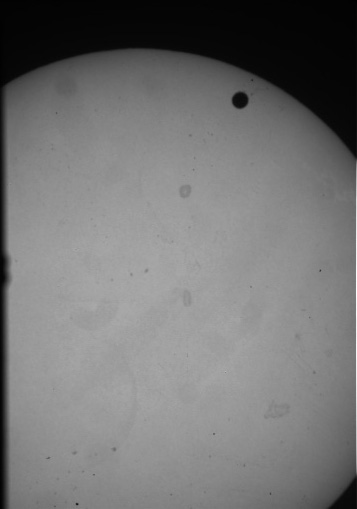
Today we use a variety of techniques to measure distances, including radar ranging (bouncing radio waves off planets and timing the round trip), so we don’t have to wait for Venus transits anymore—which is good, since they aren’t common! The last Venus transit was in 2004, but the previous one before that was in 1882, and the next one will be in 2117. I got up very early in the morning on June 8, 2004, joining some fellow astronomy enthusiasts at the Rutgers observatory, where we took the photo you see at the top of the post.

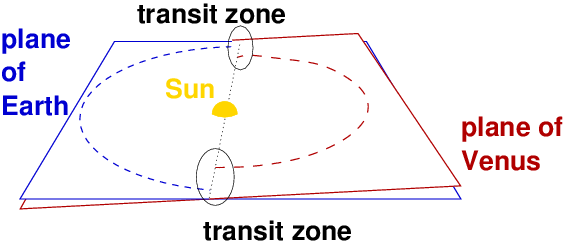
The seemingly odd intervals between transits are because Earth’s and Venus’ orbits around the Sun don’t lie in the same plane. If you draw Earth’s orbit as an ellipse on a sheet of cardboard, and Venus’ orbit on another sheet of cardboard, they need to overlap in a small X pattern, as shown in the picture. The only times Venus will transit is when both Earth and Venus are on the same side of the Sun, and only when they are in the region where the cardboard pieces overlap. The angle (3.5°) in the picture is correct, but I’ve exaggerated the size of the Sun and the sizes of the “transit zones”; in truth, even though the Sun is huge compared to Earth, it’s not that big on the sky. If you do the real calculation, you find that Venus transits happen roughly twice per century, and those two events are separated by 8 years. It’s a rare and wonderful event!

Viewing the Transit

If you want to view the Venus transit, the first thing you should do is see if it will be visible where you live. (Hopefully the weather will cooperate too! Such is the life of an astronomer.) In Richmond, Virginia (where I live), the transit begins around 6 PM. If you’re in the area, the Science Museum of Virginia is hosting a free viewing on the lawn; many other cities and towns have similar events.

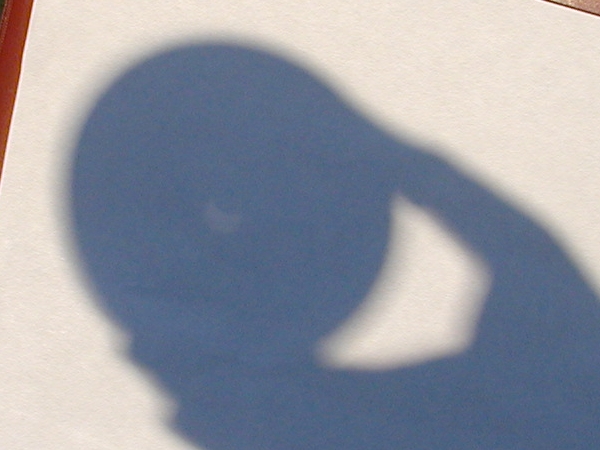
A common sense warning: please don’t look directly at the Sun! However, you don’t need fancy equipment or a big observatory to witness the transit. Two weeks ago, I observed the solar eclipse using nothing but a microwave macaroni-and-cheese container. By piercing a hole in the bottom of the tub, I created a simple pinhole camera. A small and kind of fuzzy image of the eclipse appeared on a piece of paper, which I photographed. (Obviously you can do better if you have better equipment—I happened to be far from home during the eclipse and used what I had on hand.) A piece of cardboard covered in aluminum foil with a small hole works better, and you can project the image right onto the sidewalk, the side of a building, or another screen.

If you have a pair of binoculars that use glass lenses (since plastic will melt), point the larger lens toward the Sun and the smaller lens onto a flat surface. (Again, don’t look through the binoculars if you value your eyeballs!) If you have a telescope with a mirror or glass lenses, you can also project the image onto a flat surface, or create a sun funnel. There are a lot of ways to view the Sun if the ones I mention don’t appeal to you.

As a word of caution: the Venus transit won’t look as impressive as a solar eclipse, since Venus is a lot farther away than the Moon. It will appear to be a small round shadow on the Sun’s disc. The thrill (for me at least) lies in the knowledge: you are viewing a planet not much smaller than Earth as it crosses between us and our home star! If it isn’t enough these events are rare, think of how significant it is to catch a glimpse of the sheer size of our Solar System, in a way we don’t usually get to see. And always, always remember to ask the question: “how do we know?”

Further Reading

If you want to know more about transits and why they are still scientifically important today, try these links:

  • Nicole the Noisy Astronomer has some details about her adventures making a sun funnel, along with some other tasty transit bits.
  • Summer Ash shares how the Venus transit reveals the distance between Earth and the Sun, and includes some additional viewing tips.
  • The Hubble Space Telescope will be using the Venus transit, not for what it teaches us about our Solar System, but to help the search for planets orbiting other stars, known as exoplanets. Mark Anderson has the scoop.
  • I wrote an essay last year with a lot more about how the Kepler telescope uses transits of exoplanets to hunt for other worlds. While it doesn’t mention Venus specifically, the ideas are the same!

Happy Venus-watching!

As Seen on TV! Age Your Wine in 10 Seconds!!!!

Old, old wine. (Source)

Anyone who watches TV, reads magazines, or flips through catalogs has seen some interesting products. Maybe they seem plausible to you, maybe they don’t. However, a little investigation shows they are based less on science and well…actually working, and more on wishful thinking. At worst they’re actual con-jobs, designed to separate you from your money as efficiently as possible (which I guess is a certain standard of success).


As a result, we at Double X Science are starting a new series: “As Seen on TV!” In these features, we’ll look at some of the products shilled on talk shows and infomercials, items lurking between the articles you read in magazines, or things you might find on the shelves of the stores where you shop.

Our first entry is one I spotted in SkyMall, the catalog you (if you’re like me) read if you forget to bring a book on an airplane. Where else can you find dog water bowls shaped like toilets or sports chairs built deliberately too large for anyone, so you look tiny sitting in them? While the catalog is full of impractical items (to put it mildly), some of them go beyond that into the realm of…imagination. Yeah, I’ll call it that. It avoids potential lawsuits.

It’s the Aging Accelerator! With Magnets!

Here’s the idea: depending on which device you buy, you insert either a glass or a bottle of wine, and within 10 seconds! it ages the wine, with the unspoken assumption that this is desirable. (It also evidently works for whiskey, but I’ll skip that discussion in the current article.) Now, anything that promises to drastically alter something within 10 seconds! is probably suspicious to begin with, but that’s the part I’m going to leave alone. After all, magnets do work quickly, so if the device does what it claims to do, it’s quite possible that 10 seconds will be enough time for the magic to happen.

Well, it seems like magic to me. I went to a winery last weekend, and spoke to one of the vintners there (yup, that’s the name for ’em). She told me that not all wines should be aged, and the reason has to do both with the way wine is made and how it is stored.

First, not all wine should be aged! All wines actually go bad over time, including many of the usual types you may see in the store. That time may be pretty long, but you don’t want to just buy any bottle, stick it in your basement, and wait 20 years to drink it – most of them won’t taste good. According to my source, the days are gone where you might buy bottles of wine and put them in a cellar for your children. (Who has a wine cellar now anyway? I live in a second-floor apartment!) Basically, my source tells me to ask an expert if you have any doubts, but basically all wine is sold today in a drinkable state – no aging is necessary or even wanted. (I can’t endorse it, but Wikipedia has a list of wines that can be aged, and possible ranges.) Earth’s magnetic field has nothing to do with the aging process, whatever the ad says.

Second, the reason some wines age better than others has to do with their chemistry: how much sugar is in the grapes and how much tannin content they have. Red wines typically are higher in tannins because the skins are thrown in with the flesh of the fruit – and tannins act as a preservative. Sugar also acts as a preservative, but it’s not as effective, so white wines (lower in tannins, higher in sugar) don’t keep as well.

The point I’m trying to make is that wine aging isn’t mysterious, either why it happens or how. I don’t have the “Aging Accelerator” package in front of me, so I can’t tell you if they give advice on which wines to put in it and which ones to avoid, but the picture shows both reds and whites. So let’s turn to the way the device is supposed to work: magnetism.

They certainly have one thing right: neodymium magnets are very strong! (Neodymium is one of the “rare earth” elements, found near the bottom of the periodic table, so sometimes you’ll see them referred to as “rare earth magnets”.) When I’ve used neodymium magnets for various experiments, two of them attracting each other pinched my fingers hard enough to create blood blisters.

Admittedly magnets can seem mysterious: understanding exactly how they work requires looking at electrons and atoms, which might seem a little out of the ordinary. However, challenging isn’t the same thing as magical, but some people seem to think that magnets are capable of all sorts of feats, from curing arthritis to – yes – aging wine.

How magnets actually work could be the topic of an “Everyday Science” post, but in brief: the way a material responds to a magnet is called its magnetic susceptibility. Some materials, like neodymium, are very susceptible, but most things aren’t, including the human body. (Some organisms such as pigeons use Earth’s magnetic field to navigate, but exactly how they do it is still not known.) I couldn’t find any particular data on the magnetic susceptibility of tannins or other molecules in wine, but my feeling is it’s not large. Tannins are big biological molecules – think DNA or proteins – and those don’t tend to be magnetic.

But here’s the deal: suppose tannins are magnetic. Why then would exposing them to a magnetic field age the wine? Simply putting a strong magnet near your wine would merely rearrange the molecules inside the liquid – it’s like stirring it, in other words. Obviously stirring something can change the way it tastes, since it can mix sediments in, but that’s not the same thing as aging.

So, let’s wrap up: why should we be suspicious of paying $60 or $100 for an “Aging Accelerator”?
  • The concept misuses a well-understood physical principle – magnetism. Just because someone doesn’t understand how it works doesn’t mean it can perform miracles.
  • The aging process is chemical, and we understand how that works – it involves tannins, sugars, and other molecules. There are no secrets, in other words, and nothing simple to make your wine taste better.
  • Basically, if it sounds like a magic trick, it probably is – but its main result will be to magic money out of your pocket.
We’ll see these kinds of rules repeated throughout the series!

Stay tuned for further installments of “As Seen on TV!”


By DXS Physics Editor Matthew Francis 


Related articles
Real vs fake science: How to tell them apart