
Filial cannibalism: one way evolution can bite
by Jeanne Garbarino
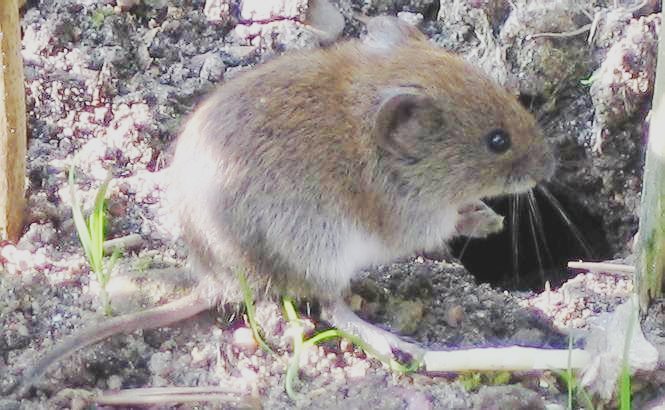
Bank vole: She’s cute, but she might eat you.
In the search for a perfect Mother’s Day card, I try to look for a greeting that perfectly captures how I feel about my mother — I want to let her know that I am grateful for all she has done for me but also want to be lighthearted and funny. If I were a bank vole or a house finch instead of a human, though, I might want a card that simply states, “Thanks, mom, for not eating me!”
A number of animal species, from mammals to insects, engage in filial cannibalism, or the consumption of one’s own offspring. And while it might seem cruel and disadvantageous for animals to eat their young, the fact that this process has persisted over the course of evolution suggests some biological benefit to it.
Harsh environmental conditions will undoubtedly put pressure on a species, and sometimes the decision of how to keep your species evolutionarily fit — by passing favorable genetic traits to subsequent generations — is in the hands — or paws (or teeth) — of the matriarch. Maternal care can increase the survival of a species, so if a mom can’t sufficiently take care of some or all of her young, she will cut her losses.
One popular explanation for why a mother might eat her young relates to food availability and reproductive success. Creating the next generation takes a lot of energy, and sometimes moms get hungry. If food is limited, a mom might eat one or several newborns in her brood and reinvest the nutrients into the selected surviving offspring. Or, in really trying times, a mom might eat her entire clutch of offspring as a survival mechanism to ensure that she is around to make babies in the future (when food might be more plentiful).
For instance, many fish eat their offspring in response to how much food they have. But the evidence supporting the idea that eating your own eggs will actually provide enough energy for survival is mixed, and moms might eat their young for other reasons.
.jpg)
American burying beetle. If you’re offspring, she can be as scary as she looks.
Perhaps one thing all moms have in common is that they don’t want to see unhealthy or even dangerous competition among their own children. Take the American burying beetle, for example. The feeding mechanism of this bug involves finding and burying carrion — dead insects, rodents, or reptiles — near their eggs. If the carrion is large enough, the burying beetle eggs will hatch, feed on the carcass, and develop into adult beetles. If the carrion is small, however, the mother burying beetle will avoid an unfavorable situation by, together with the father beetle, eating about half her brood — not because the parent beetles are hungry, but as a means to reduce competition for food among the offspring.
Nutritional needs or reducing food competition aren’t the only explanations for filial cannibalism. Sometimes a mother is selecting (not consciously, mind you) what types of babies they bring into this world. From a species survival standpoint, being able to select the qualities passed down to offspring is nothing more than a very real example of “survival of the fittest.”
There are some cases when father’s identity is unknown, leaving the mom in the dark about his traits and, presumably, her offspring’s fitness. So instead of putting in the energy to have a healthy brood, she’ll eat the whole lot. Several types of fish that show some level of prenatal care, including bluegills and sticklebacks, also show this behavior. But I was surprised to learn that this type of activity also happens in what might be more known as a caring and social animal species: langur monkeys. While filial cannibalism is a relatively rare occurrence among primates, a female langur monkey has been know to kill her infant if a new, dominant, and more genetically fit male is available for mating.
Another way filial cannibalism is linked to survival of the fittest is its use in selecting for eggs that develop fast. Not only do faster developing eggs have less of a chance to get eaten by prey, speeding up the maturation process can also widen the fertility window for females. However, the genes and other biological factors that are behind this evolutionary response have yet to be identified.
Whether a mom needs to immediately address nutritional needs or is looking to contribute to the long-term survival of her species, filial cannibalism in the animal kingdom is an interesting behavior with many potential benefits. While scientists are still trying to put together the precise reasons a mom might eat her kids, I am thankful that I was born a human where the closest we come to this kind of behavior is when grandma says, “Oh, he’s so cute, I could just eat him up!” No, grandma. Just … no.
Happy Mother’s Day!
Supporting Literature
- J. Bartlett, Filial cannibalism in burying beetles, Behavioral Ecology and Sociobiology, Vol. 21, No. 3 (1987), pp. 179-183 [PDF]
- Hope Klug and Michael B. Bonsall, When to Care for, Abandon, or Eat Your Offspring: The Evolution of Parental Care and Filial Cannibalism, The American Naturalist, Vol. 170, No. 6 (December 2007), pp. 886-901 [PDF]
- GJ Fitzgerald, Filial Cannibalism in Fishes: Why do parents eat their offspring?, Trends in Ecology and Evolution, 1992 Jan;7(1):7-10.
[Image credits:Front-page teeth image acquired via Wikimedia Commons. Photo taken by Dozenist, made available under Creative Commons Attribution Share-Alike licenses. Vole, image credit: Soebe; image via Wikimedia Commons, Creative Commons Attribution Share-Alike license. American burying beetle, image credit: Magnus Manske, image via Wikimedia Commons, Creative Commons Attribution Generic 2.0 license.]