
 |
| Source |
Category Archives: Chemistry
XX Tech Report: Rapid detection and treatment for deadly blood infections
| Methicillin-resistant Staphylococcus aureus (green), a frequent agent in blood infections, under attack from a white blood cell. Photo: Wikimedia Commons, public domain. |
By Jeffrey Perkel, Ph.D., DXS technology editor
[Ed. note: Introducing our new technology editor, Jeffrey Perkel!
Jeffrey, a recovering scientist, has always had a passion for the technology and the gadgetry of science. He has been a scientific writer and editor since 2000, when he left academia to join the staff of The Scientist magazine as a Senior Editor for Technology. Before that, he studied transcription factor biology at the University of Pennsylvania and Harvard Medical School — training that, surprisingly, has little application in the real world. In 2006, he and his family headed west to Pocatello, Idaho, and has been a freelance writer ever since. You can see why Double X Science is thrilled to have him on the team! You can find Jeffrey at his Website or on Twitter at @j_perkel. Welcome, Jeff!]
A story published earlier this week on NBCNews.com both alarmed me and piqued my interest.
It alarmed me because, well, I don’t like microbes much (despite, or perhaps because of my background in microbiology), and this article is about people getting very, very sick from sepsis (aka septicemia or bacteremia, an infection of the blood), which presents itself as a whole-body inflammatory response and a significantly increased risk of organ failure. It is an important area of microbiology because sepsis results from a bacterial infection, and the article says that 20% to 50% of infected patients die from sepsis.
My interest was piqued, however, because the piece goes on to talk about how a new genetic testing device that the US Food and Drug Administration approved in June could possibly help rein in the disease. That’s because it can reduce the time for diagnosing sepsis from days to hours. And when it comes to sepsis, time is critical.
Sepsis is confirmed by testing for the presence of specific types of bacteria in blood samples from patients and identifying what bacteria, if any, are in the circulation. If they are present, the researchers need to find out if the bugs are resistant to any antibiotic. Unfortunately, all that takes time – time the patient often doesn’t have. As the news story notes,
A 2010 study in the journal Critical Care Medicine found that for every hour of delay in administering antibiotics, mortality rose by 7.6 percent.
The new testing system is called the Verigene Gram-positive Blood Culture Test, marketed by Nanosphere Inc., a nanotechnology company in Northbrook, Ill. NBCNews.com describes the system:
About the size of a small microwave oven, the Verigene Gram-positive Blood Culture Nucleic Acid Test is the first system approved by the FDA to identify quickly certain bacteria responsible for bloodstream infections — and whether some are resistant to the top drugs used against them.
Instead of the three days required for a traditional blood culture panel, results from the Verigene test come back within three hours, identifying up to a dozen specific bacteria known to cause sepsis, including strains of Staphylococcus, Streptococcus, Enterococcus and Listeria.
Of particular importance, the system can catch some particularly nasty bugs, methicillin-resistant Staphylococcus aureus (MRSA; see Maryn McKenna’s excellent Superbug if you really want to terrify yourself on this subject) and vancomycin-resistant Enterococci.
In its press release announcing the Verigene test’s approval, the FDA said that, compared to standard microbiology methods, the Verigene test results “were consistent with traditional blood culture methods in 93 percent to 100 percent of the comparisons.”
The test is remarkably simple, and even automated, requiring a dedicated sample processing instrument and a reader from Nanosphere.
The patient sample is added to a glass slide covered with capture signals that recognize DNA from sepsis-causing bacteria. The capture signals are placed on the glass slide in a defined order, each programmed to recognize only one strain of bacteria. This uniform order helps scientists identify which strain of bacteria, if any, is responsible for the infection. If the patient blood sample contains bacteria, the signals on the glass slide will capture its DNA, and the special scanner and software can detect this capture.
What sets the Verigene test apart from the previously available tests for sepsis is precisely how they do the detecting. The test adds sub-microscopic gold balls, called gold nanoparticles, to the glass slide. These gold nanoparticles are studded with more capture signals. When bacteria match up with the same specific capture signals, the nanoparticles will attach to that area. This ball gives scientists the ability to more rapidly detect which type of bacteria, if any, is present, and thus select the right course of antibiotic treatment.
The reaction is developed by coating the gold nanoparticles with silver, a process called signal amplification, which increases sensitivity up to 100,000 times, and then hitting it with light. Those spots containing the nanoparticles scatter light; those without it, do not. The effect is so strong, the original paper detected it using a “conventional flatbed scanner,” like something you’d have in your home office.
According to Nanosphere’s website, the whole thing requires less than five minutes’ worth of hands-on time, plus 2.5 hours to get the result. That falls within the necessary time frame to diagnose sepsis and begin life-saving antibiotic therapy.
Hopefully, this is a technology that neither your family nor mine will ever need. But it’s nice to know it’s there. And now, you know how it works.
(If you’re interested in the research paper that led to this test, from company cofounders Robert Letsinger and Chad Mirkin, both of Northwestern University, you can read it here.)
Double X Science panel at GeekGirlCon 2012

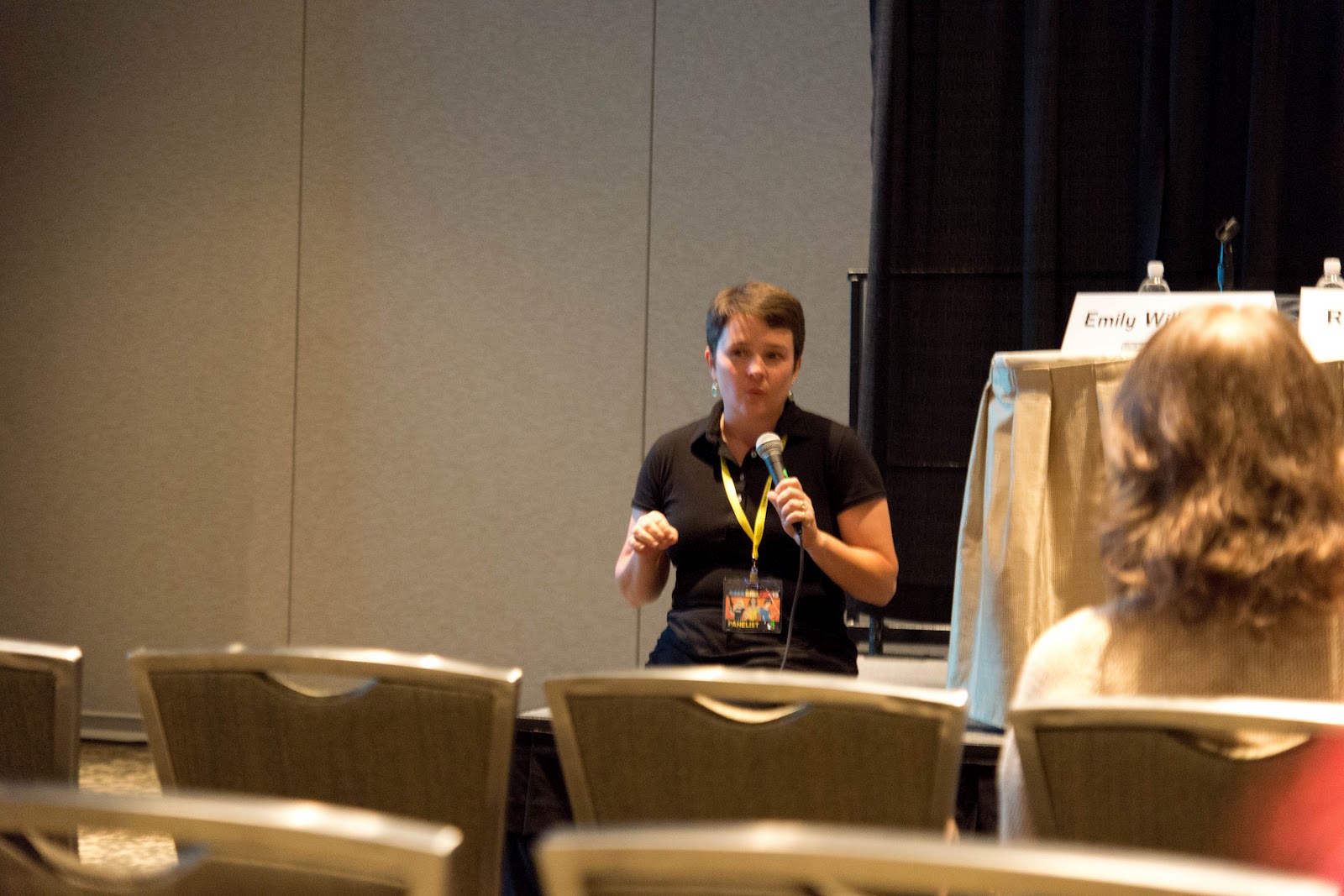
On Sunday, Aug 12, Managing Editor Emily Willingham, Chemistry Editor Adrienne Roehrich, and Contributor Raychelle Burks spoke on bringing science to you. Here’s a summary of our panel.
 |
| Photo by Ryan Roehrich and used with permission. |
We started with a welcome and gratitude to the organizers and attendees and our tagline “Science, I am Just That Into You.” We were selected to appear with a lot of fantastic programming over the weekend.
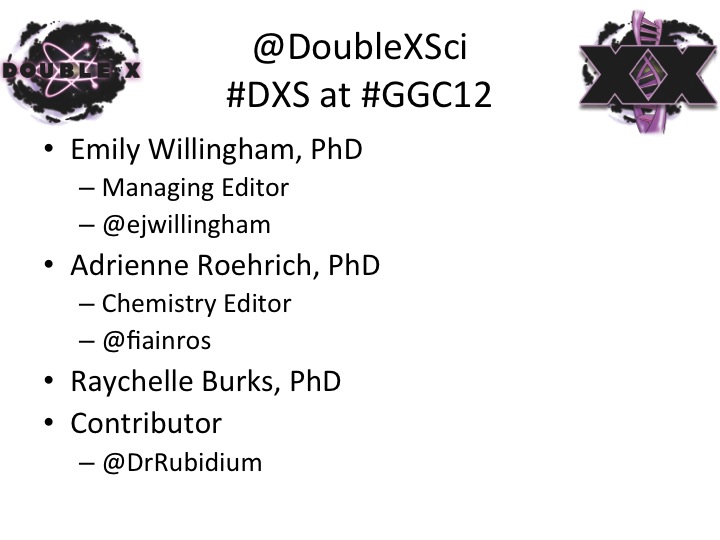
We introduced our 3 panelists:
Adrienne Roehrich, your panel moderator and the chemistry editor at Double X Science
Emily Willingham, founder and managing editor
Ray Burks, contributor to Double X Science
 |
| Photo by Ryan Roehrich and used with permission. |
All 3 have PhDs in their respective fields – Emily is a developmental biologist, Ray is an analytical chemist, and Adrienne is a physical chemist. Emily and Ray are prolific writers. You can find their articles all over the internet and in print. Ray is a staff member for GeekGirlCon and Adrienne is a Special Agent volunteer. All 3 are active on social media and welcome live-tweeting and suggest the #DXS hashtag along with the #GGC12. And you can use the @DoubleXSci for the panel.

Then a poll of the room to see who had heard of the site. Only a few attendees were already familiar with the site, so we told them that DoubleXScience covers a lot of current science. For example on (the previous) Monday, Emily posted about the Mars Curiosity Rover touchdown. In July, the physics editor covered the Higgs particle announcement. We also cover timeless, yet updated science, such as pregnancy and other health issues that we editors perceive to be of interest to ourselves and our readers.
It’s hard to discuss what Double X Science is without discussing who it is.
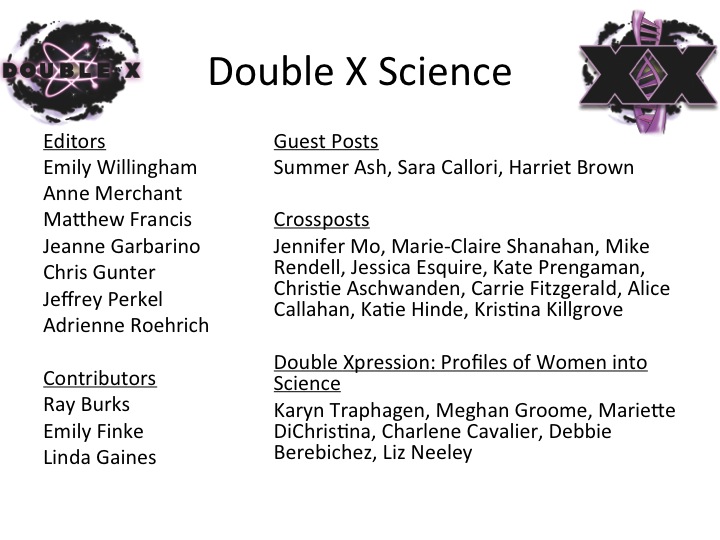
After a review of who all the people on that particular slide are and what they have to do with Double X Science, three questions were asked by the moderator:
In November of 2011, Emily founded Double X Science, Emily what was your motivation in founding the site and what was then and is now your vision for it?
As mentioned, we have content from editors, other sites and contributors. Ray was the first contributor to the site – what attracted you to Double X Science?
What do the attendees want to know?
And then our discussion really got started. Thankfully, we had 3 great tweeters attending, so I can just point you along their tweets:
[<a href=”http://storify.com/fiainros/double-x-science-panel-at-geekgirlcon-2012″ target=”_blank”>View the story “Double X Science panel at GeekGirlCon 2012” on Storify</a>]
 |
| Photo by Adrienne Roehrich and used with permission. |
Posted by Adrienne M. Roehrich, Chemistry Editor
Explosions, Just a Bit More Than Fireworks
| Image by Nux. (Source) |
By Adrienne M Roehrich, Chemistry Editor
It’s that time of the year in the U.S. – when we blow up pretty bombs in celebration of the approval of the Declaration of Independence, declaring the independence from the Kingdom of Great Britain. Around this time of year, there is no dearth of articles about the chemistry of fireworks, but the chemistry editor here could not let her secret love of this topic pass by.
What is an explosive? An explosive is a combination of materials that when reacted produce an abundance of light, sound, heat, and pressure. A firework encompasses all 4 of those: we are familiar with the light – the whole reason we view fireworks, we are familiar with the sound – the boom that follows especially large displays, we are familiar with the pressure if we are close enough – that’s the force that pushes into you and the “shock wave” pictured in movies after large explosions; and we are familiar with the heat – ever held a sparkler?
There are three main types of explosives: chemical, nuclear, and mechanical. The bulk of this post will focus on chemical explosives with a short bit about nuclear and mechanical.
If we start at the beginning – well, we’ll skip to the “accepted” first explosive – black powder. Black powder, also called gun powder and the precursor to fireworks, is coined a chemical explosive. Chemical explosions generally fall into a specific classification of chemical reactions called oxidation.
The earliest definition of oxidation was the addition of the element oxygen to a compound, also called combustion. Due to limits of this definition, it was later changed to be the loss of electrons from an element (within a compound.) The original definition can easily be shown in terms of explosives. The simple mixing of hydrogen and oxygen with the addition of just a bit of heat, will form water in an explosive display:
2H2 + O2 -> 2H2O
The little flame used to catalyze the reaction in the video is actually much more energy than is necessary to cause this reaction to occur, but it’s difficult to get an even littler source of heat and safely demonstrate this reaction. You might also note a lot more energy comes out of that reaction once started in terms of light and heat and sound. I’ve been the one lighting that reaction in a demo without both ears plugged and I couldn’t hear out of one ear for the rest of the lecture.
If we focus on the loss of electrons version of oxidation, we get specific colors. This is what the flame video by The Fabulab focused on in their entry for Alan Alda’s Flame Challenge. I direct your attention to 1:08 and the discussion of electrons.
Metals are the simplest example (and most used) example of oxidation as the loss of electrons and the color change associated. Because some electrons are lost, we now have a different set of electrons changing energy and a different color appears.
From here, it is easy to see how fireworks fall into this category of explosives. Fireworks are always being further refined to produce a specific set of light and sound. For a bit more information, this video gets fairly specific.
The vast majority of explosives in use today are considered chemical explosives. This covers a range of materials, including the aforementioned black powder and fireworks, nitroglycerin, dynamite, plastic explosives (C4 for Mythbusters and sci-fi television show fans), and the ones with water now restricting the amount of water one is allowed to bring onto an airplane in the U.S.
Another type of explosive is a nuclear explosive. The energy in these explosives come from a nuclear reaction. Wikipedia differentiates types of nuclear explosions into stellar and man-made. Another way to differentiate nuclear reactions is by fission and fusion. The explosions at the heart of stars fall under nuclear fusion and are called stellar nucleosynthesis.
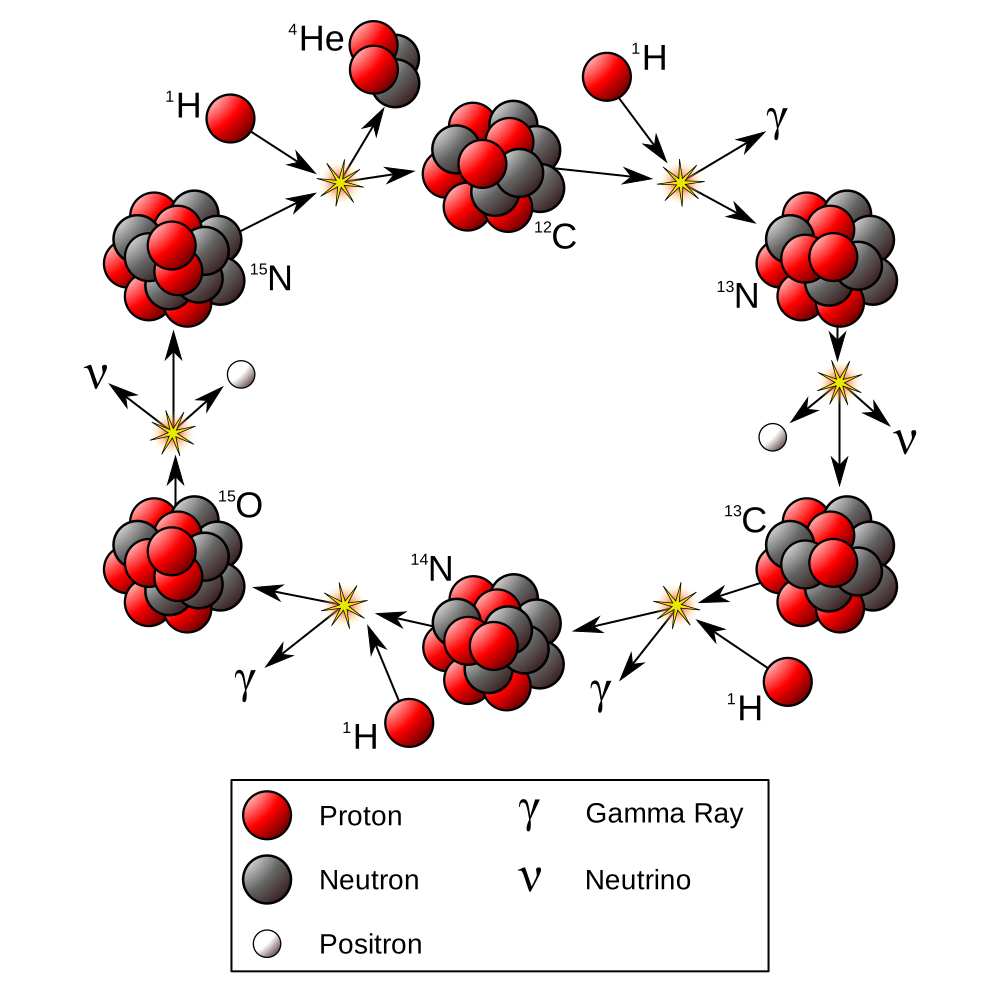
Nuclear fusion is the process of forcing 2 atoms into 1 new, larger atom. The CNO cycle, diagrammed here, is one of the nuclear fusion reactions occurring in stellar nucleosynthesis.
 |
| Source |
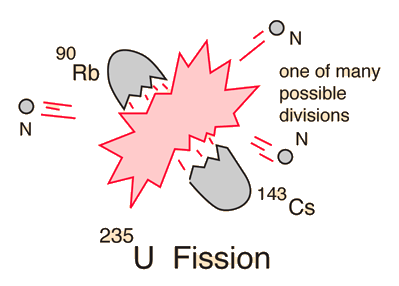
Nuclear fission is the process involved in nuclear weapons.
Nuclear fission is the process of dividing an atom into 2 or more smaller atoms. In both nuclear fusion and nuclear fission processes, specific types of radiation are emitted because the new atoms produced do not have the same energy as the starting material. The radiation emitted in these reactions is not just from a change of electrons but from a change from the nucleus of the atom. This emission of radiation is part of the light and heat from the sun and the light and heat of a nuclear bomb.
The third and last type of explosive I will cover is a mechanical explosive. These explosions occur as a purely physical process, but can then incite a chemical explosion. Mechanical explosions occur due to a sudden release of a build up of pressure. A specific kind of these explosions are under conditions where a liquid is pressurized in a vessel and a rupture brings it above its boiling point, called a boiling liquid expanding vapor explosion, BLEVE. Steam powered trains were sometimes damaged by these type of explosions. An explosion of a water heater falls into this category. Mechanical explosions are the rarest and perhaps least covered types of explosives.
Water heater explosion by the Mythbusters.
These views are the opinion of the author and do not necessarily either reflect or disagree with those of the DXS editorial team.
Biology Explainer: The big 4 building blocks of life-carbohydrates, fats, proteins, and nucleic acids
The short version
- The four basic categories of molecules for building life are carbohydrates, lipids, proteins, and nucleic acids.
- Carbohydrates serve many purposes, from energy to structure to chemical communication, as monomers or polymers.
- Lipids, which are hydrophobic, also have different purposes, including energy storage, structure, and signaling.
- Proteins, made of amino acids in up to four structural levels, are involved in just about every process of life.
- The nucleic acids DNA and RNA consist of four nucleotide building blocks, and each has different purposes.
The longer version
Life is so diverse and unwieldy, it may surprise you to learn that we can break it down into four basic categories of molecules. Possibly even more implausible is the fact that two of these categories of large molecules themselves break down into a surprisingly small number of building blocks. The proteins that make up all of the living things on this planet and ensure their appropriate structure and smooth function consist of only 20 different kinds of building blocks. Nucleic acids, specifically DNA, are even more basic: only four different kinds of molecules provide the materials to build the countless different genetic codes that translate into all the different walking, swimming, crawling, oozing, and/or photosynthesizing organisms that populate the third rock from the Sun.
Big Molecules with Small Building Blocks
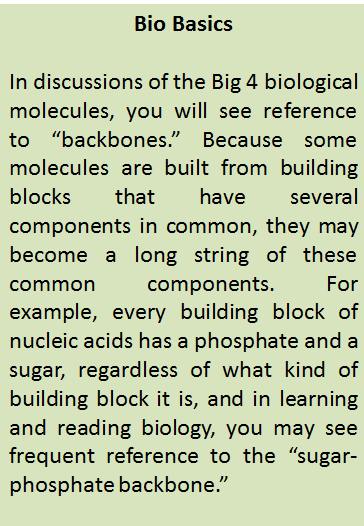
The functional groups, assembled into building blocks on backbones of carbon atoms, can be bonded together to yield large molecules that we classify into four basic categories. These molecules, in many different permutations, are the basis for the diversity that we see among living things. They can consist of thousands of atoms, but only a handful of different kinds of atoms form them. It’s like building apartment buildings using a small selection of different materials: bricks, mortar, iron, glass, and wood. Arranged in different ways, these few materials can yield a huge variety of structures.
We encountered functional groups and the SPHONC in Chapter 3. These components form the four categories of molecules of life. These Big Four biological molecules are carbohydrates, lipids, proteins, and nucleic acids. They can have many roles, from giving an organism structure to being involved in one of the millions of processes of living. Let’s meet each category individually and discover the basic roles of each in the structure and function of life.
Carbohydrates
You have met carbohydrates before, whether you know it or not. We refer to them casually as “sugars,” molecules made of carbon, hydrogen, and oxygen. A sugar molecule has a carbon backbone, usually five or six carbons in the ones we’ll discuss here, but it can be as few as three. Sugar molecules can link together in pairs or in chains or branching “trees,” either for structure or energy storage.
When you look on a nutrition label, you’ll see reference to “sugars.” That term includes carbohydrates that provide energy, which we get from breaking the chemical bonds in a sugar called glucose. The “sugars” on a nutrition label also include those that give structure to a plant, which we call fiber. Both are important nutrients for people.
Sugars serve many purposes. They give crunch to the cell walls of a plant or the exoskeleton of a beetle and chemical energy to the marathon runner. When attached to other molecules, like proteins or fats, they aid in communication between cells. But before we get any further into their uses, let’s talk structure.
The sugars we encounter most in basic biology have their five or six carbons linked together in a ring. There’s no need to dive deep into organic chemistry, but there are a couple of essential things to know to interpret the standard representations of these molecules.
Check out the sugars depicted in the figure. The top-left molecule, glucose, has six carbons, which have been numbered. The sugar to its right is the same glucose, with all but one “C” removed. The other five carbons are still there but are inferred using the conventions of organic chemistry: Anywhere there is a corner, there’s a carbon unless otherwise indicated. It might be a good exercise for you to add in a “C” over each corner so that you gain a good understanding of this convention. You should end up adding in five carbon symbols; the sixth is already given because that is conventionally included when it occurs outside of the ring.
On the left is a glucose with all of its carbons indicated. They’re also numbered, which is important to understand now for information that comes later. On the right is the same molecule, glucose, without the carbons indicated (except for the sixth one). Wherever there is a corner, there is a carbon, unless otherwise indicated (as with the oxygen). On the bottom left is ribose, the sugar found in RNA. The sugar on the bottom right is deoxyribose. Note that at carbon 2 (*), the ribose and deoxyribose differ by a single oxygen.
The lower left sugar in the figure is a ribose. In this depiction, the carbons, except the one outside of the ring, have not been drawn in, and they are not numbered. This is the standard way sugars are presented in texts. Can you tell how many carbons there are in this sugar? Count the corners and don’t forget the one that’s already indicated!
If you said “five,” you are right. Ribose is a pentose (pent = five) and happens to be the sugar present in ribonucleic acid, or RNA. Think to yourself what the sugar might be in deoxyribonucleic acid, or DNA. If you thought, deoxyribose, you’d be right.
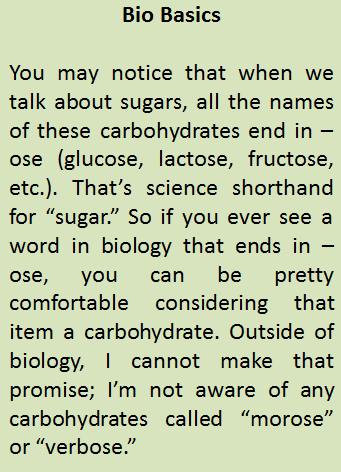
The fourth sugar given in the figure is a deoxyribose. In organic chemistry, it’s not enough to know that corners indicate carbons. Each carbon also has a specific number, which becomes important in discussions of nucleic acids. Luckily, we get to keep our carbon counting pretty simple in basic biology. To count carbons, you start with the carbon to the right of the non-carbon corner of the molecule. The deoxyribose or ribose always looks to me like a little cupcake with a cherry on top. The “cherry” is an oxygen. To the right of that oxygen, we start counting carbons, so that corner to the right of the “cherry” is the first carbon. Now, keep counting. Here’s a little test: What is hanging down from carbon 2 of the deoxyribose?
If you said a hydrogen (H), you are right! Now, compare the deoxyribose to the ribose. Do you see the difference in what hangs off of the carbon 2 of each sugar? You’ll see that the carbon 2 of ribose has an –OH, rather than an H. The reason the deoxyribose is called that is because the O on the second carbon of the ribose has been removed, leaving a “deoxyed” ribose. This tiny distinction between the sugars used in DNA and RNA is significant enough in biology that we use it to distinguish the two nucleic acids.
In fact, these subtle differences in sugars mean big differences for many biological molecules. Below, you’ll find a couple of ways that apparently small changes in a sugar molecule can mean big changes in what it does. These little changes make the difference between a delicious sugar cookie and the crunchy exoskeleton of a dung beetle.
Sugar and Fuel
A marathon runner keeps fuel on hand in the form of “carbs,” or sugars. These fuels provide the marathoner’s straining body with the energy it needs to keep the muscles pumping. When we take in sugar like this, it often comes in the form of glucose molecules attached together in a polymer called starch. We are especially equipped to start breaking off individual glucose molecules the minute we start chewing on a starch.
Double X Extra: A monomer is a building block (mono = one) and a polymer is a chain of monomers. With a few dozen monomers or building blocks, we get millions of different polymers. That may sound nutty until you think of the infinity of values that can be built using only the numbers 0 through 9 as building blocks or the intricate programming that is done using only a binary code of zeros and ones in different combinations.
Our bodies then can rapidly take the single molecules, or monomers, into cells and crack open the chemical bonds to transform the energy for use. The bonds of a sugar are packed with chemical energy that we capture to build a different kind of energy-containing molecule that our muscles access easily. Most species rely on this process of capturing energy from sugars and transforming it for specific purposes.
Polysaccharides: Fuel and Form
Plants use the Sun’s energy to make their own glucose, and starch is actually a plant’s way of storing up that sugar. Potatoes, for example, are quite good at packing away tons of glucose molecules and are known to dieticians as a “starchy” vegetable. The glucose molecules in starch are packed fairly closely together. A string of sugar molecules bonded together through dehydration synthesis, as they are in starch, is a polymer called a polysaccharide (poly = many; saccharide = sugar). When the monomers of the polysaccharide are released, as when our bodies break them up, the reaction that releases them is called hydrolysis.
Double X Extra: The specific reaction that hooks one monomer to another in a covalent bond is called dehydration synthesis because in making the bond-synthesizing the larger molecule-a molecule of water is removed (dehydration). The reverse is hydrolysis (hydro = water; lysis = breaking), which breaks the covalent bond by the addition of a molecule of water.
Although plants make their own glucose and animals acquire it by eating the plants, animals can also package away the glucose they eat for later use. Animals, including humans, store glucose in a polysaccharide called glycogen, which is more branched than starch. In us, we build this energy reserve primarily in the liver and access it when our glucose levels drop.
Whether starch or glycogen, the glucose molecules that are stored are bonded together so that all of the molecules are oriented the same way. If you view the sixth carbon of the glucose to be a “carbon flag,” you’ll see in the figure that all of the glucose molecules in starch are oriented with their carbon flags on the upper left.
The orientation of monomers of glucose in polysaccharides can make a big difference in the use of the polymer. The glucoses in the molecule on the top are all oriented “up” and form starch. The glucoses in the molecule on the bottom alternate orientation to form cellulose, which is quite different in its function from starch.
Storing up sugars for fuel and using them as fuel isn’t the end of the uses of sugar. In fact, sugars serve as structural molecules in a huge variety of organisms, including fungi, bacteria, plants, and insects.
The primary structural role of a sugar is as a component of the cell wall, giving the organism support against gravity. In plants, the familiar old glucose molecule serves as one building block of the plant cell wall, but with a catch: The molecules are oriented in an alternating up-down fashion. The resulting structural sugar is called cellulose.
That simple difference in orientation means the difference between a polysaccharide as fuel for us and a polysaccharide as structure. Insects take it step further with the polysaccharide that makes up their exoskeleton, or outer shell. Once again, the building block is glucose, arranged as it is in cellulose, in an alternating conformation. But in insects, each glucose has a little extra added on, a chemical group called an N-acetyl group. This addition of a single functional group alters the use of cellulose and turns it into a structural molecule that gives bugs that special crunchy sound when you accidentally…ahem…step on them.
These variations on the simple theme of a basic carbon-ring-as-building-block occur again and again in biological systems. In addition to serving roles in structure and as fuel, sugars also play a role in function. The attachment of subtly different sugar molecules to a protein or a lipid is one way cells communicate chemically with one another in refined, regulated interactions. It’s as though the cells talk with each other using a specialized, sugar-based vocabulary. Typically, cells display these sugary messages to the outside world, making them available to other cells that can recognize the molecular language.
Lipids: The Fatty Trifecta
Starch makes for good, accessible fuel, something that we immediately attack chemically and break up for quick energy. But fats are energy that we are supposed to bank away for a good long time and break out in times of deprivation. Like sugars, fats serve several purposes, including as a dense source of energy and as a universal structural component of cell membranes everywhere.
Fats: the Good, the Bad, the Neutral
Turn again to a nutrition label, and you’ll see a few references to fats, also known as lipids. (Fats are slightly less confusing that sugars in that they have only two names.) The label may break down fats into categories, including trans fats, saturated fats, unsaturated fats, and cholesterol. You may have learned that trans fats are “bad” and that there is good cholesterol and bad cholesterol, but what does it all mean?
Let’s start with what we mean when we say saturated fat. The question is, saturated with what? There is a specific kind of dietary fat call the triglyceride. As its name implies, it has a structural motif in which something is repeated three times. That something is a chain of carbons and hydrogens, hanging off in triplicate from a head made of glycerol, as the figure shows. Those three carbon-hydrogen chains, or fatty acids, are the “tri” in a triglyceride. Chains like this can be many carbons long.
Double X Extra: We call a fatty acid a fatty acid because it’s got a carboxylic acid attached to a fatty tail. A triglyceride consists of three of these fatty acids attached to a molecule called glycerol. Our dietary fat primarily consists of these triglycerides.
Triglycerides come in several forms. You may recall that carbon can form several different kinds of bonds, including single bonds, as with hydrogen, and double bonds, as with itself. A chain of carbon and hydrogens can have every single available carbon bond taken by a hydrogen in single covalent bond. This scenario of hydrogen saturation yields a saturated fat. The fat is saturated to its fullest with every covalent bond taken by hydrogens single bonded to the carbons.
Saturated fats have predictable characteristics. They lie flat easily and stick to each other, meaning that at room temperature, they form a dense solid. You will realize this if you find a little bit of fat on you to pinch. Does it feel pretty solid? That’s because animal fat is saturated fat. The fat on a steak is also solid at room temperature, and in fact, it takes a pretty high heat to loosen it up enough to become liquid. Animals are not the only organisms that produce saturated fat-avocados and coconuts also are known for their saturated fat content.
The top graphic above depicts a triglyceride with the glycerol, acid, and three hydrocarbon tails. The tails of this saturated fat, with every possible hydrogen space occupied, lie comparatively flat on one another, and this kind of fat is solid at room temperature. The fat on the bottom, however, is unsaturated, with bends or kinks wherever two carbons have double bonded, booting a couple of hydrogens and making this fat unsaturated, or lacking some hydrogens. Because of the space between the bumps, this fat is probably not solid at room temperature, but liquid.
You can probably now guess what an unsaturated fat is-one that has one or more hydrogens missing. Instead of single bonding with hydrogens at every available space, two or more carbons in an unsaturated fat chain will form a double bond with carbon, leaving no space for a hydrogen. Because some carbons in the chain share two pairs of electrons, they physically draw closer to one another than they do in a single bond. This tighter bonding result in a “kink” in the fatty acid chain.
In a fat with these kinks, the three fatty acids don’t lie as densely packed with each other as they do in a saturated fat. The kinks leave spaces between them. Thus, unsaturated fats are less dense than saturated fats and often will be liquid at room temperature. A good example of a liquid unsaturated fat at room temperature is canola oil.
A few decades ago, food scientists discovered that unsaturated fats could be resaturated or hydrogenated to behave more like saturated fats and have a longer shelf life. The process of hydrogenation-adding in hydrogens-yields trans fat. This kind of processed fat is now frowned upon and is being removed from many foods because of its associations with adverse health effects. If you check a food label and it lists among the ingredients “partially hydrogenated” oils, that can mean that the food contains trans fat.
Double X Extra: A triglyceride can have up to three different fatty acids attached to it. Canola oil, for example, consists primarily of oleic acid, linoleic acid, and linolenic acid, all of which are unsaturated fatty acids with 18 carbons in their chains.
Why do we take in fat anyway? Fat is a necessary nutrient for everything from our nervous systems to our circulatory health. It also, under appropriate conditions, is an excellent way to store up densely packaged energy for the times when stores are running low. We really can’t live very well without it.
Phospholipids: An Abundant Fat
You may have heard that oil and water don’t mix, and indeed, it is something you can observe for yourself. Drop a pat of butter-pure saturated fat-into a bowl of water and watch it just sit there. Even if you try mixing it with a spoon, it will just sit there. Now, drop a spoon of salt into the water and stir it a bit. The salt seems to vanish. You’ve just illustrated the difference between a water-fearing (hydrophobic) and a water-loving (hydrophilic) substance.
Generally speaking, compounds that have an unequal sharing of electrons (like ions or anything with a covalent bond between oxygen and hydrogen or nitrogen and hydrogen) will be hydrophilic. The reason is that a charge or an unequal electron sharing gives the molecule polarity that allows it to interact with water through hydrogen bonds. A fat, however, consists largely of hydrogen and carbon in those long chains. Carbon and hydrogen have roughly equivalent electronegativities, and their electron-sharing relationship is relatively nonpolar. Fat, lacking in polarity, doesn’t interact with water. As the butter demonstrated, it just sits there.
There is one exception to that little maxim about fat and water, and that exception is the phospholipid. This lipid has a special structure that makes it just right for the job it does: forming the membranes of cells. A phospholipid consists of a polar phosphate head-P and O don’t share equally-and a couple of nonpolar hydrocarbon tails, as the figure shows. If you look at the figure, you’ll see that one of the two tails has a little kick in it, thanks to a double bond between the two carbons there.
Phospholipids form a double layer and are the major structural components of cell membranes. Their bend, or kick, in one of the hydrocarbon tails helps ensure fluidity of the cell membrane. The molecules are bipolar, with hydrophilic heads for interacting with the internal and external watery environments of the cell and hydrophobic tails that help cell membranes behave as general security guards.
The kick and the bipolar (hydrophobic and hydrophilic) nature of the phospholipid make it the perfect molecule for building a cell membrane. A cell needs a watery outside to survive. It also needs a watery inside to survive. Thus, it must face the inside and outside worlds with something that interacts well with water. But it also must protect itself against unwanted intruders, providing a barrier that keeps unwanted things out and keeps necessary molecules in.
Phospholipids achieve it all. They assemble into a double layer around a cell but orient to allow interaction with the watery external and internal environments. On the layer facing the inside of the cell, the phospholipids orient their polar, hydrophilic heads to the watery inner environment and their tails away from it. On the layer to the outside of the cell, they do the same.
As the figure shows, the result is a double layer of phospholipids with each layer facing a polar, hydrophilic head to the watery environments. The tails of each layer face one another. They form a hydrophobic, fatty moat around a cell that serves as a general gatekeeper, much in the way that your skin does for you. Charged particles cannot simply slip across this fatty moat because they can’t interact with it. And to keep the fat fluid, one tail of each phospholipid has that little kick, giving the cell membrane a fluid, liquidy flow and keeping it from being solid and unforgiving at temperatures in which cells thrive.
Steroids: Here to Pump You Up?
Our final molecule in the lipid fatty trifecta is cholesterol. As you may have heard, there are a few different kinds of cholesterol, some of which we consider to be “good” and some of which is “bad.” The good cholesterol, high-density lipoprotein, or HDL, in part helps us out because it removes the bad cholesterol, low-density lipoprotein or LDL, from our blood. The presence of LDL is associated with inflammation of the lining of the blood vessels, which can lead to a variety of health problems.
But cholesterol has some other reasons for existing. One of its roles is in the maintenance of cell membrane fluidity. Cholesterol is inserted throughout the lipid bilayer and serves as a block to the fatty tails that might otherwise stick together and become a bit too solid.
Cholesterol’s other starring role as a lipid is as the starting molecule for a class of hormones we called steroids or steroid hormones. With a few snips here and additions there, cholesterol can be changed into the steroid hormones progesterone, testosterone, or estrogen. These molecules look quite similar, but they play very different roles in organisms. Testosterone, for example, generally masculinizes vertebrates (animals with backbones), while progesterone and estrogen play a role in regulating the ovulatory cycle.
Double X Extra: A hormone is a blood-borne signaling molecule. It can be lipid based, like testosterone, or short protein, like insulin.
Proteins
As you progress through learning biology, one thing will become more and more clear: Most cells function primarily as protein factories. It may surprise you to learn that proteins, which we often talk about in terms of food intake, are the fundamental molecule of many of life’s processes. Enzymes, for example, form a single broad category of proteins, but there are millions of them, each one governing a small step in the molecular pathways that are required for living.
Levels of Structure
Amino acids are the building blocks of proteins. A few amino acids strung together is called a peptide, while many many peptides linked together form a polypeptide. When many amino acids strung together interact with each other to form a properly folded molecule, we call that molecule a protein.
For a string of amino acids to ultimately fold up into an active protein, they must first be assembled in the correct order. The code for their assembly lies in the DNA, but once that code has been read and the amino acid chain built, we call that simple, unfolded chain the primary structure of the protein.
This chain can consist of hundreds of amino acids that interact all along the sequence. Some amino acids are hydrophobic and some are hydrophilic. In this context, like interacts best with like, so the hydrophobic amino acids will interact with one another, and the hydrophilic amino acids will interact together. As these contacts occur along the string of molecules, different conformations will arise in different parts of the chain. We call these different conformations along the amino acid chain the protein’s secondary structure.
Once those interactions have occurred, the protein can fold into its final, or tertiary structure and be ready to serve as an active participant in cellular processes. To achieve the tertiary structure, the amino acid chain’s secondary interactions must usually be ongoing, and the pH, temperature, and salt balance must be just right to facilitate the folding. This tertiary folding takes place through interactions of the secondary structures along the different parts of the amino acid chain.
The final product is a properly folded protein. If we could see it with the naked eye, it might look a lot like a wadded up string of pearls, but that “wadded up” look is misleading. Protein folding is a carefully regulated process that is determined at its core by the amino acids in the chain: their hydrophobicity and hydrophilicity and how they interact together.
In many instances, however, a complete protein consists of more than one amino acid chain, and the complete protein has two or more interacting strings of amino acids. A good example is hemoglobin in red blood cells. Its job is to grab oxygen and deliver it to the body’s tissues. A complete hemoglobin protein consists of four separate amino acid chains all properly folded into their tertiary structures and interacting as a single unit. In cases like this involving two or more interacting amino acid chains, we say that the final protein has a quaternary structure. Some proteins can consist of as many as a dozen interacting chains, behaving as a single protein unit.
A Plethora of Purposes
What does a protein do? Let us count the ways. Really, that’s almost impossible because proteins do just about everything. Some of them tag things. Some of them destroy things. Some of them protect. Some mark cells as “self.” Some serve as structural materials, while others are highways or motors. They aid in communication, they operate as signaling molecules, they transfer molecules and cut them up, they interact with each other in complex, interrelated pathways to build things up and break things down. They regulate genes and package DNA, and they regulate and package each other.
As described above, proteins are the final folded arrangement of a string of amino acids. One way we obtain these building blocks for the millions of proteins our bodies make is through our diet. You may hear about foods that are high in protein or people eating high-protein diets to build muscle. When we take in those proteins, we can break them apart and use the amino acids that make them up to build proteins of our own.
Nucleic Acids
How does a cell know which proteins to make? It has a code for building them, one that is especially guarded in a cellular vault in our cells called the nucleus. This code is deoxyribonucleic acid, or DNA. The cell makes a copy of this code and send it out to specialized structures that read it and build proteins based on what they read. As with any code, a typo-a mutation-can result in a message that doesn’t make as much sense. When the code gets changed, sometimes, the protein that the cell builds using that code will be changed, too.
Biohazard!The names associated with nucleic acids can be confusing because they all start with nucle-. It may seem obvious or easy now, but a brain freeze on a test could mix you up. You need to fix in your mind that the shorter term (10 letters, four syllables), nucleotide, refers to the smaller molecule, the three-part building block. The longer term (12 characters, including the space, and five syllables), nucleic acid, which is inherent in the names DNA and RNA, designates the big, long molecule.
DNA vs. RNA: A Matter of Structure
DNA and its nucleic acid cousin, ribonucleic acid, or RNA, are both made of the same kinds of building blocks. These building blocks are called nucleotides. Each nucleotide consists of three parts: a sugar (ribose for RNA and deoxyribose for DNA), a phosphate, and a nitrogenous base. In DNA, every nucleotide has identical sugars and phosphates, and in RNA, the sugar and phosphate are also the same for every nucleotide.
So what’s different? The nitrogenous bases. DNA has a set of four to use as its coding alphabet. These are the purines, adenine and guanine, and the pyrimidines, thymine and cytosine. The nucleotides are abbreviated by their initial letters as A, G, T, and C. From variations in the arrangement and number of these four molecules, all of the diversity of life arises. Just four different types of the nucleotide building blocks, and we have you, bacteria, wombats, and blue whales.
RNA is also basic at its core, consisting of only four different nucleotides. In fact, it uses three of the same nitrogenous bases as DNA-A, G, and C-but it substitutes a base called uracil (U) where DNA uses thymine. Uracil is a pyrimidine.
DNA vs. RNA: Function Wars
An interesting thing about the nitrogenous bases of the nucleotides is that they pair with each other, using hydrogen bonds, in a predictable way. An adenine will almost always bond with a thymine in DNA or a uracil in RNA, and cytosine and guanine will almost always bond with each other. This pairing capacity allows the cell to use a sequence of DNA and build either a new DNA sequence, using the old one as a template, or build an RNA sequence to make a copy of the DNA.
These two different uses of A-T/U and C-G base pairing serve two different purposes. DNA is copied into DNA usually when a cell is preparing to divide and needs two complete sets of DNA for the new cells. DNA is copied into RNA when the cell needs to send the code out of the vault so proteins can be built. The DNA stays safely where it belongs.
RNA is really a nucleic acid jack-of-all-trades. It not only serves as the copy of the DNA but also is the main component of the two types of cellular workers that read that copy and build proteins from it. At one point in this process, the three types of RNA come together in protein assembly to make sure the job is done right.
This material originally appeared in similar form in Emily Willingham’s Complete Idiot’s Guide to College Biology.
Life and science challenges: flames, Hawkeye, the needle and the damage done
 |
| (source) |
Of Heroin, Honorable Mentions, and Hawkeye: A day I will never forget
By Double X Science Biology Editor Jeanne Garbarino
“I look forward to seeing you in 3 months when you will be a whole person again.”
Those were my parting words to a special person in my life who was embarking on an undoubtedly difficult journey toward sobriety. It was only 7:45am on Friday, June 1st, but already I had learned that the strings from a bikini top make a good tourniquet, and I actually held the syringe that, only moments before, contained a bolus of heroin. I am still trying to believe that this really was the last time.
As I attempted to wrap my head around what was happening, I remembered a description of a heroin high as told to me by a former addict. According to this person, being on heroin feels like you’ve been swaddled in a warm blanket, and gently rocked by a loving mother, except the loving mother was actually the devil.
Though I could never really understand what it feels like to be hooked on heroin, this helped me make some sense of it. But, as much as I wanted to be sympathetic, I also wanted to grab my friend by the shoulders and scream. “Why have you done this to yourself? Why have you done this to us?” It has truly been a difficult time, watching this person struggle. And finding out that I can’t control any of it was probably the hardest lesson I’ve ever learned.
Still, life must go on.
I took a few deep breaths, which helped to quiet the tremble, and began to gather my thoughts. What was it that I had to do today? As if I flipped some switch, I began to plan out my day – renew my parking permit, finish that Western blot, read that thesis, and get that new post up on the site.
Then, around 8:15am, I received an unexpected phone call. It was Liz Bass from the Center of Communicating Science at Stony Brook University. She was calling to see if I could make Alan Alda’s World Science Festival discussion about the Flame Challenge, which was to occur at 4pm that afternoon. Not really knowing what was in store, I quickly accepted (um, hello, Alan Alda). A second phone call about 20 minutes later informed me that I would be joining Alan on stage. Was this really happening? In about 30 minutes time, I went from despair to elation. I also went to the store to buy a skirt since I was already in transit to my lab (and was dressed like a “scientist”).
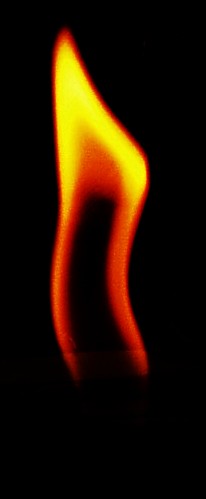
As I sat on the train, I began to reflect. Much of my free time during the month of March was dedicated to producing an entry to Alan Alda’s Flame Challenge contest, which, in an effort to raise science communication awareness, asked scientists from all over the world to define a flame to an 11 year old. Because I enjoy working on a team, I asked my fellow scicommies, Deborah Berebichez and Perrin Ireland, to join me on this endeavor (three times the brain power!). For several weeks, we worked on the script, and regularly discussed our progress during late night Google hangouts (which is a fantastic way to collaborate). This was mostly due to the fact that we all have day jobs and obligations outside of work. Luckily for me, Debbie and Perrin were willing to meet at a time that coincided after my children’s bedtime routine.
This experience was truly fun and rewarding. Each of us has a certain set of strengths, which when combined, seemed to just synergize. We literally examined every word in the script to make sure that it was clear, concise, and hopefully captivating. Furthermore, we wanted to make sure that it was something an 11-year-old would both learn from and enjoy.
But, we did labor over one particular issue, and that was our use of the Bohr Model to represent an atom. While this model might be commonplace in many classroom textbooks, scientists now know that electrons exist in orbitals, also known as electron clouds, and the calculations to determine the exact location(s) of an electron are based on probability. Clearly, this was something very different than stating that electrons simply orbit around a nucleus.
The analogy that electrons travel around the nucleus in the same way that planets travel around the sun is downright inaccurate. However, this is an analogy that is still commonly used and is, in my opinion, a great example of how we sacrifice accuracy for simplicity. I believe that this is the greatest challenge for a science communicator.
As we talked through this issue, we tried to not lose site of the actual mission, which was to explain a flame to an 11 year old. Would it help our story to break down the currently accepted atomic theory or would it detract from it? In the end, we decided to keep our atomic structure simple, but noted that it was a simplified version of an atom. We figured that by having this little disclaimer, it would inform our audience that there is more to it that what we showed, and maybe it would lead them down a road of scientific inquiry.
Perhaps it was this attention to detail that landed our Flame Challenge video a spot in the top 15 entries (FYI there were close to 900 entries). Or perhaps it was because our entry was cute and artistic. Whatever the reason, we proudly accepted our honorable mention, and I was looking forward to discussing our video with the man himself.
Getting back to Friday, June 1st. I arrived at the Paley Center for Media around 3:30pm (in a new skirt) and was immediately brought up to the 11th floor and into the green room of Alan Alda. There, I met my fellow awardees (a combination of finalists and honorable mentions), and of course Alan Alda, who was fantastically charming and funny. We all sat, around an old table, on which was a lovely array of cheese, nuts, banana chips, and get this, Swedish fish! I don’t know what it was about the Swedish fish, but seeing this candy helped calm my nerves.
Alan helped us all to break the ice, and discussed his plans for the event. Apparently we would be leading a panel discussion, and I would be on that panel. On a stage. In front of a very large audience. And it was to be webcasted. So I popped a few of those Swedish fish and told myself to not be nervous.
As my jaw worked to chew those sticky sweet candies, I couldn’t help but think about when I was a kid and how I used to sit with my dad and watch M*A*S*H. I never would have believed you if you told me that I was going to be hanging out with Hawkeye when I was older. But, there he was, telling us about the birth of the Flame Challenge. I was tempted to ask him where Corporal Klinger is these days, but decided that my time would be better spent getting the plan for the panel firmed up in my brain.
After some quick chitchat, we were asked to make our way to the auditorium. Seating was charted and mics were checked and around 4pm, it all began. About an hour into it, we were asked to come on stage. Each of our entries were highlighted, followed by a chance speak our piece. Add in some Q&A from the audience and the panel discussion was complete. A hearty round of applause later, I found myself getting whisked away for pictures.
When the dust began to settle, I grabbed a beer and started to decompress. I just couldn’t believe how this day turned out, especially given its start. The stresses my family and I have been dealing with have certainly taken its toll on all of us, and I am grateful for that little dose of Hawkeye to help lighten things up. I’m not sure if I will ever experience a day like that again, but that’s ok with me.
What does ‘safe’ mean when we’re talking about chemicals?
 |
| It’s not easy being green. First, you have decide which green to be. (Source) |

[We at Double X Science had been considering a “toxins” post but then found the following post by Jennifer Mo, a happily childfree vegetarian who lives in California with a cat named Brie but variously nicknamed Walnut “for her brain capacity” or Toxokitty for her history of toxoplasmosis-which, as it turns out, turns up in Jennifer’s guest post, below. This post first appeared at Jennifer’s blog, It’s Not Easy to Be Green, where she writes about environmental issues as a “rationalist and a pragmatist.” You can also follow Jennifer on Twitter @noteasy2begreen. We appreciated the pragmatics of this particular post quite a bit and thank Jennifer for allowing us to host it at Double X Science. We are particularly taken with the fact that she asks if we’d ever wanted to call our own brain a troglodyte.]
It’s a common demand from the public to scientists: prove to us something is safe before unleashing your monster on the world. And on one hand, it’s a totally fair, reasonable request to not be treated as lab rats. I get that. I hate the idea of having big chemical corporations profiting off their creations that create long term problems for ordinary people and the environment. On the other, whether you’re talking about GMOs or synthetic chemicals, it’s a problematic request for a couple of key reasons:
- It assumes a binary between safe and unsafe without regard to exposure level or other circumstances. Just about everything can be harmful under the right (or perhaps I should say wrong?) conditions. Take water, for example.Tons Continue reading
How to find science near you
 |
| (Source) |
By DXS Chemistry Editor Adrienne Roehrich
For scientists, finding science going on nearby seems to not be an issue. If they don’t wish to spend time in their own lab, they can generally walk down the hall to speak to a colleague. But to those who don’t know scientists in their daily lives (or don’t think they know scientists), finding a place to discuss your interests in science can be a daunting task.
Where can you find like-minded people to discuss science? There are a number of local groups in any location that may help you satisfy your science craving.
The big one, Science Online, is an annual meeting in North Carolina of scientists, science educators, science communicators, and science enthusiasts. The next meeting (in 2013 as of the writing of this post) has a planning wiki up, and a Twitter account. Science Online has spawned several local science online groups. According to the Science Online Now site, NYC, Seattle, Vancouver, and the Bay Area are having regular meetings, and tweet-ups occur in NYC, DC, and NC Tri-Cities area. There are also two conferences, one for teens in NC, and one in London.
Another way to get your science fill is to attend a “science café.” Science cafés are live events, usually hosting scientists to speak in a pub, coffee, shop, or other gathering spot, to discuss nifty science. These are not just oral presentations, they are also discussions. There’s not a state in the union without one of these events, although many occur in the more highly populated areas.
Meetup.com may be a place to see if there is a science group meeting near you. However, you must have a meetup account to view these possibilities, and a search for “science” may get you a lot of woo, too.
Maybe you aren’t looking for a discussion, but a place to do some hands-on science. Science Centers exist all over the world. Some are geared for children, but some include adults (and I enjoy playing with the kids science activities as an adult.) A listing as of 1999 exists here. However, googling “science centers” and your location (or a location you are visiting) will hopefully provide a more up-to-date result. Please comment if you know if another way for someone to find science near them.
No gene is an island: What do scientists mean when they talk about environment and genes?
 |
| Nope. This island does not represent your genes. (Source) |
When you read news stories about what affects a developing human in the womb or how cancer or obesity arises, you probably also see references to genes and environment. Some articles may focus on genes versus environment, or mention that something is “mostly” genetic or that the “environment” contributes to a disorder or trait in some way.
What some people may not realize is that “environment” to a scientist talking about genetics may be something very different from “environment” to a non-scientist reading a news article. While a scientist may be vividly imagining a bustling microenvironment of native molecules in the way only scientists seem to do, the general reader may simply be thinking about “toxins” or “chemicals.” That’s why Double X Science is here to help with a primer on what those scientist types may mean when they talk about genes and environment. See how useful we are? Tell your friends! (Speaking of environmental influences… ).
Where does environment begin and end? Let’s begin at the end
No gene is an island. Your genes consist in part of a special code that is really an instruction manual. Your cells rely on internal translators to decode these instructions and use them as a guide to make various proteins, the molecules that give your cells, tissues, organs, organ systems, and you much of their structure and function. Proteins do thousands of jobs, from breaking down food to building and replacing tissues (news release) to governing cell division. Most of your cells are engaged in making proteins, a complex, exquisitely regulated and multi-step process. But they don’t do it in a vacuum.
That code the cell uses to build the protein? That instruction manual is susceptible to all kinds of interference. Pages get torn out or folded over or stuck together. The words of the code can be changed, sometimes subtly, sometimes unmistakably, and all kinds of factors can jumble up those words so that cell ends up making a protein that isn’t quite what was intended. It’s even possible to use the cellular version of Liquid Paper(TM) to mask the code so that the cell doesn’t recognize its existence. Sometimes, these changes have no observable effect. Sometimes, they have big bad effects, such as disease, or helpful outcomes, such as disease resistance.
That code sits in a cell in a body (you) made of trillions of cells doing hundreds of different jobs, taking in things from the environment, playing host to millions of other organisms (themselves an environment), altering and shifting with every passing second as the whole system works to keep you together and functioning within certain acceptable limits for human life. All of these processes can influence the code, leading the cell to use it, change it, use only certain parts of it, Liquid Paper over it, tweak what results from its instructions, or just ignore it. It’s impossible for any code in that situation to function in the total absence of influence from its environment, in part because the code itself is just the beginning. Much of the environment’s influence is reflected in what the cell does with the instructions, not just what the instructions say.
This multitude of environmental influences is one reason that even people with identical genetic codes can have differences in diseases we think of as being largely genetic. No gene-no code-is an island. You are not your genes. You are your genes and your environment.
No nucleus is an island. Most of our genes are packaged neatly with the rest of our DNA around molecular spools inside a cellular vault called the nucleus. This vault is a choosy sentry, letting in only certain molecules carrying proper ID. Yet inside the nucleus, there is an environment. This environment is not “toxins” or “chemicals,” the things that many people probably think of when someone says “environment” and talks about genes. But it is a busy place with its own milieu. Some parts of the code are in use, some sit quiet, and many molecules bustle and hustle to maintain, copy, process, or protect these important instructions. Every little bit of this hustle and bustle can influence some aspect of what happens to a code in the nucleus, interfering with or enhancing its use or resulting in accidental changes that may have big effects further down the line. The nucleus is the final stop in the chain of environmental influence, wherever that influence may originate.
No cell is an island. Outside of that vault is the big, wide world of the cell. The cell is the molecular version of a busy metropolis (see beautiful video, The Inner Life of the Cell, below), a complex system of cellular highways that the cell uses to deliver packages internally, take in deliveries from the outside world, and transfer the millions of molecules it’s using and making to the right places at the right time. There’s a generator, a recycling center, guards at the gate, and a protein production facility and processing plant, complete with a post office. And that cell sits in an environment, usually, of many many other cells, also busy with their duties. What happens outside of that cell affects the inside of the cell, altering traffic flows, protein production and packaging, signaling and delivery along the routes, and, ultimately, processes inside the vault called the nucleus, the final destination in the chain of environmental effects. From outside the cell, through the cell, and to the nucleus, every step along the way is one that environment can affect, all the way down to what the cell does with its genes-the codes-for the proteins it makes.
No tissue or organ is an island. A lot of cells working together to do the same thing in your body make up a tissue. Tissues combined together to perform a function are an organ. Let’s take the organ named after living, the liver. It keeps you alive by filtering your blood and reconstructing substances that might harm your cells into less-harmful compounds. Just about everything you ingest gets passed through here. When the liver takes up something like ethanol, the alcohol we ingest at wine o’ clock, and gets to work making it less awful for your body, guess what does that work? The cells that make up the liver. The liver’s environment is their environment is each individual cell’s environment, and eventually, the influence will pass to the nucleus, the final destination in the chain of environmental influence, where the code lies.
You are not an island. And whatever you encounter in this world may well influence you right down to the level of your genes. But while many people might think of “toxins” or “chemicals” when they think of environmental influences on genes, your chemical exposures-and chemicals include oxygen, water, body fluids, nutrients and not-so-nutrients in your foods, medications you may take-are among many, many examples of environmental factors that may reach via a chain reaction all the way to your genes. Some of these factors affect your genes by way of your sensory system: A hug, an angry encounter, a sick child, a laugh with a friend-you respond to each of these environmental influences, often by way of hormones that have a chat with your cells. Your cells respond by adjusting how they use the code in the nucleus so that in the face of anger or love or worry, your body still functions within the essential parameters of life. Below, we list with tongue slightly in cheek a sampling of other factors that constitute an “environment” that could influence your genes and how your cell uses them and the proteins they encode. Whether you know it or not, you’re encountering a million factors every day, big and small, that may trigger some effect way down there in the nuclear vaults of your cells, one that reverberates body wide.
Some examples of “environment” that might influence genes
Environmental influence on genes and how your cells use their instructions and the resulting proteins can come from almost anywhere, any factor, from outside of you and within you. It’s not just about exposures to “bad” chemicals or “toxins.” While the list of potential environmental factors influencing genes and how the cell uses them is practically infinite, we give you just a few examples for thought below:
- Your parents, siblings, friends, extended family, co-workers, soccer team-you know, other people
- Infections
- The billions of microbes that live on you and in you
- Lifestyle factors like diet, exercise, sleep, stress
- A dusty house
- A clean house
- Hormones, from inside and out
- Age
- Sex
- School
- Pets
- Hugs
- Isolation
- Crowding
- Talking
- Supplements
- The womb and factors therein
- Playing outside
- Playing inside
- Having sex
- Abstaining from sex
- Your job
- Yogurt?
- Puberty
- Other genes
- Learning things
- Not learning things
- Minecraft
- Mozart
- Birth order
- Watching sports
- Playing sports
- Sitting a lot
- Standing a lot
- The Sun (and just about everything under it)
You get the idea.
By Emily Willingham, DXS managing editor
These views are the opinion of the author and do not necessarily either reflect or disagree with those of the DXS editorial team.
The path from science to alarmism: How science gets twisted before it gets to you
 |
| Source. |
Today’s post is long. It’s long because it involves the winding path that science can take from ignition to exploding into the public view… and how the twists and turns in that path can result in a skewed representation and understanding of the science. Read the whole thing. It focuses on an example that involves autism-which seems to pop up in skewed representations every day-but certainly this path from science to you, the consumer, happens with scientific information in general. The author is Jess, who blogged this originally at “Don’t Mind the Mess” and graciously gave us permission to reproduce it here. Jess, an attorney with a B.S. in biochemistry, parent of an autistic child and brand new baby, and self-described “Twitter fiend,” tweets as @JessicaEsquire.
—————————————————————
I am putting my foot down.
As the parent of an autistic child I hear a lot about vaccines and about half a million other things that people think cause autism.
I’m hyperaware of the attention autism gets in the media. So I know about the CDC’s new stats on autism rates. I know about the debate on whether the increase in autism is due to more awareness and diagnosis or more actual occurrences. (Personally, I find the former to be a serious factor, though who’s to say how much.) And I see all the articles that come out week after week about the millions of things that are linked to autism.
There’s a recurring problem here. Valuable research is done. Research is disseminated. Information is reported. Articles are read. Findings are spread. What starts in a lab ends up in a Facebook status. What starts as truth ends up as mistruth in something like a child’s game of telephone. Along the way, piece by piece, truth fades away in favor of headlines and pageviews and gossip.
It’s getting just plain stupid. I’m starting to suspect these articles have nothing to do with serious research but with a search for traffic and hype, an attempt to ride the wave of a trendy topic as concerned parents read every horror story they can find.
A particularly egregious one came up recently. This one doesn’t just cite some random correlation. This one is just plain making things up. The problems here just pile one on top of the other. So let’s consider it piece by piece, a case study in how real research becomes misinformation.
Part One: Research
It starts with scientists. It starts with research. They write up their findings and publish them in a peer-reviewed scientific journal. In this case there are several papers published over a few years about chemicals and their link to brain development. They cover a wide variety of issues and present a wide variety of conclusions. All of them suggest further study.
Maybe they have bad methodology or use statistics incorrectly. Only a few people would ever know the difference. That’s not my concern today. Bad science is one thing, but bad information on good science is another. So let’s assume we have good, solid science in this research.
Part Two: The Conference
Scientists and researchers with similar interests get together and discuss their findings. It’s not that difference from any other conference. There are panels and presentations.
Part Three: The Op-Ed
Next, a group that works on environmental hazards for children publishes a paper. Not a research study but an op-ed in a peer-reviewed journal. In this op-ed they review the conference from Part Two and encourage the study of environmental factors and their relationship to neurodevelopment disorders. Autism is one of many neuro-ish disorders and is mentioned by name in the piece and its title. It’s unclear to me why they zero in on autism. They have a couple vague pieces of evidence that are autism-specific, but the vast majority of what they’re looking at has never been demonstrated to have any kind of relationship to autism, not even a correlation.
Problem #1 is the unnecessary autism name-checking. Problem #2 is much worse, it’s the list of 10 chemicals they suggest for future study. The list itself isn’t a bad idea, I guess. They’re suggesting places for potential research, which certainly needs to be done. But it does reek a little bit of the kind of thing magazines do, you know what I mean, 10 Ways To Get Your Guy All Fired Up! and such. Still, it’s their prerogative.
So let’s examine their evidence for these suggestions. They cite at least one paper for each of these chemicals. I checked them all. The vast majority of them have never shown any connection to Autism (or even ADHD, another diagnosis they name-check). In fact, many of them show that with exposure to these chemicals, the outcome differentials between exposure and non-exposure is 5 IQ points.
FIVE IQ POINTS. Statistically significant? Perhaps. Practically important for a parent? No.
IQ itself is a strange and vague thing. And 5 points isn’t going to move your super-genius down to the level of an average person They’d still be a super-genius. And adding 5 points to someone with severe deficits isn’t going to make them average, either. It’s hard to imagine what difference you’d see between two people whose IQ’s are 5 points apart.
Such statistical differences may well be a sign to warrant further study. And they may be a sign that these chemicals affect neurological development. But it’s getting a bit ahead of ourselves to say they are suspected of being tied to autism. Many of these papers are in areas of research that are just beginning. Many of them involve homogeneous groups (for example, all the participants are Mexican-American migrant workers) which makes issues of genetics and heredity very difficult to account for. Many involve parents self-reporting by filling out surveys rather than having the children examined by professionals.
Let’s be fair. These are the very beginnings of research. You’ll need to do all sorts of rigorous testing and consideration to make real connections. Of course more research is needed. And it’s important that we keep that in mind as we move forward.
(Though, of course, no one else will.)
Part Four: The Press Release
The op-ed is about publicity so it’s the beginning of the problem. But it gets worse. A press release comes out with the list of ten chemicals and already the twisting starts. These are chemicals suggested for further research, but suddenly they’re a ”List of the Top Ten Toxic Chemicals Suspected to Cause Autism and Learning Disabilities.” This, unsurprisingly, is the headline you’ll see all over the internet when news organizations report on the press release. Already it’s turned from suggestions for research into a watchlist.
It gets worse. The press release has this second headline:
The editorial was published alongside four other papers — each suggesting a link between toxic chemicals and autism.
No, actually that’s not at all accurate.
Let’s start with the first paper, which examines the possibility of a connection between maternal smoking and autism. What’s their conclusion?
The primary analyses indicated a slightly inverse association with all ASDs[.]
What does that mean? Among the autistic kids vs. regular kids, there was actually LESS maternal smoking in the autism group. The paper does point out that when it comes to “subgroups,” for instance high-functioning ASD or Asperger’s, there may be a possibly positive relationship. But there are so many caveats I can’t even get to them all. Let’s just take this one:
The ASD subgroup variables were imperfect, relying on the child’s access to evaluation services and the documentation by a myriad of community providers, rather than direct clinical observation.
This means that when they’re saying some groups of ASD kids may have this relationship, they didn’t actually classify these kids. They never saw these kids. They’re relying on data collected by other people. Not even by a consistent set of people. It comes from 11 different states and who knows how many providers. Who’s to say how accurate any of it is. And who’s to say whether these kids are correctly classified at their particular place on the spectrum.
So take all that with a whole jar full of salt and you’re still looking at, overall, no connection with smoking. If anything, the data would indicate smoking has LESS autism rather than more.
After this there are 2 papers on the same chemical. One of them does not contain the word “autism” anywhere. (One of its references has it, but nowhere does it appear in the text of their paper.) The second paper is better. It focuses on the chemical’s effects in particular processes which have been linked to autism. This is very micro-scale science, there are no people involved, just cells and chemicals. It’s important research, but there’s a long stretch between cellular interactions and a person’s diagnosis. It didn’t involve any analysis with autistic individuals. This is certainly the most useful paper of the bunch by a long shot, but it still just sets the stage for further research.
The fourth paper is a review. That means it asserts no new information but summarizes the research on a particular issue, specifically pesticides and autism. Technically I suppose it does assert a link, but none of this is new information.
So I think we’ve pretty much destroyed the headline in that press release. There were not 4 articles suggesting a connection between chemicals and autism.
Is it likely that the writers who take this press release and write articles on it are going to read the papers it cites? Are they going to realize that what they’re saying isn’t actually true? They should. Of course they should. But they don’t.
This list has chemicals suspected of being tied to neurological development. And we should just leave it at that. It’s not that they shouldn’t be studied. They should. But we shouldn’t be throwing out buzzwords like ADHD and Autism when the research doesn’t show any firm data.
Part Five: News Articles
This is a process, though. First research, then op-ed, then press release and finally news articles. So what’s the headline of our news article? “Top 10 Chemicals Most Likely to Cause Autism and Learning Disabilities.” Guilty of serious fearmongering, no? A more accurate title may be: Researchers propose list of chemicals potentially tied to neurological development for further study. But I doubt anyone’s going to write that.
The article itself, to be fair, is full of caveats. The reasons for the increase in autism are “controversial.” There is a “gap in the science.” But then you get a sentence like this:
But clearly, there is more to the story than simply genetics, as the increases are far too rapid to be of purely genetic origin.
Clearly? Clearly says who? What source says it’s too rapid? The author certainly isn’t a reliable source. She is Robyn O’Brien, a writer for Prevention who posted this article. Her scientific credentials are nonexistent. She is a former financial analyst who now writes about the food industry. She has an MBA, and her undergraduate was in French and Spanish.
Full disclosure: I have a B.S. in Biochemistry, but I feel I’m unqualified to write this article. I’d much rather it be written by someone with a PhD. I’m married to a PhD, which has given me a lot more exposure to science since leaving school, but I fully acknowledge that I shouldn’t be the one doing this. I know how to read a scientific article and examine its conclusions, but I certainly am not someone who can tell you if their methods and analysis are correct.
But I’m talking because there aren’t enough people talking about it. Because the PhD’s aren’t generally science writers. They are scientists. They write about their research in journals, not in the newspaper. And certainly not on a blog for a healthy living magazine.
The author goes on to restate the inaccurate subheadline of the press release verbatim.
In the end she suggests things like buying organic produce, opening your windows and buying BPA-free products.
This is part 5 of our process, but it’s where many of us start. Many of us will only read this article and not the press release or the op-ed or the research papers. Most of us aren’t qualified to do so, all we have is this article. Well, we have that and what other people tell us. Which leads us to our next step.
Part Six: Readers
The article is frustrating, but I can only get so mad. She is saying what the scientists told her to say. She has even included some cautionary language. The problem is that when writing for laymen, you have to be careful.
And with AUTISM? You have to be really careful. Just for you I’m going to venture into the comments to this article to show you how people have responded.
–How about we quit injecting our kids with aluminum, formaldehyde and the rest of the toxic stew that they call vaccines — we bypass every natural defense our bodies have (skin, saliva, stomach acid) to put these things directly in the blood stream.–Thank you Robyn for always providing sound information to continue guiding our decisions.–What about heavy metals like Arsenic that are trapped in soils that our “organic” brown rice is growing in to be made into brown rice syrup to sweeten organic foods and baby formula? Not to mention the reports coming in regarding the radiation and contamination from Fukushimi that has reached the west coast an is spreading across this country in the produce and even the pollen…–Unvaccinated children are some of the healthiest little people on the planet. As far as the Autism link, who really knows but why risk it.–Thank you for this information. It confirms to me that we should keep doing what we are doing. It also helps me to enforce our no shoes policy in our home. Some people are so disrespectful and just don’t take them off and I hate to sound like a nag and ask even though they already know its what we prefer.
Thankfully there are some people in there who take the writer to task, but how is a reader to trust any one commenter over another? You have no way of knowing from a comment what someone’s experiences or qualifications are.
There’s a reason we need responsible scientific reporting. I’m all for the open dissemination of information, but I’m also aware of what happens when people read something they don’t understand.
I encountered this FB conversation the other day. Usually I overlook such things but I could not help myself. I jumped in. I tried hard to be polite and present facts. When all that was over, no one was convinced. The response?
Enough articles on vaccines and people are scared even without evidence. Enough headlines and people don’t bother reading articles. It doesn’t matter how much is retracted or debunked, the damage is done.
We need responsible science reporting. We need responsible reporting, period. I’ve seen plenty of lazy articles on Supreme Court opinions that lead me to read the opinion myself only to realize that they’ve stated the conclusions all wrong.
I don’t want to go on all day, but I do feel like it’s important for us to put our foot down and demand better.
We aren’t all scientists. But we can ask for science writers with the appropriate qualifications. We can ask for links and citations in their articles. (I spent quite some time tracking everything down for this post, and luckily I’m relatively familiar with looking up scientific articles online.) We can ask for articles that show failed connections. It doesn’t all have to be “Autism linked to X” there’s plenty of “Autism not linked to Y” that happens in these studies but you never see that, do you?
As for us laymen, we have to find our own trusted experts. Ask your pediatrician. And if your pediatrician’s not qualified (most of them are MD’s but not PhD’s) ask them if they have a trusted source. Track down specialists in Autism with PhD’s and ask them what they think of the research. Find reliable books and articles and spread them to your friends. We can’t necessarily do a lot, but we can do our part to stop the spread of misinformation and demand better.
These views are the opinion of the author and do not necessarily either reflect or disagree with those of the DXS editorial team.
These views are the opinion of the author and do not necessarily either reflect or disagree with those of the DXS editorial team.
—————————————————————
We also suggest