
 |
| A line of cars and their headlights: a reminder of higher DNA organization. (Source) |
by Jeanne Garbarino, DXS biology editor
My commute can often cut through some interesting scenery, leading me to occupy myself by staring through the windows. However, it was only the other night that I noticed the highway running parallel to the train. It was packed with cars as New Yorkers were fleeing to their homes in order to brace for the imminent blizzard. Needless to say, the road traffic moved at a snail’s pace.
My vision of the highway and all of the beaming headlights reminded me of when I was a kid, stuck in traffic as a passenger in the back seat of my parents’ car. I would try to take my mind off of my seemingly infinite confinement by pretending that the glowing headlights coming toward our car were diamonds, strung up on the most amazing necklace ever made. Truly extravagant beads on a string. But, seeing that sight again no longer conjured up thoughts of priceless neckwear. Instead, these brightly lit “beads on a string” immediately reminded me of one thing and one thing only: the cellular organization of DNA. (Talk about science on the brain.)
In addition to my (sad?) association of consecutive headlights with DNA organization, this imagery also summoned previously dormant areas of my brain, bringing to my current consciousness pictures of my college genetics professor and her lessons on DNA packaging. All of a sudden, I was thinking about histones, chromatin, and solenoids, which are all terms to describe the higher organizational structures of DNA.
| Actual “beads on a string,” aka DNA being organized for packaging. |
Because we’ve been able to capture images of these structures using microscopes, the “beads on a string” analogy is the classic description used by scientists and teachers to talk about how DNA is packaged in our cells. It essentially describes an elegant solution that has evolved to keep DNA both compact and easily accessible. To fully appreciate this, one must consider the scale of this molecular machinery. If placed end-to-end, the DNA found in a single human cell would be approximately 2 meters (6.6 feet) in length. Now imagine having to package the DNA into a compartment within the cell, called the nucleus, that is so small it can only be visualized with the aid of a microscope. Put another way, this is equivalent of packaging 40km (or 24 miles) of super fine thread into something the size of a tennis ball.
How is it possible to do this in such a way that prevents the DNA from becoming a tangled mess while still allowing the cellular machinery to easily access the important information kept in our genetic code? The answer starts with the enlistment of specialized proteins called histones. A length of DNA will wrap around a histone core (1.75 times to be exact; equivalent to 146 base pairs), essentially giving the illusion of a “bead” with each bead separated by a short, linear segment of DNA approximately 60 base pairs long, called a “linker.” Together, one bead plus its neighboring linker sequence is called a nucleosome. When examined on a microscope, the serial organization of each nucleosome unit resembles “beads on a string” and, hence, the analogy has been forever implanted in my mind.
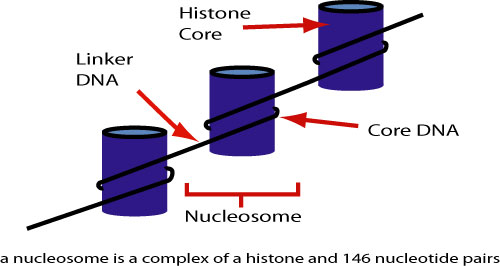 |
| (Source) |
More appropriately termed chromatin, the “beads on a string” is only the first level of organization required for DNA packaging with our cells. Chromatin can be further condensed into higher-order structures accomplished by interactions formed between nucleosomes. What has helped me to understand this process is the following: Imagine you have a long, thin stick, around which you begin to tightly wrap a chromatin fiber. Then, after all of the chromatin has been spiraled around the stick, you slide the stick out leaving a tube-like structure. The tube, which is held together through the interactions formed between nucleosomes, is called a solenoid. The solenoid can be further condensed by looping, ultimately resulting in a super tight and compact packaging of DNA.
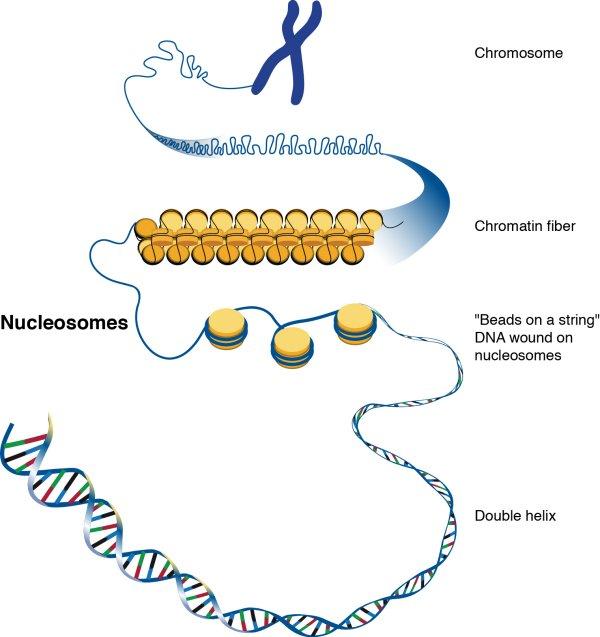 |
| The hierarchy of DNA organization. Source. |
So, will the next time you see headlights in traffic make you think of DNA organization? For my sake, I sure hope so!
For more information, check out this video:
Also, check out this interactive site from HHMI.