Double Xpression: Karyn Traphagen, co-founder of ScienceOnline

 
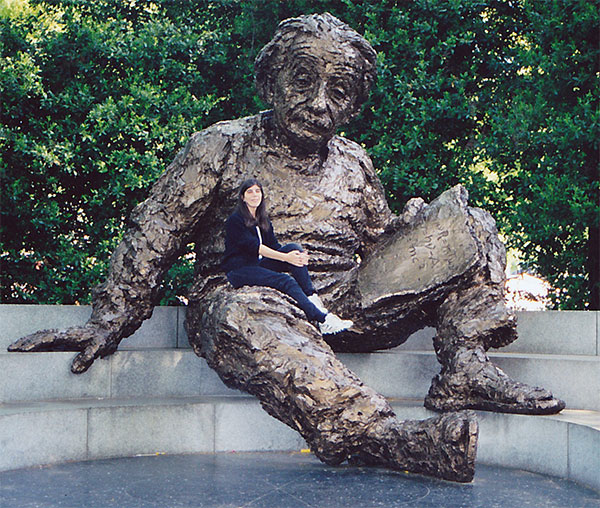
Hanging out with Al.

Karyn Traphagen is the Executive Director of ScienceOnline Inc., a non-profit organization representing a diverse science community that cultivates conversations both online and face-to-face. At face-to-face events, including a perennially popular signature conference in North Carolina, ScienceOnline encourages creativity, collaborations, connections, and fun. Through social media, the ScienceOnline community listens, supports, shares, recommends, and reaches out. ScienceOnline also develops tools such as ScienceSeeker news river and curates The Open Lab, an annual anthology of the best science writing on the web.
Karyn previously taught physics at the high school, undergraduate and graduate levels. As a teacher, she sought to connect the science of the curriculum with the everyday life of her students and to instill lifelong skills for learning. Karyn completed graduate work at the University of Virginia and also studied at the University of Stellenbosch (South Africa). She has trained physics teachers through the University of Virginia’s Physics department and traveled to South Sudan to conduct professional development training for local teachers. She has more than 10 years of experience developing and teaching online courses.

In addition to her science work, Karyn maintains a freelance graphic design studio. Her latest project was a work on Ancient Near Eastern royal inscriptions.

Karyn lives in Durham, North Carolina, and she encourages readers wherever they are to Stay Curious at her blog. Connect with her on Twitter or Google+. You can also follow ScienceOnline on Twitter and Google+. [Editor’s note: Karyn is also an official ADK46er, which is pretty incredible.]


DXS: First, can you give me a quick overview of what your scientific background is and your current connection to science?
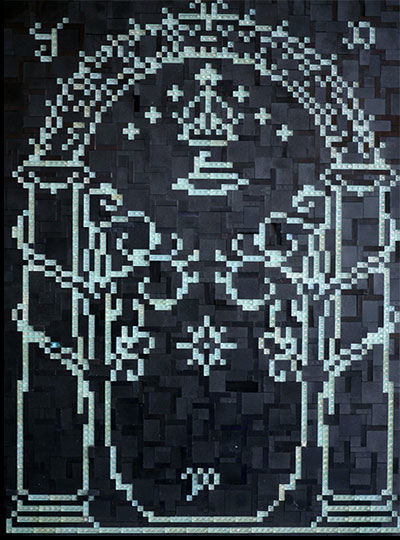
Karyn enjoys creating art with…LEGOS!

I remember one of my favorite childhood gifts was a chemistry set and a microscope. My mother was a great role model. She left a job as a chemist to get married and raise a family, but she always instilled in me the attitude that if I was interested in any subject, I could learn it and do it. I always accepted a challenge.
Although I attended excellent public schools, I had to overcome some significant challenges. Our family was one of the only ones in our town designated as eligible for the new free lunch program, and I started high school when Title IX was passed (go ahead, do the math). This was an exciting time for girls in school-but not just for sports (our legacy to our 8thgrade class was a change in our public (!) school policy to allow girls to wear jeans).

I was thrilled to be the one of two females on our Math League squad and to have access to advanced science courses and labs in high school. It seems I always took a circuitous route though. I helped change the rules so that I could graduate in 3 years. I was very fortunate to have lots of opportunities after graduation (including being recruited for the first female class at West Point). But then, I took on other responsibilities and went back to school later to finish my degrees.

In addition to research, I have taught high school physics and physical science, undergrad physics (I especially liked the Physics for Non-Science majors!), and helped to develop a degree program in the university physics department for high school physics teachers. I’ve led sailing trips in the Bahamas for biology students and I’ve been trained by the American Meteorological Society to use live data in classrooms. I’ve even been a programmer. Obviously I’m interested in too many things for my own good.

Currently, I am the Executive Director of ScienceOnline, a non-profit organization that facilitates discussion about science through online networks and face-to-face events. We welcome all to the conversation – scientists, journalists, librarians, educators, students, and anyone interested in engaging in science. Four words that help to define ScienceOnline are: Connections, conversations, collaborations, and community. We also develop projects that work to connect scientists and their research to the public. I’m thrilled to be representing this thriving community, and I enjoy working with so many talented, brilliant, and fun people.

Karyn has traveled to South Sudan to conduct professional development training for local teachers.

DXS: What ways do you express yourself creatively that may not have a single thing to do with science?
I have an insatiable thirst to learn and try new things, which has resulted in a string of very diverse jobs. Over the years my creative activities (and jobs) have included medieval calligraphy, art, photography, mathematics (I count this as creative), LEGO creations, graphic design, garment creation, gardening, construction projects, violin/guitar (as musician and also instructor), studying ancient languages and writing systems (both real and created).

On the surface, many people think these are not “science-y” but really, they are all about science. Seeing that connection is something I love to introduce people to. My science career has included research that helps create more bio-fidelic crash test dummies (I worked with cadavers-this makes for great party stories), meteorology, high school physics teacher, and university physics instructor. I used to think that people would think I was flighty or unable to commit to a project. Now I see the benefits of having been successful at so many different skills and fields of study. The key was seeing how they all tapped into my curiosity and creativity.
DXS: Do you find that your scientific background informs your creativity, even though what you do may not specifically be scientific?

Definitely. Paying attention to the details of the world gives me opportunity to see beauty, symmetry, order, and chaos in unusual places. I am thrilled by the macro and the micro vision of our universe and lives (which is why I continue to study other fields of science in addition to physics). These are not only realms to explore with experiments, but to experience emotionally and to communicate creatively. I have learned to appreciate the details in science and that carries over into the art, photography, design, and construction projects that I may spend time on. Even my tattoo (snow crystals) reflects both beauty and science (and a lot of personal meaning too!)
DXS: Have you encountered situations in which your expression of yourself outside the bounds of science has led to people viewing you differently-either more positively or more negatively?

I think that sometimes the more conventional creative side of my life makes me seem more “human” and approachable. When non-science people ask what I do, I don’t usually start with “physics” in the answer because that often is hard for people to relate to and the conversation dies. But if they get to know some things I am interested in or the diversity of things I’ve created, and THEN learn about my science background, they are more likely to perceive me as more than a physics geek. At that point they feel more comfortable asking questions about science.
On the other hand, some of my science colleagues in the physics department saw those other activities as something that took me away from time that could be spent on physics. Even if they thought my non-science activities might be amazing they minimized their value. Thinking back now, maybe this is why I keep so much of what I do to myself and it takes time to draw out of me all the things that I have had the joy of learning and doing.
I think there is a geek aspect to many of the things I like to do. They don’t completely overlap with the same brand of geekiness though. It’s just that you align yourself with a community that is very engaged in a certain niche. A tribe if you will. Some of these tribes don’t understand each other very well, so I sometimes feel like an ambassador of the various communities I am a member of.

DXS: Have you found that your non-science expression of creativity/activity/etc. has in any way informed your understanding of science or how you may talk about it or present it to others?

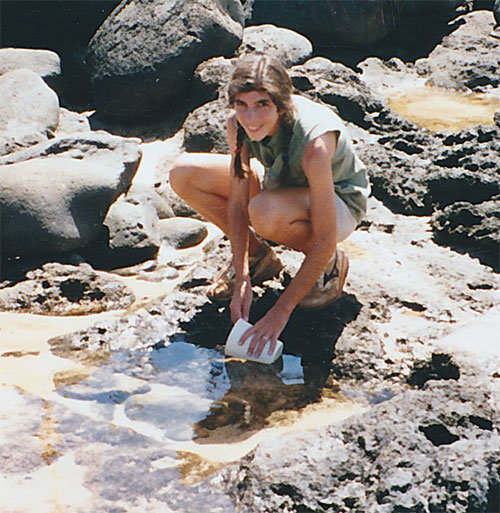
Karyn collecting water samples in Molokai, Hawaii

Yes, I used to focus more on the narrow aspects of my field. Now I try to see interconnectedness—not only with other fields of science, but more broadly with day-to-day life. My “non-science” expressions are really gateways into understanding the science better or being willing to think more creatively about how to solve a research problem. Bottom line: I always want to stay curious. We don’t value curiosity enough. I think curiosity undergirds creativity. Curiosity doesn’t just beget science questions. We also have to ask, “What would happen if I mixed these colors together?” or “How small can I write with this pen nib and ink?” or “What kind of effects can I create in this photograph by changing the lens?”
DXS: How comfortable are you expressing your femininity and in what ways? How does this expression influence people’s perception of you in, say, a scientifically oriented context?

I really tried to think about this carefully. In the physics department at the university where I worked, my main concern was not the fact that I was in the minority (or that there were more men’s rooms in the building), but that the lab was freezing and I needed to keep warmer layers at work to survive! Basically, the lab protocols determined what kind of clothing and shoes I could wear, how I kept my hair (out of the way!) etc. I never felt those things were anything particularly against being feminine, but I didn’t go out of my way to wear makeup or dress special.

On the other hand, I do think that female visitors and students who dressed more feminine were definitely treated differently. I desperately wanted to be valued for my ideas and work ethic and not what I looked like or which bathroom I used, so I was probably more affected by others attitudes than I realize(d).
Probably the most feminine thing I’ve ever done was to have children and show my priority for them (I realize that there are fathers who do this too, so it may be more a parent thing than a feminine thing, but in the society I live in, it is still the mothers who bear the lion’s share of the responsibility for child-rearing). I had colleagues who could not understand some choices I made because of family. They felt I was wasting my potential (whatever that means!).

Now that I am not in a lab and don’t have small children at home, I alternate between tomboy and professional attire. I do like that it is easier to create a more feminine professional wardrobe these days.

I find it odd that women are complimented for their appearance more than men. I don’t think people realize how out-of-balance this is. I try to notice and mention men’s clothing and appearance as a small step toward equalizing that.

DXS: Do you think that the combination of your non-science creativity and scientific-related activity shifts people’s perspectives or ideas about what a scientist or science communicator is? If you’re aware of such an influence, in what way, if any, do you use it to (for example) reach a different corner of your audience or present science in a different sort of way?

I think that getting the attention of whatever audience you are addressing is paramount. You may have something wonderful to share, but if you don’t have their attention, it will fall to the ground. I want to develop a relationship with people in order to get them to trust me, believe me, and be interested in what I have to say. Dispensing information is not enough.
The manner in which I communicate makes all the difference in how the person will engage the topic. To do this, I need to listen first and understand who my audience is. Using creativity, I will then try to connect with each person or audience in a way that I hope will best bring them along the journey I have experienced. Some people will want to know more specific details, others will want to know how it affects their lives, and still others will challenge and question my thoughts and methods.

Using visual arts (e.g. fine arts, video, etc) can be as important as a data chart. As long as the conversation continues, then I have been successful in communicating. My goal is to make someone (whether a researcher or a teenager) so interested that they will take on a search for more information on their own. That’s really how we learn and retain best—to explore something we have invested our own time in.

I also use a variety of outlets for communication. There are definitely important and different roles for journals, conference presentations, Twitter, blogs, Google+, etc. These diverse outlets are just as important as creative ways of presenting material. Again, you must always be aware of your audience. I would use a museum’s Twitter account to communicate differently than I would my regular account.

DXS: If you had something you could say to the younger you about the role of expression and creativity in your chosen career path, what would you say?

Knowing myself, I’m not so sure that the younger me would listen to any advice I would give! In some ways, going through the experiences is what made me who I am and there are no short cuts for that. However, there are definitely things that would have been great to learn earlier on.
So, I would tell the younger me not to try to keep creative interests and career objectives separate or think that they have to be at odds with each other. They don’t need to be in competition for your attention. Creativity, job skills, life experiences, and responsibilities can interweave. You will not only be more content, but probably more productive in all your endeavors.

I would also tell her that “no” is not a dirty word and that it is ok to be selective in how you spend your time.

So What’s the Big Deal About the Higgs Boson, Anyway? A Physics Double Xplainer

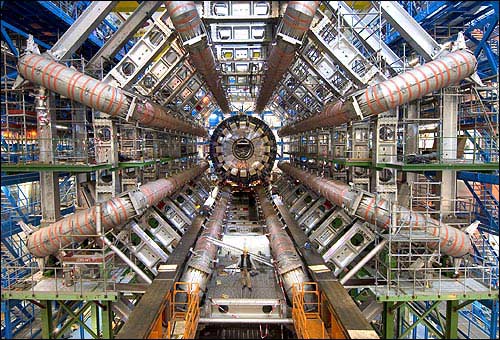
The ATLAS detector at the Large Hadron Collider, one of four
detectors to discover a new particle.
By Matthew Francis, physics editor

After decades of searching and many promising results that didn’t pan out, scientists working at the Large Hadron Collider in Europe announced Wednesday they had found a new particle. People got really excited, and for good reason! This discovery is significant no matter how you look at it: If the new particle is the Higgs boson (which it probably is), it provides the missing piece to complete the highly successful Standard Model of particles and interactions. If the new particle isn’t the Higgs boson, well…that’s interesting too.

So what’s the big deal? What is the Higgs boson? What does Wednesday’s announcement really mean? What’s the meaning of life? Without getting too far over my head, let me try to answer at least some of the common questions people have about the Higgs boson, and what the researchers in Europe found. If you’d rather have everything in video form, here’s a great animation   by cartoonist Jorge Cham and an elegant explanation by Ian Sample. Ethan Siegel also wrote a picture-laden joyride through Higgs boson physics; you can find a roundup of even more posts and information at Wired and at Boing-Boing. (Disclaimer: my own article about the Higgs is linked both places, so I may be slightly biased.)

Q: What is the Higgs boson?
A: The Higgs boson is a particle predicted by the Standard Model. It’s a manifestation of the “Higgs field”, which explains why some particles have mass and other particles don’t.

Q: Whoa, too fast! What’s a boson?
A: A boson is a large mammal indigenous to North America. No wait, that’s bison. [Ed note: Ha. Ha. Ha.] On the tiniest level, there are two basic types of particles: fermions and bosons. You’re made of fermions: the protons, neutrons, and electrons that are the constituents of atoms are all fermions. On a deeper level, protons and neutrons are built of quarks, which are also fermions. Bosons carry the forces of nature; the most familiar are photons-particles of light-which are manifestations of the electromagnetic force. There are other differences between fermions and bosons, but we don’t need to worry about them for now; if you want more information, I wrote a far longer and more detailed explanation at my personal blog.

Q: What does it mean to be a “manifestation” of a force?
A: The ocean is a huge body of water (duh), but it’s always in motion. You can think of waves as manifestations of the ocean’s motion. The electromagnetic field (which includes stuff like magnets, electric currents, and light) manifests itself in waves, too, but those waves only come in distinct indivisible chunks, which we call photons. The Higgs boson is also a manifestation of a special kind of interaction.

Q: How many kinds of forces are there?
A: There are four fundamental forces of nature: gravity, electromagnetism, and the two nuclear forces, creatively named the weak and strong forces. Gravity and electromagnetism are the forces of our daily lives: Gravity holds us to Earth, and electromagnetism does nearly everything else. If you drop a pencil, gravity makes it fall, but your holding the pencil is electromagnetic, based on how the atoms in your hand interact with the atoms in the pencil. The nuclear forces, on the other hand, are very short-range forces and are involved in (wow!) holding the nuclei of atoms together.

Q: OK, so what does the Higgs boson have to do with the fundamental forces?
A: All the forces of nature have certain things in common, so physicists from Einstein on have tried to describe them all as aspects of a single force. This is called unification, and to this day, nobody has successfully accomplished it. (Sounds like a metaphor for something or other.) However, unification of electromagnetism with the weak force was accomplished, yielding the electroweak theory. Nevertheless, there was a problem in the first version: It simply didn’t work if electrons, quarks, and the like had mass. Because particles obviously do have mass, something was wrong. That’s where the Higgs field and Higgs boson come in. Scottish physicist Peter Higgs and his colleagues figured out that if there was a new kind of field, it could explain both why the electromagnetic force and weak force behave differently and provide mass to the particles.

Q: Wait, I thought mass is fundamental?
A: One of the insights of modern physics is that particles aren’t just single objects: They are defined by interactions. Properties of particles emerge out of their interactions with fields, and mass is one of those properties. (That makes unifying gravity with the other forces challenging, which is a story for another day!) Some particles are more susceptible to interacting with the Higgs. An analogy I read (and apologies for not remembering where I read it) says it’s like different shoes in the snow. A snowshoe corresponds to a low-mass particle: very little snow mass sticks to it. A high-mass particle interacts strongly with the Higgs field, so that’s like hiking boots with big treads: lots of places for the snow to stick. Electrons are snowshoes, but the heaviest quarks are big ol’ hiking boots.

Q: Are there Higgs bosons running around all over the place, just like there are photons everywhere?
A: No, and it’s for the same reason we don’t see the bosons that carry the weak force. Unlike photons, the Higgs boson and the weak force bosons (known as the W and Z bosons — our particle physics friends run out of creative names sometime) are relatively massive. Many massive particles decay quickly into less massive particles, so the Higgs boson is short lived.

Q: So how do you make a Higgs boson?
A: The Higgs field is everywhere (like The Force in Star Wars), but to make a Higgs boson, you have to provide enough energy to make its mass. Einstein’s famous formula E = mc^2 tells us that mass and energy are interchangeable: If you have enough energy (in the right environment), you can make new particles. The Large Hadron Collider (LHC) at CERN in Europe and the Tevatron at Fermilab in the United States are two such environments: Both accelerate particles to close to the speed of light and smash them together. If the collisions are right, they can make a Higgs boson.

Q: Is this new particle actually the Higgs boson then?
A: That’s somewhat tricky. While the Standard Model predicts the existence of a Higgs boson, it doesn’t tell us exactly what the mass should be, which means the energy to make one isn’t certain. However, we have nice limits on the mass the Higgs could have, based on the way it interacts with other particles like the other bosons and quarks. This new particle falls in that range and has other characteristics that say “Higgs.” This is why a lot of physics writers, including me, will say the new particle is probably the Higgs boson, but we’ll hedge our bets until more data come in. The particle is real, though: four different detectors (ATLAS and CMS at CERN, and DZero and CDF at Fermilab) all saw the same particle with the same mass.

Q: But I’m asking you as a friend: Is this the Higgs boson?
A: I admit: a perverse part of me hopes it’s something different. If it isn’t the Higgs boson, it’s something unexpected and may not correspond to anything predicted in any theory! That’s an exciting and intriguing result. However, my bet is that this is the Higgs boson, and many (if not most) of my colleagues would agree.

Q: What’s all this talk about the “God particle”?
A: Physicists HATE it when the Higgs boson is called “the God particle.” Yes, the particle is important, but it’s not godlike. The term came from the title of a book by physicist Leon Lederman; he originally wanted to call it “The Goddamn Particle”, since the Higgs boson was so frustrating to find, but his editor forced a change.

Q: Why should I, as a non-physicist, care about this stuff?
A: While it’s unlikely that the discovery of the Higgs boson will affect you directly, particle colliders like the LHC and Tevatron have spurred development of new technologies. However, that’s not the primary reason to study this. By learning how particles work, we learn about the Universe, including how we fit into it. The search for new particles meshes with cosmology (my own area): It reveals the nature of the Universe we inhabit. I find a profound romance in exploring our Universe, learning about our origins, and discovering things that are far from everyday. If we limit the scope of exploration only to things that have immediate practical use, then we might as well give up on literature, poetry, movies, religion, and the like right now.

Q: If this is the Higgs boson, is that the final piece of the puzzle? Is particle physics done?
A: No, and in fact bigger mysteries remain. The Higgs boson is predicted by the Standard Model, but we know 80% of the mass of the Universe is in the form of dark matter, stuff that doesn’t emit or absorb light. We don’t know exactly what dark matter is, but it’s probably a particle — which means particle colliders may be able to figure it out. Hunting for an unknown particle is harder than looking for one we are pretty sure exists. Finding the Higgs (if I may quote myself) is like The Hobbit: It’s a necessary tale, but the bigger epic of The Lord of the Rings is still to come.

To Everything (Turn Turn Turn) There is a Season

Today – June 20 – is the northern Summer Solstice, sometimes known as the Northern Solstice, “first day of summer”, or Midsummer’s Day, depending on where you live. It’s the longest day and shortest night of the year in the northern hemisphere (where I live), though exactly howlong or short depends on how far north you live. And of course in the southern hemisphere, today is is the shortest day and longest night, since the seasons are reversed.
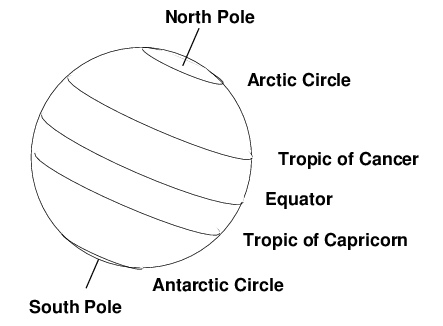
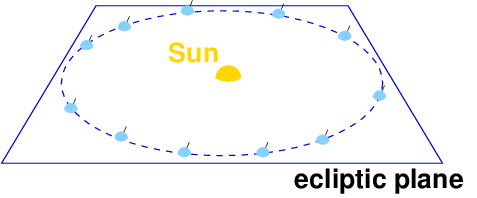
The secret to the solstice and to Earth’s seasons in general involves the tilt of Earth’s axis. Our planet orbits the Sun in an elliptical path, which you can draw on a flat piece of paper: it doesn’t move “up” or “down”, but stays in a single plane known as the ecliptic. (The name “ecliptic”, as you might guess, is related to the word “eclipse”, since ancient astronomers determined eclipses of the Moon and Sun could only occur at certain places in the sky.) Earth’s axis is tilted compared to the ecliptic, and the axis points more or less in the same direction, wherever the planet is in its orbit. The axis points almost directly at Polaris, the North Star, which is why that star is a good navigational guide for those in the northern hemisphere: no matter what time of year, it’s always in the same spot in the sky. Other stars rise and set as Earth rotates, but not Polaris. (Unfortunately, there isn’t a South Star.)
As you can see from the diagram above, during about half the year, the North Pole points more toward the Sun, while it points more away for the rest of the year. Where I live, the Sun will never be directly overhead, even at noon. The farthest north that will ever happen is a special latitude known as the Tropic of Cancer – and the northern Summer Solstice is the day that occurs. On the northern Winter Solstice, which happens on December 21 or 22, the Sun is directly overhead at noon at the latitude of the Tropic of Capricorn.
Now we can see why summers are hot! In summer, the Sun rises earlier, sets later, and reaches a higher point in the sky. Those things combined mean extra sunlight, heating up the air and the ground longer. We can also see why I put “first day of summer” in quotes: the Solstice is the apex of the process, but the increase in daylight and temperatures begins long before June 20 (at least every place I’ve lived). The Midsummer’s Day festival, celebrated throughout northern Europe, acknowledges that; Shakespeare’s play A Midsummer Night’s Dream may have been written for the English version of the festival (though from what I can tell, the historical evidence is scant).
Similarly, during winter the Sun’s light comes in at a steeper angle and days are shorter, so the time for the ground to warm is greatly reduced. The northern Winter Solstice (also known as the Southern Solstice, “first day of winter”, Midwinter’s Day, or Yule) is the shortest day and longest night of the year in the northern hemisphere. On that day, the North Pole points as far away from the Sun as it ever does. We also have the reason the tropics are warm all year around: they receive about the same amount of sunlight during both summer and winter.
Approximately halfway between the solstices, the Sun appears directly overhead at noon at the Equator. On those days, everywhere on Earth gets about 12 hours of daylight and 12 hours of night. These days are the equinoxes, meaning “equal night”. (The spell to extinguish light in the Harry Potter books is “nox”, for what it’s worth. Yes, I remember such things. I’m still waiting for my “accio!” summoning spell, though.) The two days are known as the Vernal(or spring) and the Autumnal (or autumn) Equinox, again based on the seasons in the northern hemisphere. From an astronomical point of view, Earth’s “solar year” is marked between successive vernal equinoxes. (A second measurement of the year, known as the sidereal year, is measured with respect to the stars. These two year measurements are almost, but not quite, the same length!)
Now let’s put all of this together in a movie! (For some reason, the Sun – which was a gently glowing lamp in my original simulation – came out looking flat and boring in the final movie. I guess I still have more to learn about creating three-dimensional animations.) For best results, please view this full-screen.

A Once-in-a-Lifetime Truly Double X Event: Venus in Transit

By DXS Physics Editor Matthew Francis, who usually brings you Everyday Science. As you will see, this is science of the Not-So-Everyday sort.

Perhaps the most important question to ask in science is “how do we know?” While it’s appropriate to ask this every day, today it feels even more so, as we prepare to witness a very rare astronomical event. This time, it’s happening on June 5, 2012; when this event occurred during the 18th century, it allowed astronomers to make the first precision measurements of the size of our Solar System. Captain James Cook, best known for his exploration of the Pacific (for Europe, that is—the natives already knew what was there), took a set of scientific instruments aboard his ship to Tahiti; other teams of researchers took measurements at those locations.

The rare event they observed was the transit of Venus: when Venus travels directly between Earth and the Sun, blocking a tiny amount of light. Astronomers in different locations timed the crossing of Venus across the Sun’s disc, and by comparing their numbers, were able to determine the distance between Earth and the Sun. With that distance in hand, they were able to calibrate the size of the entire Solar System. The 1769 observation was an international scientific effort (to use modern language), and while the results weren’t as good as the astronomers of the day had hoped, they still agreed with modern measurements.

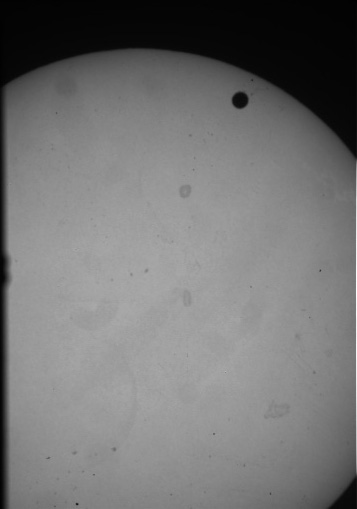
Today we use a variety of techniques to measure distances, including radar ranging (bouncing radio waves off planets and timing the round trip), so we don’t have to wait for Venus transits anymore—which is good, since they aren’t common! The last Venus transit was in 2004, but the previous one before that was in 1882, and the next one will be in 2117. I got up very early in the morning on June 8, 2004, joining some fellow astronomy enthusiasts at the Rutgers observatory, where we took the photo you see at the top of the post.

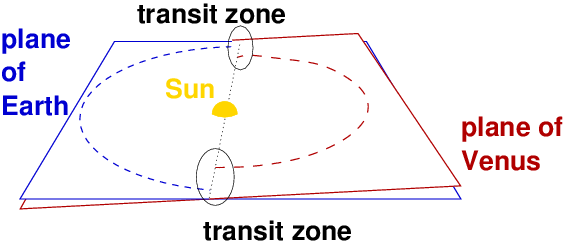
The seemingly odd intervals between transits are because Earth’s and Venus’ orbits around the Sun don’t lie in the same plane. If you draw Earth’s orbit as an ellipse on a sheet of cardboard, and Venus’ orbit on another sheet of cardboard, they need to overlap in a small X pattern, as shown in the picture. The only times Venus will transit is when both Earth and Venus are on the same side of the Sun, and only when they are in the region where the cardboard pieces overlap. The angle (3.5°) in the picture is correct, but I’ve exaggerated the size of the Sun and the sizes of the “transit zones”; in truth, even though the Sun is huge compared to Earth, it’s not that big on the sky. If you do the real calculation, you find that Venus transits happen roughly twice per century, and those two events are separated by 8 years. It’s a rare and wonderful event!

Viewing the Transit

If you want to view the Venus transit, the first thing you should do is see if it will be visible where you live. (Hopefully the weather will cooperate too! Such is the life of an astronomer.) In Richmond, Virginia (where I live), the transit begins around 6 PM. If you’re in the area, the Science Museum of Virginia is hosting a free viewing on the lawn; many other cities and towns have similar events.

A common sense warning: please don’t look directly at the Sun! However, you don’t need fancy equipment or a big observatory to witness the transit. Two weeks ago, I observed the solar eclipse using nothing but a microwave macaroni-and-cheese container. By piercing a hole in the bottom of the tub, I created a simple pinhole camera. A small and kind of fuzzy image of the eclipse appeared on a piece of paper, which I photographed. (Obviously you can do better if you have better equipment—I happened to be far from home during the eclipse and used what I had on hand.) A piece of cardboard covered in aluminum foil with a small hole works better, and you can project the image right onto the sidewalk, the side of a building, or another screen.

If you have a pair of binoculars that use glass lenses (since plastic will melt), point the larger lens toward the Sun and the smaller lens onto a flat surface. (Again, don’t look through the binoculars if you value your eyeballs!) If you have a telescope with a mirror or glass lenses, you can also project the image onto a flat surface, or create a sun funnel. There are a lot of ways to view the Sun if the ones I mention don’t appeal to you.

As a word of caution: the Venus transit won’t look as impressive as a solar eclipse, since Venus is a lot farther away than the Moon. It will appear to be a small round shadow on the Sun’s disc. The thrill (for me at least) lies in the knowledge: you are viewing a planet not much smaller than Earth as it crosses between us and our home star! If it isn’t enough these events are rare, think of how significant it is to catch a glimpse of the sheer size of our Solar System, in a way we don’t usually get to see. And always, always remember to ask the question: “how do we know?”

Further Reading

If you want to know more about transits and why they are still scientifically important today, try these links:

  • Nicole the Noisy Astronomer has some details about her adventures making a sun funnel, along with some other tasty transit bits.
  • Summer Ash shares how the Venus transit reveals the distance between Earth and the Sun, and includes some additional viewing tips.
  • The Hubble Space Telescope will be using the Venus transit, not for what it teaches us about our Solar System, but to help the search for planets orbiting other stars, known as exoplanets. Mark Anderson has the scoop.
  • I wrote an essay last year with a lot more about how the Kepler telescope uses transits of exoplanets to hunt for other worlds. While it doesn’t mention Venus specifically, the ideas are the same!

Happy Venus-watching!

Double Xpression: Debbie Berebichez, PhD Physicist

Deborah is the first Mexican woman to graduate with a physics PhD from Stanford University. She is a physicist, author, and media personality whose initiatives to popularize science have impacted thousands of people around the world. Her passion is to popularize science and motivate young minds to think analytically about the world. This has led her to pioneer learning initiatives in schools and universities in Mexico, Africa, the US and Israel. She is a frequent public speaker and has been recognized by numerous media outlets such as Oprah, CNN, WSJ, TED, DLD, WIRED, Martha Stewart, City of Ideas, Dr. Oz Show, Celebrity Scientist and others. She regularly appears as a science expert on different international TV networks; currently she is the TV host of National Geographic’s “Humanly Impossible” show. And she will appear on the Discovery Channel’s upcoming show ‘You’ve Been Warned.’ You can find Deborah on Twitter, or on her blog, Science With Debbie. You can also find Deborah telling her story for The Story Collider.


DXS: First, can you give me a quick overview of what your scientific background is and your current connection to science?

I grew up in Mexico City in a fairly conservative community, and as a child, I was discouraged from doing and studying science. My parents, family, and peers would all ask, “oh, why don’t you study a more feminine career?” Although I was pretty good in school, I wasn’t exactly a math wizard. I used to say that I loved philosophy and physics – because philosophy was a deep discipline of asking questions about the world. And physics studied the world itself.  
It was clear when I was born that my personality was was quite different to the one of my mom. When I was growing up, my mom was scared because she didn’t know what to do with this little girl that was smart and always asking questions. She is not a naturally curious person, so she kept trying to tame down my curiosity and kept telling me not to tell boys that I was interested in math and science because I would never find a husband. According to her, the life goal for a girl was to find a husband, have kids, and that’s it. Women didn’t have to have a career. (Not that there is anything wrong with not having a career.) My high school teachers and counselors were not so different and encouraged me to go into philosophy or literature, not into math or physics. And my friends in school told me I literally had to be an out of the world genius to be able to study physics.  
Given the circumstances, I started studying philosophy in Mexico. There were some classes with logic, and some with a little bit more math, and those were the ones I just devoured! And, at the same time – secretly – I was reading the biographies of scientists. For some bizarre reason, I was hugely attracted to their life stories. I didn’t have any family members, or anyone else for that matter, that had pursued a career in science, so I didn’t have a mentor or a role model. I felt an extreme kinship with Tycho Brahe, who in the late 1500’s was locked in a tower, doing all of these calculations for years, hated by everyone in the town. Go figure! I felt some kinship with these scientists. But I didn’t have the courage nor the means to switch majors. I did confess that I wanted to study another area (physics), but in Mexico one cannot study two majors. So, I studied philosophy for two years.

In the middle of it, I felt way too curious about science and I decided to apply to schools in the US. It was hard at the time because college in Mexico was a lot cheaper than in the states. At the private school where I was attending, my tuition was about $5,000 per year. If I were to come to the US, I would be looking at costs exceeding $35,000 per year. I couldn’t really ask my dad to help me with that price tag so I started to apply everywhere and anywhere that had scholarship opportunities.

I ended up getting a letter from Brandeis

University saying that they would let me take this advanced placement test and write an essay, which, if I did well, would give me a full scholarship. I received a full Wien Scholarship and was to continue studying philosophy in the US. This was probably the nicest thing that has ever happened to me because it opened the path of opportunity.

Brandeis transformed me as a person – I saw females doing science! But, the bravado moment that changed my life was a very general course called Astronomy 101. The teaching assistant, Roopesh, was a very sweet man from India and he saw that my eyes would just light up when I was in that class – I was much more curious than the random student that was just taking it to fulfill some requirement.  
At the end of that year, Roopesh and I

were walking around Harvard Square and stopped to sit under a tree. I started to tell him, with tears in my eyes, that I just don’t want to die without trying. What I meant by that is I don’t want to die without trying to do physics. Everyone’s questioning of my decision made me question my actual ability. Everyone telling me ‘no’ hampered my development. I mean, I was good at math, but I definitely didn’t have the same background as all the kids coming in with advanced math and physics courses.
 

I told Roopesh that I don’t even remember how to solve the equation (a+b)2 – even my algebra was rusty! But, he believed in me and went back to his professor and told him my story. This professor decided to meet with me and ends up telling me about someone who had done this sort of thing in the past. His name was Ed Witten and he went on to become the father of string theory.

He said “Witten had switched from history to physics, and I will let you try too.” With that, he handed me a book on vector calculus called ‘Div, Grad and Curl’ and told me that If I could master it in three months by the end of the summer, they would let me switch my major to physics and also let me bypass the first two years of course work. This would allow me to graduate by the time my scholarship ran out.    
I have never in my life experienced the level of scientific passion condensed into such a short amount of time and I am jealous of the person I was that summer. I had so much perseverance and focus. I don’t think I can ever reproduce that intensity again. From the moment I woke up to the moment I went to sleep, and even in my dreams, I only thought about physics. Roopesh, who became my mentor for the summer, taught me.

I always wanted to pay Roopesh for his tutoring, but he would never accept any money. He told me that when he was growing up in the mountains of Darjeeling in India, there was this old man who would climb up to his home and teach him and his sisters English, the musical instrument Tabla, and math. Roopesh’s father always wanted to pay the old man for his tutoring, but the man always declined. The man said that the only way he could ever pay him back was if Roopesh did the same thing with someone else in the world. And by mentoring me, Roopesh fulfilled his payment to the old man.  
Out of that, that became a seed for my physics journey and purpose. It is now my life’s mission to do the same for other people in the world – especially women – who feel attracted to science but feel trapped. They for some reason, whether it is social, financial, etc., just can’t find the way toward science. That is the motivation that dictates my actions.
I was able to pull it off and graduated Brandeis Summa Cum Laude with highest honors in physics and philosophy. I went back to Mexico afterwards to figure out what to do next and to spend some time with my family. At the same time, I did a master’s degree in physics at the largest university in Mexico UNAM. My curiosity for physics didn’t diminish and in 1998, I randomly applied to two physics PhD programs in the US. I applied very, very late, but, fortunately, I won a merit-based full scholarship from the Mexican government who provided me with funding, which made it easier for me.  


Because I loved biophysics, I did a search on who was doing this line of research. I came across Steven Chu, who is currently the secretary of energy. At the time I was applying, he was at Stanford and was one of the first to manipulate a single strand of DNA with his ‘optical tweezers.’ To me, his story was fascinating! Without really knowing who he was other than what I found on the web, I wrote him an email asking him if I could work in his lab. Had I known who he was – that he had just won the Nobel prize in 1997 – I would have been too intimidated.


I was admitted to Stanford and was invited to work with Dr. Chu, but after two years I decided to switch labs. As expected, it was a very challenging environment and having only studied two years of physics at Brandeis, I wasn’t as prepared as most of the other students. I struggled for the first two years. Everyone worked so extremely hard at Stanford and there I was, struggling to be the best, but, in the beginning, I couldn’t even be average.

Fast forward four years. I had worked my butt off and ended up becoming the first Mexican woman to graduate with a PhD in physics from Stanford. It was the best day of my life – I kept thinking that I was so blessed to have my parents live to see this! It was so moving, I was crying so much and I couldn’t believe what had happened. My friends had flown in from all over the world to be with me. It was amazing.

When people hear what I do, they – especially teenage girls – feel intimidated. But, when they hear the whole story, their tune changes. I tell them that I know what it is like to not understand something. I was not the kind of person where comprehension of my science came naturally. But I did it. And if I can do it, anyone can do it! My story can be inspirational to someone who comes from a background completely lacking in science because they, like me, can reach their goal.
DXS: What ways do you express yourself creatively that may not have a single thing to do with science?

I was always a very curious girl growing up. I had a lot of interests, one of which being theatre. I wanted to be an actress when I was young, but my father didn’t let me pursue that as a career, which was probably a good idea. But, during high school, I went to an after school drama program. I wrote my own plays – three of them – and performed one of them. I was in heaven when I was on stage.

In NY, I have tried to do a little bit of that. Of course, I’ve never done any big roles, but I will be an extra in a film, or if there is a small production being made in Spanish, I will play a part. It doesn’t matter how big the role is – I just love doing something creative and getting into a character.

DXS: What types of productions and/or films have you done?

I don’t think I would come up in the credits as an extra, but I did a movie with Simon Pegg, Kirsten Dunst and Megan Fox in the movie “How to lose Friends and Alienate People.” It was a very, very fun film! In theatre, Jean Genet, who is a French playwright, has a play called The Maids, and I was the madame.

DXS: Do you find that your scientific background informs your creativity, even though what you do may not specifically be scientific?

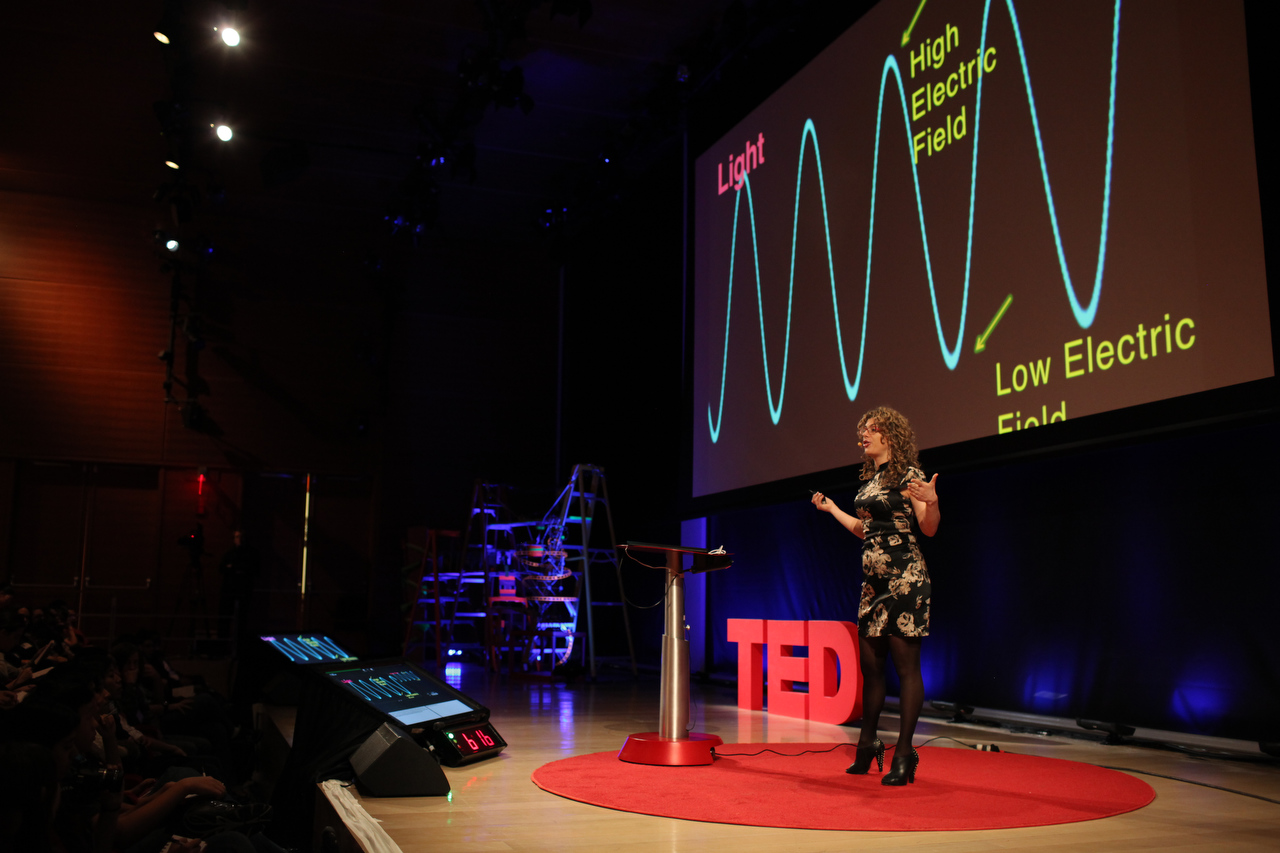
Debbie talking to the TEDYouth audience about waves.

I have a concept that I call “physics glasses.” And what I mean by that is, for me, physics is not a subject that you just teach in a complex way in a classroom. Rather, physics is something that is related to everyday life. From the moment you wake up, you can just put on your physics glasses. It is a mode of thinking – it is a way where although reality can be very rich and diverse, physics goes very deep and it abstracts commonalities, general principles that apply to many things. To give you an example, I asked the kids in the audience of my TEDYouth talk, “what do the sun, the ocean, and a symphony orchestra have in common?” When just looking at them on the surface, there isn’t much in common. I mean, they are all beautiful things but they are not obviously related. But, to a physicist, they are all waves. You have sound waves, light waves, and water waves and you can interchange many of the concepts in physics to explain all three.


Where most of us see the world with our eyes through light waves, other might see the world differently. Take, for example, my friend Juan, who is blind. He “sees” the world with sound waves – he senses sound as it bounces off the objects around him. Through this, he can bike, play basketball, and do a load of activities using sound as a guide. This is one of my favorite analogies because, really, physics “infects” the way I see the world.

Deborah the Physicist model

To give you a more specific example in the creativity realm, when I got to NY, I felt really un-feminine. When I was studying physics, I felt that if I was even slightly feminine, I wouldn’t be respected. It didn’t help that some of the other women in the physics program at Stanford were more of a “guys girl,” always wearing a baseball cap and t-shirts. Now, since I am Latin, I first showed up wearing a skirt to class, but I quickly learned to dress down. Looking feminine would assure that no one would talk to me in class.


So, when I got to NY, I had an explosion. I wanted to know what it was like to express myself as a woman and my friend suggested that I do some modeling. So I did. It was a brief, lasting about a year. But during that time, my friend, who was a designer from Mexico, asked me to work with her and I wrote and did some videos about the physics of fashion, which also included the physics of high heels video.


Some people could consider fashion to be superficial, but not me. I love fashion and color. But, other scientists generally looked down upon you for liking this sort of thing. This fueled my desire to prove to everyone that there actually is science everywhere, including fashion, and that they shouldn’t be snobs about it. There is complex science in how different materials work, how they interact with the environment and you can prove to the women, like my mother and friends back home who think that science has nothing to do with their everyday lives, that it has EVERYTHING to do with it. So I talked about a Newtonian theory for color – how to pick the right color for you based on how much light the color would reflect on that day, etc.

DXS: Like a more sophisticated version of colors based on your “season?”

DB: Exactly!

I also did pieces on the materials, including some of the newest engineering accomplishments with fabric. For example, I hooked up with a woman and helped her to design a fashionable and very scientific coat. It ended up costing $11,000, but it was made up of nano fibers and it had a patch in it that could detect the temperature and the probability of rain. Based on this probability, it could change permeability of the fabric. It was a very light coat that was comfortable in nice weather, but when it would rain, it would become impermeable to water once it detected a high probability of rain, transforming into a raincoat.

DXS: That’s incredible! I wish it wasn’t $11,000!

DB: Yeah, that’s usually the problems with these technologies. They are often so novel, but one day I’m sure we can figure out how to make things like this scalable.

Science is very much what guides my thinking when I am being creative and I wish I had more time to do creative things while being influenced by a scientific mindset.

DXS: It is so cool that physics has such an incredible overlap with everyday living. Like, when we take a shower, I want to know “how is the water getting pumped from the ground or through pipes and make its way out of the showerhead?” But, as a biochemist, I often find it hard to relate everyday things to biochemistry, but I would like to!

DB: Its funny that you say that. When I try to teach girls that the worst thing they can do is memorize. Critical thinking is so important and they shouldn’t take anything at face value, and they should even question teachers and authoritative figures in their lives. Always ask: what goes into making this? Why is this here? Why is it this way and not another? Constantly ask questions. That s the gift that physics will give you.

DXS: Have you encountered situations in which your expression of yourself outside the bounds of science has led to people viewing you differently-either more positively or more negatively?

Without saying I am a scientist, I can tell you that people have come up to me and told me that before they even hear me speak, they think I am dumb. They are usually surprised that I am smart! I think it is because I am bubbly and friendly and that often makes an impression as being unintelligent. For them it seems that if a woman is intelligent, she is very cold and distant and serious.


I’ve met a lot of physicists, and yes, some of them do tend to be that way, often as a reaction to how others treat them. Or, people would say to me that, because I am Latin, my cultural identity comes across as being warm and the last thing they’d expect me to be into was something as cold as physics. So yeah, I have definitely been judged so many times!


It even happens in my current job on Wall Street, especially with my male peers. When there are off site client meetings, I’m often accompanied by my male sales colleague. Sales people are generally required to know less about the complexities behind our risk models compared to someone on a more research-oriented role, like me and he will bring me along to these sales meetings in case the potential client has more sophisticated questions that go beyond what he can comfortably answer. Many times upon meeting the clients for the first time they think that I am the sales person, there to be the smiling face to sell them something, and that he is the risk modeler. They always direct their mathematical questions to him.
It came to a point where I became so annoyed that I decided to stop caring. Now, my sales colleague goes out for drinks with the clients and I know that I am going to be invisible. So I don’t go anymore. I know that I am always going to struggle to get the full intellectual respect in that industry – it will always be a challenge.

DXS: Have you found that your non-science expression of creativity/activity/etc. has in any way informed your understanding of science or how you may talk about it or present it to others?

Yes, absolutely. For example in Mexico, unlike the US, you absolutely have to do an honors thesis project as an undergrad  in science. Because I had already studied philosophy for four years, I wanted to do a thesis project in philosophy. But I also wanted to do one in physics. I recall that back in 1997, when you presented a dissertation in front of the physics community, if you had any power point, forget it. You would be immediately be called dumb or not a good physicist. Because, who takes the time to do something fancy! If you had any color in your presentation, forget it!


So, literally, the smartest students in physics were people who didn’t really communicate that well, or didn’t really speak English that well, or just didn’t really make an effort. Their slides were on those overhead projector things with those rolls of plastic sheets, and most of their talks were so confusing and couldn’t be interpreted! But they were respected! It was just assumed that if the formula looked complex, they were probably right.
So what I did was completely different. I infused my talk with my spiciness and color. I did an artwork of liquid crystals, which was my research at Brandeis. Liquid crystals are little cigar-shaped molecules that actually make up the screen of your laptop. If you pass an electric field through them, they all orient themselves and that is how we can use them for displays in our laptops and TVs.

I colored these cigar-shaped molecules with purples and reds and greens, and I tried to explain it at the most basic level. This is because of one my philosophy professors in Mexico, who told me that if you cannot explain what you do to your grandmother or 6 year old niece, you don’t understand what you are doing – I loved it!


And I said to myself that I shouldn’t care what they think. I pretty much expected to not gain a lot of respect from the physics department, but it had the opposite effect! I actually had one of the professors from that department come up to me and tell me that he had never really understood what a liquid crystal looked like or what it really was! He said that “finally I understand [liquid crystals] because of your drawing. Thank you!” It was incredible!


To see the effect on people and from then on, I bounced up in down, I made jokes, I put in creativity. It doesn’t always have a great effect on very serious audiences, but the younger generation is definitely appreciative. When it keeps going well, you gain confidence. And, for me, I even started wearing high heels to the next talk. When someone commented about my attire, I would counter, hey I have a PhD!

DXS: How comfortable are you expressing your femininity and in what ways? How does this expression influence people’s perception of you in, say, a scientifically oriented context?

This question is deep and a little bit of a struggle at the moment. This is because I still have that fear – when I arrived in NY, I did that short stint in modeling and I expressed myself and I would dress very creatively – just like my other girlfriends who were not scientists. But I did feel a little bit of a backlash. By that I mean that I would post a photo of myself on Facebook or something like that. They were pretty pictures, not at all seductive or provocative, and my high school mates, usually male, would write me saying: “I always knew you as a serious person and you have achieved so many things – I am just telling you for your own good that this can really damage your image.” That made me reply with “so you’re telling me that being smart is actually kind of a bummer?” That actually means that I have to dress very differently from what other women wear for the rest of my life?

I remember feeling very upset about all of that. I think that not being taken seriously is still a little bit of a fear of and I think my website has damaged my serious image a little bit. As a scientist, I was very secluded from the outside world. I didn’t have a lot of friends when I moved here, but I did know an amazing and powerful woman who happened to be the CEO of Blip TV. She was insisting that I do videos! So she invited me to her place and showed me how to do video. Being the quick woman that she was, she asked me to make up a name for myself on the spot. When I didn’t answer, she instantly coined “The Science Babe” for me. I was like, sure, what a cool idea!

It was kind of a cute name, but because English is not my first language, I don’t always understand some of the cultural connotations associated with some English words. A few months later, I started to get a few emails from mothers who were upset that I was using my looks. They would say things like “Are you saying that women have to be in the kitchen or wear short skirts to be scientists?” I would answer that no, that was not it at all. I would further explain that I was trying to change the definition of “babe.” If you are smart, if you are empowered, you will be a babe no matter how you look. I am trying to shift what people think of when they think “scientist.”

I don’t feel quite successful with The Science Babe. It seems like there are quite a few people, especially some from the older generation, who say that they’d love to introduce me to fancy science organizations but are worried that the name “the science babe” will make it difficult. Also, I had the BBC wanted to talk to me about doing a TV show in NY, and then they said but there’s so much bad stuff out there about you! And I was like, what do you mean? They answered “All these things with the “science babe” brand…”

It doesn’t happen all the time, but some people are really critical about the science babe theme, citing that its way too feminine. Other female scientists that haven’t gone that route have perhaps discounted my seriousness about science. They assume that what I am doing is not really that important because I do focus on the science everyday life, which is simpler, and it is too much color and too much vivaciousness for our field. I feel like my femininity has decreased over the last few years because I’ve been too nervous about not being taken seriously. It s almost like the balance tipped the other way. I feel like perhaps I’ve feminized things to a fault and now I want to appear more serious. So, I am changing my website to “Science With Debbie” because I really felt the backlash.

It is a struggle to find the balance between being able to express my femininity and presenting myself in a way that people will take me seriously. In a way, I wish I had a little more courage to not care that much about what people have to say about the science babe but, unfortunately, agents have told me that if I don’t go to the “dumbed down version of femininity” I would get better speaking engagements. Being feminine has literally affected my career, and it’s because of other people’s perceptions. I’m never going to be bland, but I will try to change things so I am more serious

DXS: Do you think that the combination of your non-science creativity and scientific-related activity shifts people’s perspectives or ideas about what a scientist or science communicator is? If you’re aware of such an influence, in what way, if any, do you use it to (for example) reach a different corner of your audience or present science in a different sort of way?

The fact that I am approachable and pretty down to earth has allowed me to reach corners of society that more distant and fancy scientists would never even consider. For instance, I am going to a small university to give a talk. Some of my friends ask why I even bother, especially considering that this insitution is not the most renowned university. But, I feel the opposite – it is these corners that need the influence the most! Similarly, when I go to Hispanic high schools, many of the mothers have never seen a scientist. And there I am, a scientist from Mexico, speaking to them and their kids. It is that powerful combination of being a smart and warm female that can be shocking, which is cool.

In line with this, there was an experiment where women were asked to draw a female scientist. Most drew a plain, relatively unattractive woman. Immediately when you break that mold, it has an incredible effect. People say, “Hey! She kind of looks like me and she dresses like me. Maybe I can do science too!” Some girls are afraid that by being smart, boys won’t talk to them. My femininity allows me to be a voice in a field that has tended to isolate themselves from the public, which is bad. Some of my colleagues have become a little snobbish. The fact that I have serious credentials (PhD and 2 postdocs) shows that I had to work like crazy – looks and personality can only go so far. It s hard work that gets you there! Serious science communication has a lot of math and problem solving in order to explain things accurately to the public. So I still feel like I am doing science!

Don’t worry so much about being the right type of science role model

Role models: How do they look? (Source)
[Today we have a wonderful guest post from Marie-Claire Shanahan, continuing the conversation about what makes someone a good role model in science. This post first appeared at Shanahan’s science education blog, Boundary Vision, and she has graciously agreed to let us share it here, too. Shanahan is an Associate Professor of Science Education and Science Communication at the University of Alberta where she researches social aspects of science such as how and why students decide to pursue science degrees. She teaches courses in science teaching methods, scientific language and sociology of science. Marie-Claire is also a former middle and high school science and math teacher and was thrilled last week when one of her past sixth grade students emailed to ask for advice on becoming a science teacher. She blogs regularly about science education at Boundary Vision and about her love of science and music at The Finch & Pea.]

What does it mean to be a good role model? Am I a good role model? Playing around with kids at home or in the middle of a science classroom, adults often ask themselves these questions, especially when it come to girls and science. But despite having asked them many times myself, I don’t think they’re the right questions.


Studying how role models influence students shows a process that is much more complicated than it first seems. In some studies, when female students interact with more female professors and peers in science, their own self-concepts in science can be improved [1]. Others studies show that the number of female science teachers at their school seems to have no effect [2].


Finding just the right type of role model is even more challenging. Do role models have to be female? Do they have to be of the same race as the students? There is often an assumption that even images and stories can change students’ minds about who can do science. If so, does it help to show very feminine women with interests in science like the science cheerleaders? The answer in most of these studies is, almost predictably, yes and no.


Diana Betz and Denise Sekaquaptewa’s recent study “My Fair Physicist: Feminine Math and Science role models demotivate young girls” seems to muddy the waters even further, suggesting that overly feminine role models might actually have a negative effect on students. [3] The study caught my eye when PhD student Sara Callori wrote about it and shared that it made her worry about her own efforts to be a good role model.


Betz and Sekaquaptewa worked with two groups of middle school girls. With the first group (144 girls, mostly 11 and 12 years old) they first asked the girls for their three favourite school subjects and categorized any who said science or math as STEM-identified (STEM: Science, Technology, Engineering and Math). All of the girls then read articles about three role models. Some were science/math role models and some were general role models (i.e., described as generally successful students).


The researchers mixed things even further so that some of the role models were purposefully feminine (e.g., shown wearing pink and saying they were interested in fashion magazines) and others were supposedly neutral (e.g., shown wearing dark colours and glasses and enjoying reading).* There were feminine and neutral examples for both STEM and non-STEM role models. After the girls read the three articles, the researchers asked them about their future plans to study math and their current perceptions of their abilities and interest in math.**


For the most part, the results were as expected. The STEM-identified girls showed more interest in studying math in the future (not really a surprise since they’d already said math and science were their favourite subjects) and the role models didn’t seem to have any effect. Their minds were, for the most part, already made up.


What about the non-STEM identified girls, did the role models help them? It’s hard to tell exactly because the researchers didn’t measure the girls’ desire to study math before reading about the role models. It seems though that reading about feminine science role models took away from their desire to study math both in the present and the future. Those who were non-STEM identified and read about feminine STEM role models rated their interest significantly lower than other non-STEM identified girls who read about neutral STEM role models and about non-STEM role models. A little bit surprising was the additional finding that the feminine role models also seemed to lower STEM-identified girls current interest in math (though not their future interest).


The authors argue that the issue is unattainability. Other studies have shown that role models can sometimes be intimidating. They can actually turn students off if they seem too successful, such that their career or life paths seem out of reach, or if students can write them off as being much more talented or lucky than themselves. Betz and Sekaquaptewa suggest that the femininity of the role models made them seem doubly successful and therefore even more out of the students’ reach.

The second part of the study was designed to answer this question but is much weaker in design so it’s difficult to say what it adds to the discussion. They used a similar design but with only the STEM role models, feminine and non-feminine (and only 42 students, 20% of whom didn’t receive part of the questionnaire due to an error). The only difference was instead of asking about students interest in studying math they tried to look at the combination of femininity and math success by asking two questions:

  1. “How likely do you think it is that you could be both as successful in math/science AND as feminine or girly as these students by the end of high school?” (p. 5)
  2. “Do being good at math and being girly go together?” (p. 5)

Honestly, it’s at this point that the study loses me. The first question has serious validity issues (and nowhere in the study is the validity of the outcome measures established). First, there are different ways to interpret the question and for students to decide on a rating. A low rating could mean a student doesn’t think they’ll succeed in science even if they really want to. A low rating could also mean that a student has no interest in femininity and rejects the very idea of being successful at both. These are very different things and make the results almost impossible to interpret.

Second these “successes” are likely different in kind. Succeeding in academics is time dependent and it makes sense to ask young students if they aspire to be successful in science. Feminine identity is less future oriented and more likely to be seen as a trait rather a skill that is developed. It probably doesn’t make sense to ask students if they aspire to be more feminine, especially when femininity has been defined as liking fashion magazines and wearing pink.

Question: Dear student, do you aspire to grow up to wear more pink? 

Answer (regardless of femininity): Um, that’s a weird question.

With these questions, they found that non-STEM identified girls rated themselves as unlikely to match the dual success of the feminine STEM role models. Because of the problems with the items though, it’s difficult to say what that means. The authors do raise an interesting question about unattainability, though, and I hope they’ll continue to look for ways to explore it further.

So, should graduate students like Sara Callori be worried? Like lots of researchers who care deeply about science, Sara expressed a commendable and strong desire to make a contribution to inspiring young women in physics (a field that continues to have a serious gender imbalance). She writes about her desire to encourage young students and be a good role model:

When I made the decision to go into graduate school for physics, however, my outlook changed. I wanted to be someone who bucked the stereotype: a fashionable, fun, young woman who also is a successful physicist. I thought that if I didn’t look like the stereotypical physicist, I could be someone that was a role model to younger students by demonstrating an alternative to the stereotype of who can be a scientist. …This study also unsettled me on a personal level. I’ve long desired to be a role model to younger students. I enjoy sharing the excitement of physics, especially with those who might be turned away from the subject because of stereotypes or negative perceptions. I always thought that by being outgoing, fun, and yes, feminine would enable me to reach students who see physics as the domain of old white men. These results have me questioning myself, which can only hurt my outreach efforts by making me more self conscious about them. They make me wonder if I have to be disingenuous about who I am in order to avoid being seen as “too feminine” for physics.

To everyone who has felt this way, my strong answer is: NO, please don’t let this dissuade you from outreach efforts. Despite results like this, when studies look at the impact of role models in comparison to other influences, relationships always win over symbols. The role models that make a difference are not the people that kids read about in magazines or that visit their classes for a short period of time. The role models, really mentors, that matter are people in students’ lives: teachers, parents, peers, neighbours, camp leaders, and class volunteers. And for the most part it doesn’t depend on their gender or even their educational success. What matters is how they interact with and support the students.
Good role models are there for students, they believe in their abilities and help them explore their own interests.

My advice? Don’t worry about how feminine or masculine you are or if you have the right characteristics to be a role model, just get out there and get to know the kids you want to encourage. Think about what you can do to build their self-confidence in science or to help them find a topic they are passionate about. When it comes to making the most of the interactions you have with science students, there are a few tips for success (and none of them hinge on wearing or not wearing pink):

§ Be supportive and encouraging of students’ interest in science. Take their ideas and aspirations seriously and let them know that you believe in them. This turns out to be by far one of the most powerful influences in people pursuing science. If you do one thing in your interactions with students, make it this.

§  Share with students why you love doing science. What are the benefits of being a scientist such as contributing to improving people’s lives or in solving difficult problems? Students often desire careers that meet these characteristics of personal satisfaction but don’t always realize that being a scientist can be like that.

§  Don’t hide the fact that there are gender differences in participation in some areas of science (especially physics and engineering). Talk honestly with students about it, being sure to emphasize that differences in ability are NOT the reason for the discrepancies. Talk, for example, about evidence that girls are not given as many opportunities to explore and play with mechanical objects and ask them for their ideas about why some people choose these sciences and others don’t.
There are so many ways to encourage and support students in science, don’t waste time worrying about being the perfect role model. If you’re genuinely interested in taking time to connect with students, you are already the right type.
__________________________________________________________

* There are of course immediate questions about how well supported these are as feminine characteristics but I’m willing to allow the researchers that they could probably only choose a few characteristics and had to try to find things that would seem immediately feminine to 11-12 year olds. I still think it’s a shallow treatment of femininity, one that disregards differences in cultural and class definitions of femininity. (And I may or may not still be trying to sort out my feelings about being their gender neutral stereotype, says she wearing grey with large frame glasses and a stack of books beside her).

**The researchers unfortunately did not distinguish between science and math, using them interchangeably despite large differences in gender representation and connections to femininity between biological sciences, physical sciences, math and various branches of engineering.

[1] Stout, J. G., Dasgupta, N., Hunsinger, M., & McManus, M. A. (2011). STEMing the tide: Using ingroup experts to inoculate women’s self-concept in science, technology, engineering, and mathematics (STEM).Journal of Personality and Social Psychology, 100, 255-270.

[2] Gilmartin, S., Denson, N., Li, E., Bryant, A., & Aschbacher, P. (2007). Gender ratios in high school science departments: The effect of percent female faculty on multiple dimensions of students’ science identities.Journal of Research in Science Teaching, 44, 980–1009.

[3] Betz, D., & Sekaquaptewa, D. (2012). My Fair Physicist? Feminine Math and Science Role Models Demotivate Young Girls Social Psychological and Personality Science DOI: 10.1177/1948550612440735


Further Reading

Buck, G. A., Leslie-Pelecky, D., & Kirby, S. K. (2002). Bringing female scientists into the elementary classroom: Confronting the strength of elementary students’ stereotypical images of scientists. Journal of Elementary Science Education, 14(2), 1-9.

Buck, G. A., Plano Clark, V. L., Leslie-Pelecky, D., Lu, Y., & Cerda-Lizarraga, P. (2008). Examining the cognitive processes used by adolescent girls and women scientists in identifying science role models: A feminist approach. Science Education, 92, 2–20.

Cleaves, A. (2005). The formation of science choices in secondary school.International Journal of Science Education, 27, 471–486.

Ratelle, C.F., Larose, S., Guay, F., & Senecal, C. (2005). Perceptions of parental involvement and support as predictors of college students’ persistence in a science curriculum. Journal of Family Psychology, 19, 286–293.

Simpkins, S. D., Davis-Kean, P. E., & Eccles, J. S. (2006). Math and science motivation: A longitudinal examination of the links between choices and beliefs. Developmental Psychology, 42, 70–83.

Stout, J. G., Dasgupta, N., Hunsinger, M., & McManus, M. (2011). STEMing the tide: Using ingroup experts to inoculate women’s self-concept and professional goals in science, technology, engineering, and mathematics (STEM). Journal of Personality and Social Psychology, 100,255–270.


As Seen on TV! Age Your Wine in 10 Seconds!!!!

Old, old wine. (Source)

Anyone who watches TV, reads magazines, or flips through catalogs has seen some interesting products. Maybe they seem plausible to you, maybe they don’t. However, a little investigation shows they are based less on science and well…actually working, and more on wishful thinking. At worst they’re actual con-jobs, designed to separate you from your money as efficiently as possible (which I guess is a certain standard of success).


As a result, we at Double X Science are starting a new series: “As Seen on TV!” In these features, we’ll look at some of the products shilled on talk shows and infomercials, items lurking between the articles you read in magazines, or things you might find on the shelves of the stores where you shop.

Our first entry is one I spotted in SkyMall, the catalog you (if you’re like me) read if you forget to bring a book on an airplane. Where else can you find dog water bowls shaped like toilets or sports chairs built deliberately too large for anyone, so you look tiny sitting in them? While the catalog is full of impractical items (to put it mildly), some of them go beyond that into the realm of…imagination. Yeah, I’ll call it that. It avoids potential lawsuits.

It’s the Aging Accelerator! With Magnets!

Here’s the idea: depending on which device you buy, you insert either a glass or a bottle of wine, and within 10 seconds! it ages the wine, with the unspoken assumption that this is desirable. (It also evidently works for whiskey, but I’ll skip that discussion in the current article.) Now, anything that promises to drastically alter something within 10 seconds! is probably suspicious to begin with, but that’s the part I’m going to leave alone. After all, magnets do work quickly, so if the device does what it claims to do, it’s quite possible that 10 seconds will be enough time for the magic to happen.

Well, it seems like magic to me. I went to a winery last weekend, and spoke to one of the vintners there (yup, that’s the name for ’em). She told me that not all wines should be aged, and the reason has to do both with the way wine is made and how it is stored.

First, not all wine should be aged! All wines actually go bad over time, including many of the usual types you may see in the store. That time may be pretty long, but you don’t want to just buy any bottle, stick it in your basement, and wait 20 years to drink it – most of them won’t taste good. According to my source, the days are gone where you might buy bottles of wine and put them in a cellar for your children. (Who has a wine cellar now anyway? I live in a second-floor apartment!) Basically, my source tells me to ask an expert if you have any doubts, but basically all wine is sold today in a drinkable state – no aging is necessary or even wanted. (I can’t endorse it, but Wikipedia has a list of wines that can be aged, and possible ranges.) Earth’s magnetic field has nothing to do with the aging process, whatever the ad says.

Second, the reason some wines age better than others has to do with their chemistry: how much sugar is in the grapes and how much tannin content they have. Red wines typically are higher in tannins because the skins are thrown in with the flesh of the fruit – and tannins act as a preservative. Sugar also acts as a preservative, but it’s not as effective, so white wines (lower in tannins, higher in sugar) don’t keep as well.

The point I’m trying to make is that wine aging isn’t mysterious, either why it happens or how. I don’t have the “Aging Accelerator” package in front of me, so I can’t tell you if they give advice on which wines to put in it and which ones to avoid, but the picture shows both reds and whites. So let’s turn to the way the device is supposed to work: magnetism.

They certainly have one thing right: neodymium magnets are very strong! (Neodymium is one of the “rare earth” elements, found near the bottom of the periodic table, so sometimes you’ll see them referred to as “rare earth magnets”.) When I’ve used neodymium magnets for various experiments, two of them attracting each other pinched my fingers hard enough to create blood blisters.

Admittedly magnets can seem mysterious: understanding exactly how they work requires looking at electrons and atoms, which might seem a little out of the ordinary. However, challenging isn’t the same thing as magical, but some people seem to think that magnets are capable of all sorts of feats, from curing arthritis to – yes – aging wine.

How magnets actually work could be the topic of an “Everyday Science” post, but in brief: the way a material responds to a magnet is called its magnetic susceptibility. Some materials, like neodymium, are very susceptible, but most things aren’t, including the human body. (Some organisms such as pigeons use Earth’s magnetic field to navigate, but exactly how they do it is still not known.) I couldn’t find any particular data on the magnetic susceptibility of tannins or other molecules in wine, but my feeling is it’s not large. Tannins are big biological molecules – think DNA or proteins – and those don’t tend to be magnetic.

But here’s the deal: suppose tannins are magnetic. Why then would exposing them to a magnetic field age the wine? Simply putting a strong magnet near your wine would merely rearrange the molecules inside the liquid – it’s like stirring it, in other words. Obviously stirring something can change the way it tastes, since it can mix sediments in, but that’s not the same thing as aging.

So, let’s wrap up: why should we be suspicious of paying $60 or $100 for an “Aging Accelerator”?
  • The concept misuses a well-understood physical principle – magnetism. Just because someone doesn’t understand how it works doesn’t mean it can perform miracles.
  • The aging process is chemical, and we understand how that works – it involves tannins, sugars, and other molecules. There are no secrets, in other words, and nothing simple to make your wine taste better.
  • Basically, if it sounds like a magic trick, it probably is – but its main result will be to magic money out of your pocket.
We’ll see these kinds of rules repeated throughout the series!

Stay tuned for further installments of “As Seen on TV!”


By DXS Physics Editor Matthew Francis 


Related articles
Real vs fake science: How to tell them apart

The Only Mother’s Day Gift Guide You Will Ever Need

Our mothers were nothing like either of these people. (Source)

(Warning: We are having some fun, so what you are about to read does not explicitly contain science but does reference soy, onanism, tubed meats, and vacuums. In keeping with the DXS mission, however, we have embedded a little science here and there in the links. )

While the celebration of mothers is not a new concept, the modern version of Mother’s Day is a far cry from the ancient festivals that honored  Cybele. However, in 1907, when  Anna Jarvis invented the modern Mother’s Day as a means to pay homage to her own mother, it was not her intention to use moms for profit.
 
But, alas, by the 1920s, this well-intended national holiday quickly morphed into the cash cow we see today. Sure, it is nice to receive a gift, but perhaps capitalism has since stripped Mother’s Day of its original meaning, and for the first week or two in May, we are bombarded with advertisements that claim to know what item every mother must have.

 
From this, many sites have done us all the great favor of curating these cannot-live-without gifts into a single, easy to navigate list (financial kickbacks notwithstanding), often broken down into natural June Cleaveresque categories like “kitchen” and “for the home” (read: how to cook for everyone and keep shit clean).  Besides the fact that these lists can be generalized to every gift-giving holiday for the lovely lady in your life, even Don Draper himself would scoff at many of these suggestions.
 
Because we at DXS wish to ensure that your Mother’s Day experience is the best it can possibly be, we present you with a different kind of list – one that provides the most valuable unsolicited advice you will ever receive when it comes to choosing for dear old mom. Here, you will be schooled on what not to get for the woman that gave you life.

   
  1. Flowers. One of the most suggested gifts for Mother’s Day is flowers. What woman doesn’t love flowers? Well, one who does not need one more thing to water, or sees her own mortality in each dried up petal aimlessly floating down onto the floor that had just been cleaned. Oh, and those tears you see building up in our eyes? Not tears of joy. You better back up or you might get caught in a sneezing fit of fury because, frankly, the last thing we want to do on “our” day is pretend that we like feeling like our heads will explode. And let us not forget how those flowers came to be available in your local flower shop or supermarket in the first place… from Colombia?


  1. Soy Candles. Soy. For the last decade or two, we have seen the magical benefits of this plant product popping up in pseudoscientific “reports” in quality magazines like First for Women. And now, soy-pushers all over the intertubes will willingly exclaim that soy is the superior material for the production of candles, allegedly “soot free” (they aren’t really). Sure, anything soy-based will help the American Soy Farmer keep up with the Joneses, but a candle is a candle and unless you are also giving me a golden ticket to enjoy its inherent ambience whilst I soak in my imaginary claw-footed tub, full of bubbles and rose petals and the sultry sounds of Barry White, save it. Plus, I’d rather not burn my house down (again).


  1. Gift Baskets! What says “I admire you like a work colleague” more than a gift basket? Sure, smoked cheeses and tubed meats taste fine after a few martinis, but when enjoying such delicacies, I prefer to do it while watching my co-workers photocopy their ass cheeks. Some things just don’t have the same effect in the home.


  1. Teething Necklace. One website was flashing necklaces all over the place – but these weren’t just any old necklaces – they doubled as teething necklaces for the baby. Anyone who knows anything about a teething baby knows that, despite the alleged pain babies feel (hey, I don’t remember it, do you??), moms suffer the most. So instead of the necklace, why don’t you go ahead and take the dang baby for a few hours and give me a much deserved break? I’ll even sweeten the deal and throw some Tylenol in the diaper bag. And, in the strange and rare event that I might want rope burn on my neck, I’d rather get it from some fantasy role-playing in the boudoir. Take that as you will.


  1. Vacuum Cleaner. If you really think that I want another reminder of how much I have to pick up after you and all of your friends – who regularly come over and wipe out all of the food I just deposited into my refrigerator – then yes, go ahead and buy me a vacuum. I mean, it is not like I don’t already spend all of my “free” time vacuuming the floors, so why not give me the gift that embodies what you really think of me (your maid)? Plus, Dyson has been showing commercials non-stop for a sale that runs until Mother’s Day, with the clear implication to get your mother (or if you are a mother to get yourself) a vacuum for Mother’s Day. So if you do decide to get a vacuum, make sure you have $500 for it. Remember, though, that a vacuum is really empty space, so you might want to consider getting me something more tangible-and fun.


  1. 50 Shades of Gray. Well, maybe I am not too opposed to this, but let it be known that I will probably need about ten minutes (give or take) of “alone” time after each time I pick up this series. As long as you are OK with this, I am OK with this. By the way, did you know that there are really more than 50 shades of grey?
 
We hope you will seriously consider this advice. After all, we really don’t need more shit to take care of, water, clean with, or… actually, we can always use some more good reads. Happy Mother’s Day!

Making Light in Electronics

By DXS Physics Editor Matthew Francis 

A while back, I wrote about one of the most common ways of making electric light: fluorescent bulbs. Understanding fluorescent lights requires quantum mechanics! While a lot of quantum physics seems pretty removed from our daily lives, it’s essential to most of our modern technology. In fact, reading what I’m writing requires quantum mechanics, since you are using a computer (maybe a handheld computer like an iPad or smart phone, but it’s still a computer) or a printout from a computer.

Modern electronics, including computers and phones, depend on semiconductors. Conductors (like the copper wire in power cords) let electricity flow easily, but semiconductors conduct electricity more reluctantly—but that very reluctance lets us control the flow. While they can’t sustain large currents like conductors can, we can tinker with the chemistry of semiconductors to make them conduct electricity in very precise ways. One of those ways lets semiconductor devices make light: those are known as light-emitting diodes, or LEDs.

You likely have many LEDs in your home: they’re common as indicator lights on appliances, and you might even have LED light bulbs. While they’re pretty expensive right now, the price of LED lights is getting lower all the time, and they have major advantages over both incandescent (old-style) light bulbs and fluorescents. They won’t burn out even as quickly as fluorescent lights (themselves longer-lived than incandescents), and consume less energy. Since they are based on solids rather than gases, they’re not going to break easily, either! But how do they work?

The Electrons in the Band

When I described fluorescent lights in my earlier post, I described how atoms have distinct energy levels inside them, and light is produced when electrons move between those energy levels. Fluorescent lights use gases (generally mercury vapor), so the atoms are relatively widely separated. In solids, including semiconductors, atoms are tightly packed together, forming bonds that don’t break without high pressures or temperatures. In fact, they may also share electrons with each other; a particularly dramatic example of this is in metals, where the electrons in the highest energy levels of the atoms all form a gas that surrounds the atoms. That’s why metals are such good conductors—a little push from a battery or other power source makes those electrons flow in one direction (on average at least), much as a fan creates currents in the air.

Semiconductors are a bit more complicated: their electrons are loosely bound, but still stuck to their host atoms. The way physicists understand this is something known as the band model: just like atoms have energy levels, solids have energy bands. Low energies correspond to electrons stuck to their atoms, which can’t leave; we call these closed shell electrons (for reasons that aren’t important for this particular post). Moderate energies are known as valence electrons, which stay put ordinarily, but can be persuaded to move if given the right incentive. Finally, high energies are conduction electrons, which aren’t tied to a particular atom at all; as their name suggests, they are the ones that carry electric current.

Whether a solid conducts electricity depends on its band structure, and the size of the energy barrier in between the bands, which is called a gap. Large gaps require large energies for electrons to jump them, while smaller gaps are more easily jumped. Conductors have negligible gaps between their valence and conduction bands, while insulators have huge gaps. Semiconductors lie in between; adding extra atoms to a semiconductor can make the gap smaller (a process known as “doping”, which sometimes makes describing it unintentionally funny).

Cars and Roads and Electrons

At low temperatures, semiconductors may not conduct electricity at all, since no electrons can jump the gap into the conduction band. Either warming them up a bit or applying an external electric current gives the electrons the energy they need to move into the conduction band.

I was pondering analogies about band structures to help us understand them, and thought of this one based on cars and roads. Think of closed shells as like parking spaces along a road: cars (which stand in for electrons) are stationary. Valence bands are the slow lane, which is clogged with traffic, so the cars technically can move, but don’t. The conduction bands are fast lanes: cars can really zip, but there’s a traffic barrier between the slow lane and fast lane. (That barrier is the weakest part of my analogy, so remember that we should be thinking of a barrier as something that can be traversed under some conditions but not others.)

One more complication: there are two types of semiconductors, known as n-type and p-type. In n-type, just a few electrons (cars) have access to the conduction band (fast lane) at a time, but in p-type, enough electrons get in to leave holes in the valence band. Applying a current to the semiconductor shifts another valence electron into the hole, but that leaves another hole, and so forth…so it looks like the hole is moving! In fact, physicists refer to this as “hole conduction”, which also sounds odd if you’re not used to it.

Now we’re finally ready to understand LEDs. If you join an n-type semiconductor to a p-type semiconductor, you make something known as a diode. (The prefix di- refers to the number two. If you join three semiconductors, you get a transistor of either the pnp or npn types, depending on the order you use.) The bands (lanes) don’t line up perfectly at the junction: the conduction band in the n-type is generally only slightly higher than the valence band of the p-type, so just a little nudge is needed to move electrons across. This means when they reach the junction between the materials, electrons from the n-type semiconductor can fill the holes on the p-type, which is a decrease in energy. Just as in individual atoms, moving from a higher energy level to a lower energy level makes a photon—and that’s where the LE in the D comes from!

LEDs tend to produce very pure colors, rather than the mixture of colors our eyes perceive as white light. To create LED light bulbs, generally blue LEDs are coated with a phosphorescent material, much like the kind used in fluorescent bulbs. Unlike fluorescents, though, there’s no gas involved, and less heat is lost (though there is still a little bit). Together these factors make LED light bulbs longer-lasting and more efficient even than fluorescents, though currently they are far more expensive.

Despite how common LEDs and other semiconductors are, they’re considered fairly advanced physics. But guess what: if I did my job right, you should understand LED physics now! What is often thought of as “advanced” is really everyday science, and it’s a part of how quantum mechanics (with all its electrons and fascinating interactions on the microscopic level) has helped create our modern world.

Why is the sky pink?


On Mars, the sky is pink during the day, shading to blue at sunset. What planet did you think I was talking about?

On Earth, the sky is blue during daytime, turning red at as the sun sinks toward night.

Scattering light

Well, it’s not quite as simple as that: if you ignore your dear sainted mother’s warning and look at the Sun, you’ll see that the sky immediately around the Sun is white, and the sky right at the horizon (if you live in a place where you can get an unobstructed view) is much paler. In between the Sun and the horizon, the sky gradually changes hue, as well as varying through the day. That’s a good clue to help us answer the question every child has asked: why is the sky blue? Or as a Martian child might ask: why is the sky pink?

First of all, light isn’t being absorbed. If you wear a blue shirt, that means the dye in the cotton (or whatever it’s made of) absorbs other colors in light, so only blue is reflected back to your eye. That’s not what’s happening in the air! Instead, light is being bounced off air molecules, a process known as scattering. Air on Earth is about 80% nitrogen, with almost all of the rest being oxygen, so those are the main molecules for us to think about.

As I discussed in my earlier article on fluorescent lights, atoms and molecules can only absorb light of certain colors, based on the laws of quantum mechanics. While oxygen and nitrogen do absorb some of the colors in sunlight, they turn right around and re-emit that light. (I’m oversimplifying slightly, but the main thing is that photons aren’t lost to the world!) However, other colors don’t just pass through atoms as though they aren’t there: they can still interact, and the way we determine how that happens is again the color.

The color of light is determined by its wavelength: how far a wave travels before it repeats itself. Wavelength is also connected to energy: short wavelengths (blue and violet light) have high energy, while long wavelengths (red light) have lower energy. When a photon (a particle of light) hits a nitrogen or oxygen molecule, it might hit one of the electrons inside the molecule. Unless the wavelength is exactly right, the photon doesn’t get absorbed and the electron doesn’t move, so all the photon can do is bounce off, like a pool ball off the rail on a billiards table. Low-energy red photons don’t change direction much after bouncing–they hit the electron too gently for that. Higher-energy blue and violet photons, on the other hand, scatter by quite a bit: they end up moving in a very different direction after hitting an electron than they moving before. This whole process is known technically as Rayleigh scattering, for the physicist John Strutt, Lord Rayleigh.

The blue color of the sky

Not every photon will hit a molecule as it passes through the atmosphere, and light from the Sun contains all the colors mixed together into white light. That means if you look directly at the Sun or the sky right around the Sun during broad daylight, what you see is mostly unscattered light, the photons that pass through the air unmolested, making both Sun and sky look white. (By the way, your body is pretty good at making sure you won’t damage your vision: your reflexes will usually twitch your eyes away before any injury happens. I still don’t recommend looking at the Sun directly for any length of time, especially with sunglasses, which can fool your reflexes into thinking everything is safer than it really is.) In other parts of the sky away from the Sun, scattering is going to be more significant.

The Sun is a long way away, so unlike a light bulb in a house, the light we get from it comes in parallel beams. If you look at a part of the sky away from the Sun, in other words, you’re seeing scattered light! Red light doesn’t get scattered much, so not much of that comes to you, but blue light does, meaning the sky appears blue to our eyes. Bingo! Since there is some green and other colors mixed in as well, the apparent color of the sky is more a blue-white than a pure blue.

(The Sun’s light doesn’t contain as much violet light as it does blue or red, so we won’t see a purple sky. It also helps that our eyes don’t respond strongly to violet light. The cone cells in our retinas are tuned to respond to blue, green, and red, so the other colors are perceived by triggering combinations of the primary cone cells.)

At sunset, light is traveling through a lot more air than it does at noon. That means every ray of light has more of a chance to scatter, removing the blue light before it reaches our eyes. What’s left is red light, making the sky at the horizon near the Sun appear red. In fact, you see more gradations of color too: moving your vision higher in the sky, you’ll note red shades into orange into yellow and so forth, but each color is less intense.

So finally: why is the Martian sky pink? The answer is dust: the surface of Mars is covered in a fine powder, more like talcum than sand. During the frequent windstorms that sweep across the planet, this dust is blown high into the air, where light (yes) scatters off of it. Since the grains are larger than air molecules, the kind of scattering is different, and tends to make the light appear red. (Actually, the sky’s “true” color is very hard to determine, since there is a lot more variation than on Earth.) When there is less dust in the atmosphere, the Martian sky is a deep blue, when the Sun’s light scatters off the carbon dioxide molecules in the air.

By DXS Physics Editor Matthew Francis