
How do girls learn they’re “bad at science and math”?
by Chris Gunter
Obviously you, like we at Double X Science, are just that into learning and sharing all things science. Believe it or not, a serious question to ponder is not necessarily how you got that interested, but how did you, if you are female, stay that way up to this point?
In the last few weeks, the stereotypes of women and their performance in STEM fields have been in the news. Sheryl Sandberg, in her interview on NPR’s “Morning Edition,” covered the topic of stereotype threat and its effects on female performance. Her explanation:
“”What’s holding women back in computer science is the exact same thing … that’s holding women back in leadership,” Sandberg says. It’s something social scientists call “stereotype threat.”
“Stereotype threat means that the more we’re aware of a stereotype, the more we act in accordance with it,” Sandberg explains. “So, stereotypically we believe girls are not good at math. Therefore, girls don’t do well at math, and it self-perpetuates. If you ask a girl right before she takes a math test to check off ‘M’ or ‘F’ for male or female, she does worse on that test. The reason there aren’t more women in computer science is there aren’t enough women in computer science.””
My ears perked up when I heard this over my morning tea, because I covered this same area in a column for the journal Genome Biology, for their issue published in March. My focus was on getting more girls into science, and the effects of stereotype threat are just the beginning of examining how effective role modeling is by female scientists. To be honest, when I started writing about it, I idly thought this might be too simplistic and anachronistic a concept. Aren’t we beyond that now?
Exhibit A that the concept is oh so alive still: Elise Andrew and her Facebook page with 4.3 million+ followers, I F**ing Love Science. Although she’s never made any effort to hide her gender, when she recently opened a twitter account with her picture as the avatar, media attention and remarks from praise to trolls ensued. In her 27 March interview on CBS This Morning, she said:
“Commenters said they were very sort of surprised they had the same bias within themselves. They were saying ‘[I] didn’t realize that I had this, but I obviously do. I never dreamed that I was sexist in any way, I never dreamed that I had this bias, but it’s there. I thought you were a guy’.”
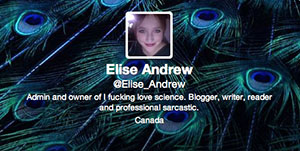 What does that say to girls who might hear about this controversy? It teaches them that there is a stereotype that women would not or can not be so into science. Not anachronistic yet, I am sad to report.
Of interest to our discussion on stereotypes, in this same interview, the physicist Michio Kaku states that interest of boys and girls in science is equal “until we hit junior high school. Then all the social pressure kicks in and women scientists just drop like flies. So we need role models like her.” Great (if somewhat awkwardly phrased) sentiment: although data suggest that female scientists persist much longer now than junior high, they ultimately do choose non-tenure-track academic careers more often than males.
The catch is that this threat is pernicious and comes across in multifarious ways, at so many levels. Exhibit B from the month of March 2013: a post by science communicator Matt Shipman on gender bias in research communication, covering a paper recently published online. The paper is so littered with stereotypes that one hardly knows where to start. First, the authors of this paper took abstracts covering research communication and assigned them into categories based on whether they covered “male-type” or “female-type” subjects [Stereotype 1]. The same abstracts were given either male or female authors, randomly [Stereotype 2], and then graded for “scientific quality” by graduate students in communication, either male or female [Stereotype 3]. This means these students who were being evaluated for their perception of quality based on gender stereotypes could be the same people who would be studying in and reporting on trends of the same bias in communication, theoretically.
This is a complicated paper and worth reading if you can get a copy. Unfortunately, like a number of similar studies published in the last year, abstracts from male authors were ranked more highly than from female authors (by evaluators of both genders), and male authors of “male-typed topics” received the highest quality ratings. The authors of the paper even conclude with the sentence:
“The overall conclusion is that male scholars will have a much smoother ride, especially if they work on male-typed topics.”
Let’s not waste any more time dwelling on the stereotypes, and instead talk about some ways that you can help to break them. Here are some things you can do, with colleagues or with your kids, to encourage interest in STEM.
- Check out the fun Grandma Got STEM blog. Better yet, submit something about your own grandma. The site’s author, Rachel Levy of Harvey Mudd College Mathematics, is looking for submissions “to counter the implication that grannies (gender + maternity + age) might not easily pick up on technical/theoretical ideas.”
- Sign your kids, especially daughters, up for any local afterschool or summer programs that relate to STEM. In a recent report from the Girl Scouts of America on encouraging girls and STEM, at most 36% of the girls indicated they had taken this opportunity. Some regional/national summer camps include Camp Invention and Club Scientific.
- If you are a female scientist yourself, interact with kids of all ages. A 2008 study suggested that girls can be intimidated by stereotypes of female scientists who seem “too perfect” – the idea being that the pressure of living up to this perfect stereotype is just too much – and instead the girls just want to interact with scientists as people. I recently spent an evening extracting DNA with kids for an elementary school science night, and only the adults mentioned it was great to see a female scientist. The kids might not say anything, but research suggests they pay attention to gender and learn that all kinds of people can make a career in STEM.
- Finally, and best of all, don’t be afraid to show that you too f**ing love science.
Thank you for posting this article. Next week I’ll be talking with 6th and 7th grade girls about women and science, and your 3rd and 4th bullet points (especially) were very helpful. Cheers!
You should check out http://www.projectscientist.org! We are here to change those stereotypes!
Thanks for this post, Chris. It’s an important issue. I have three daughters, and one thing that I’m doing as a parent is going out of my way to introduce my daughters to scientists I know that happen to be women. For example, my kids, being quite young, are very interested in insects and other assorted creepy-crawlies. To foster that interest, I’ve been asking entomologists I know to let us visit them in the lab. I’ve particularly focused on female entomologists, so that my girls can meet successful, female scientists. I’m very fortunate, in that my job brings me into contact with hundreds of researchers — so I have the contacts to introduce my kids to female role models in the sciences. Other parents don’t have those contacts, but would likely be happy to take advantage of opportunities — at museums or elsewhere — for their kids to meet female role models in science.
Great post. I’m a science educator and have two girls and a boy. At my 7-year old daughter’s birthday party, two of her friends came up to me and said, “We don’t believe that you’re a scientist.” When I asked them why they didn’t believe it, they replied that I don’t look like a scientist. “How do scientists look?” I asked. “Men….old men,” one of them answered. These kids go to a great school and have a fantastic teacher whose daughter worked for NASA, but I’m convinced that kids form stereotypes based more on television than reality. I love Phineas and Ferb as much as anyone, but if the only scientist you see, day after day, is Dr. Doofensmirtz, you may start to believe that he represents all scientists: evil, dorky and male.
Getting kids interested in science is great. However, I feel like your suggestions don’t really get at the real problem, at least in my field. In biology and biomedical science, 60% of bachelor’s degrees and 53% of PhDs in the US are earned by women. I’m teaching a class of chemists this semester that is 93% female. For me, this means that it’s not an issue of getting girls interested in the field. It’s biased evaluation of women’s accomplishments, structural problems in scientific careers, and internal and external barriers to women in leadership positions.
Just saying we need to encourage girls to go into science is too simplistic.
Thanks, Patricia. I don’t agree that this is too simplistic a message, obviously, but I do agree (and of course data out there support) that there are numerous problems along the pipeline. Here I’m taking the approach that this is where we start, and I’d be glad to brainstorm on the other issues.
-Chris
Pingback: Science Policy Around the Web – April 21, 2013 | Science Policy For All
Pingback: Saying "Neigh" to Equestria Girls | GeekMomGeekMom
Pingback: Stereotype threat for girls and STEM : Monkeys in the Brain
Pingback: Stereotype threat for girls and STEM : Monkeys in the Brain